
Philadelphia: City of International Diplomacy
I
On September 12, 1973, an American Pan Am 707 landed in Shanghai. On board were 120 members of the Philadelphia Orchestra, led by their conductor, Eugene Ormandy. After taking a final late-night flight from Shanghai to Beijing, the orchestra disembarked and was led through the quiet early morning streets by Chinese officials and staffers at the US liaison office in Beijing. The orchestra’s trip was planned on the heels of Secretary of State Henry Kissinger’s secret 1971 visit to China, as well as Richard Nixon’s official 1972 visit. After these early successes in the Nixon administration’s detente with China, Nixon sought to initiate a diplomatic offensive to win over Chinese officials. To this end, the US government mobilized the nation’s soft power, bringing its artists, athletes, scientists, and scholars overseas to promote cross-cultural exchange and bypass the difficulties of formal diplomacy between nations with profoundly different political and governance philosophies. Among the most impactful of these soft power exchanges was the Philadelphia Orchestra’s concert tour.
The Philadelphia Orchestra had arrived in China at a challenging time. There was still no formal diplomatic relationship between the US and the People’s Republic, leading to scheduling and communications difficulties in the planning stages of the trip. China was also in the midst of the Cultural Revolution. Determined to prevent the emergence of a bureaucracy governed by a “privileged class”, as he believed had happened in the Soviet Union, Mao Zedong (毛泽东) called on the Chinese masses to embark on a campaign of criticism against leaders in the Communist Party and many traditional elements of Chinese society and culture. Working with limited communication due to chilly diplomatic relations, Ormandy and the orchestra tried to determine which performances would be acceptable to shifting popular sentiments in China. Although Ormandy pre-emptively sought to incorporate Chinese pieces and excluded Russian, baroque, and romantic compositions from the program, the orchestra still had to make last-minute changes. After they had arrived in China, Mao’s wife Jiang Qing (江青) demanded that the orchestra play Beethoven’s Sixth Symphony instead of his Fifth. Jiang believed that the Sixth Symphony emphasized the rural life of the peasantry that was a core value of the Chinese Revolution, but Ormandy was frustrated at the demand that his orchestra play an unrehearsed composition. In the end, he relented, but became further frustrated at what he perceived as muted applause for the orchestra’s performance.
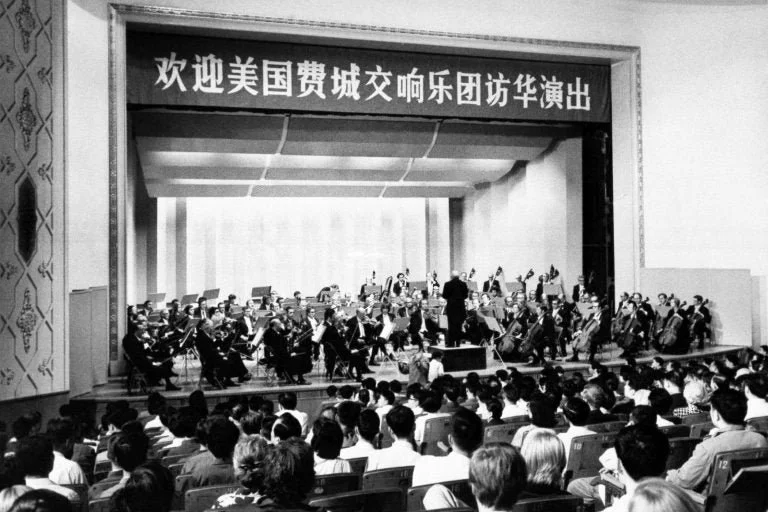
The Philadelphia Orchestra in China, 1973. Xinhua News Agency
Ultimately, the Philadelphia Orchestra’s trip to China accomplished its purpose. The normalization of US-China relations proceeded, with the US relinquishing its recognition of the nationalist government in Taipei in favor of Beijing; a prerequisite for further normalization. The orchestra’s tour of China also had a profound cultural impact, as it helped to revive the popularity of classical music in China after it had fallen out of favor during the Cultural Revolution. Today, China is one of the great consumers of and contributors to classical music. The Chinese-American composer and conductor Tan Dun (谭盾) felt compelled to pursue his passion for music despite official discouragement when, as an educated youth assigned to work in the countryside in 1973, he heard the orchestral performance playing from a nearby loudspeaker. The Philadelphia Orchestra’s tour also promoted a lasting cultural relationship, with the orchestra returning to China more than a dozen times over the next 50 years. On December 9th, 1979, Philadelphia became sister cities with Tianjin, a city of 13 million people south of Beijing. In 1983, artisans from Tianjin came to Chinatown, Philadelphia to build that neighborhood’s iconic “Friendship Arch”. In 2011, when the Philadelphia Orchestra became the first major American orchestra to file for bankruptcy, China came to the rescue. Beijing’s National Center for the Performing Arts signed an agreement with the Philadelphia Orchestra, under which the performers would cultivate Chinese orchestral talent through cultural exchange programs, tutelage and workshops. The program also included a good deal of scheduled performances that would help replenish the orchestra’s coffers while bringing top tier orchestral talent to China’s major cities and beyond. In one instance, the Bank of China paid hundreds of thousands of dollars for a single orchestral performance at the Shanghai Grand Theatre.
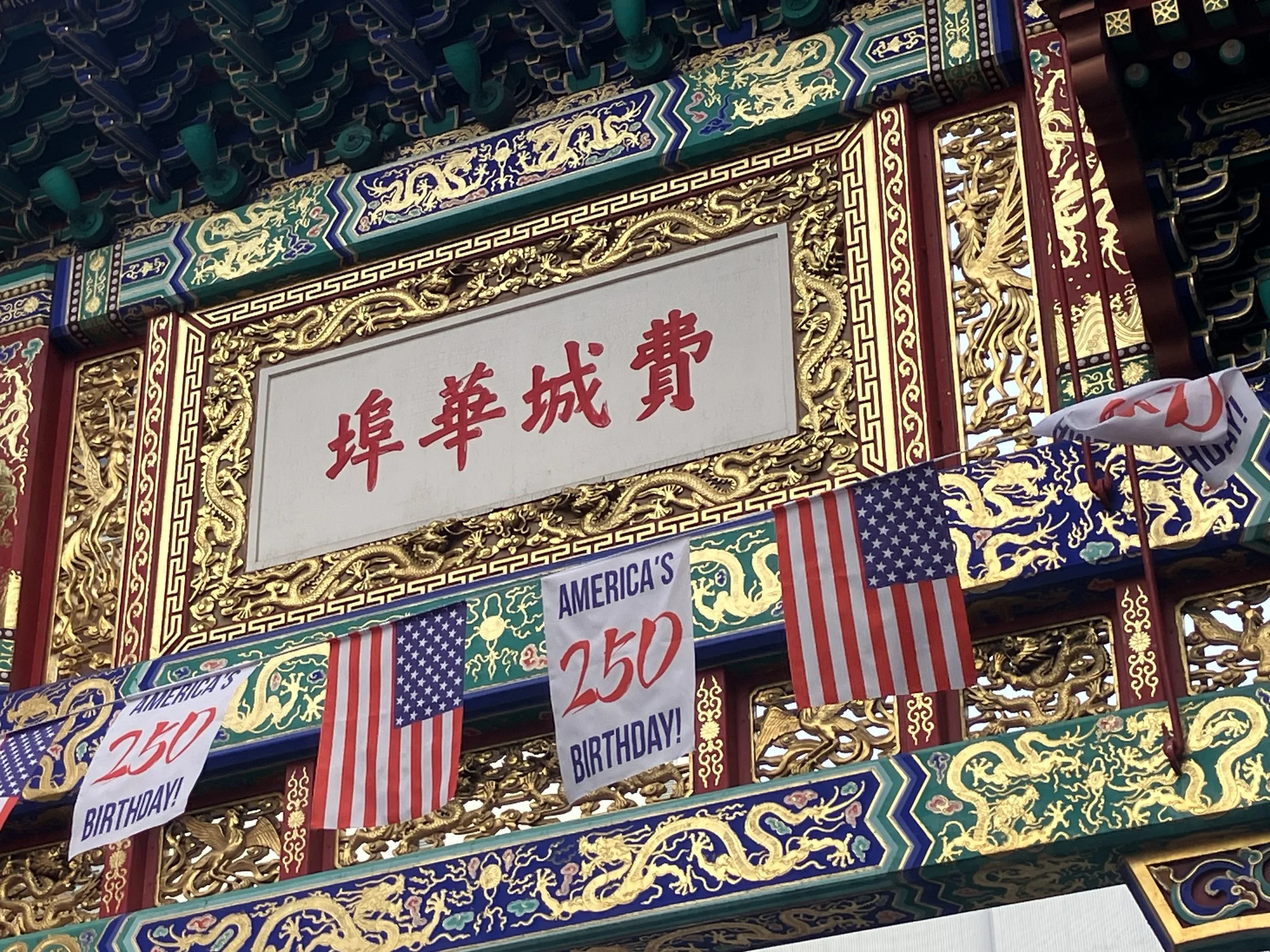
Friendship Arch, Philadelphia Chinatown
The decision by the Chinese government to support the Philadelphia Orchestra in its time of need was, of course, not purely altruistic. It was also an opportunity for China to make the case that the Chinese system was better than the American system at supporting the arts. Nixon’s visit to China wasn’t altruistic either – he wanted to turn a bipolar Cold War into a multipolar one, and succeeded in doing so by taking advantage of divisions between the Soviet Union and China to accelerate the splitting of the Eastern Bloc. Nixon’s détente profoundly altered the trajectory of the Cold War, pushing the split in the socialist camp beyond any easy reconciliation. America’s mythology – the image it projects of itself to the world – made that possible, and Philadelphia has always had a part in that performance.
II
Philadelphia, being the birthplace of the American republic, has hosted its share of diplomatic events over the centuries, capitalizing on its political and cultural heritage to become – in principle – a launching point for democracy and national self-determination for many peoples around the world, as it was for the American republic. In practice, however, the success of these efforts has always been hampered by the geopolitical considerations of the time, and the many ways in which America has failed to live up to its espoused principles. Nonetheless, in the later years of World War 1 and its immediate aftermath, more than a few “founding fathers” for new or aspiring independent nations around the world got their start in Philadelphia.
By 1918, the multi-ethnic empires in Eastern and Central Europe were collapsing after a half decade of war and instability. Russia had lost most of its Eastern European territories after the 1917 Russian Revolutions, but the other empires that sought to claim those lands had themselves faced military defeat and had no capacity to occupy new territories. Hoping to turn a world war into a class war, Vladimir Lenin (Владимир Ленин) called for the workers of the world to unite under a vision of proletarian internationalism, believing that the war between Europe’s imperialist powers would be capitalism’s final crisis, and that workers and soldiers of every nationality would rise up, overthrow their exhausted governments and join together in a union of socialist republics. But after the United States entered the Great War in 1917, President Woodrow Wilson formulated his Fourteen Points: a response to Lenin that proposed an alternative resolution for the crisis of world war to those who opposed Lenin’s vision of world revolution. When the Allies won the war in late 1918, Wilson got to work imposing his liberal internationalist beliefs on the peace negotiations with the Central Powers. Wilson’s Fourteen Points were broad, and they touched on issues ranging from freedom of navigation on the seas and open diplomacy to the formation of a forum for world governance. But the underlying theme that defined Wilson’s internationalist beliefs was the "principle of nationality," more commonly recognized today as the concept of national self-determination. In contrast to Lenin’s vision, Wilson believed that the defeated empires of Europe should be broken up into smaller nations on the basis of a shared language or ethnicity. To Wilson, groups with a shared national identity formed the ideal basis for a government: the nation-state. He believed that a community of nation-states – a League of Nations – could replace the multi-ethnic empires of the prewar era and foil the socialist drive for revolution in Europe.
In October of 1918, with victory in Europe only months away, nationalist representatives for the Czechoslovaks, Poles, Yugoslavs, Ukrainians, Uhro-Rusyns, Lithuanians, Romanians, Italians, Greeks, Albanians, and Armenians, as well as some early Zionists, convened at Independence Hall in the spirit of Wilsonian internationalism. Their aim was to formulate a set of shared governance principles to promote good relations between the fledgling states of Eastern Europe. The delegates gathered for three days, with Czechoslovak statesman Tomáš Masaryk serving as the chairman of the congress, to debate various proposals regarding how the new nations of Europe would be governed. The product of this conference was a document called the Declaration of Common Aims. This document pledged the support of the conference’s delegates to the Allied war effort and the principles of Wilsonian internationalism. It also called for the formation of a league of Eastern European states to promote cooperation between the region’s new nation-states. However, the Mid-European Union, as it was called, would fail to realize Wilson and Masaryk’s ambitions. Delegates to the conference began fighting over border issues and ethnic rivalries almost immediately after it started. The Polish delegates wanted a Ukrainian representative removed from the conference because he had killed a Polish governor during the war. A Yugoslav delegate ripped up a map that showed land on the Adriatic coast being given to the Italians and withdrew from the conference over this issue, despite protests from Serbian and Macedonian members of his delegation who still wanted to support the union. Though Masaryk was able to wrangle most of the delegates into signing the Declaration of Common Aims, by the summer of 1919 the Mid-European Union had dissolved. The failure of this diplomatic effort highlights a core problem with Wilson’s nation-state based vision of internationalism: Internationalism must be based on a consistent set of universal principles, but nationalists are primarily concerned with the self-determination of their specific ethnic or linguistic group, sometimes at the expense of universal principles or other nationalities. In the interwar period, the lands of Eastern Europe were a melting pot of many different ethnicities, and while one could roughly define the boundaries of different national “homelands,” there were many people from any given nationality living outside those borders. As the century progressed, attempts by nationalists to build larger, more consolidated states for their people would lead to population transfers and expulsions, violent attacks on ethnic minorities and conflicts between nation-states in Eastern Europe and in many other regions of the world.
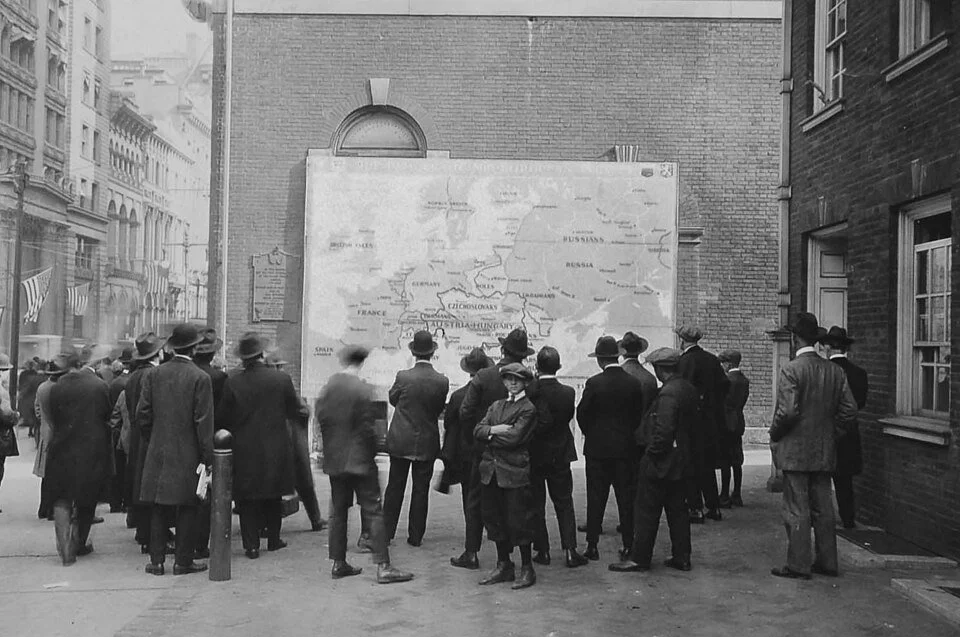
Onlookers observe a map of new European nations displayed in Philadelphia, October 1918
Adding to the limitations of Wilsonian internationalism were Woodrow Wilson’s own prejudices and hypocrisies. Wilson was an avowed racist and segregationist in his domestic politics, and on the international scene he did not believe that non-white peoples were capable of self-governance. Wilson's belief in self-determination was bound up with classical liberal assumptions about rationality. In Wilson's worldview, the acceptance and development of free markets was what made men free and rational. According to the historian William Appleman Williams, “People who did not use their freedom to accept and act on the free market-free men philosophy became increasingly defined and dealt with as objects – things to be manipulated and if necessary, physically removed.” Wilson's dehumanization of those who did not share his free market philosophy was already evident in his administration's approach toward Latin America, where American marines occupied Veracruz and Nicaragua and intervened throughout the Caribbean to ensure that men whom Wilson considered "responsible" would open overseas markets that could supply the demand necessary to make America's rapidly expanding industrial capacity profitable. But nowhere was Wilson's overseas hypocrisy more evident than in his approach to Lenin's revolution. Williams writes that "Wilson and Lenin personified a fundamental confrontation between the established free market-free men conception of the world and the most far-reaching critique and challenging alternative that it had ever encountered. The Bolsheviks were in reality calling for an end to economic man and his replacement by the whole human being... economic organization as a means whereby men could free themselves to realize their potential and not, as in the philosophy of classical liberalism, as the basis for defining their manhood." Despite much quintessentially liberal hand-wringing and agonizing over it, Wilson authorized American participation in an allied intervention against the fledgling Soviet Union in the Russian Civil War, denying the Russian people the right to determine their own destiny and drastically expanding the economic and human costs of the fighting.
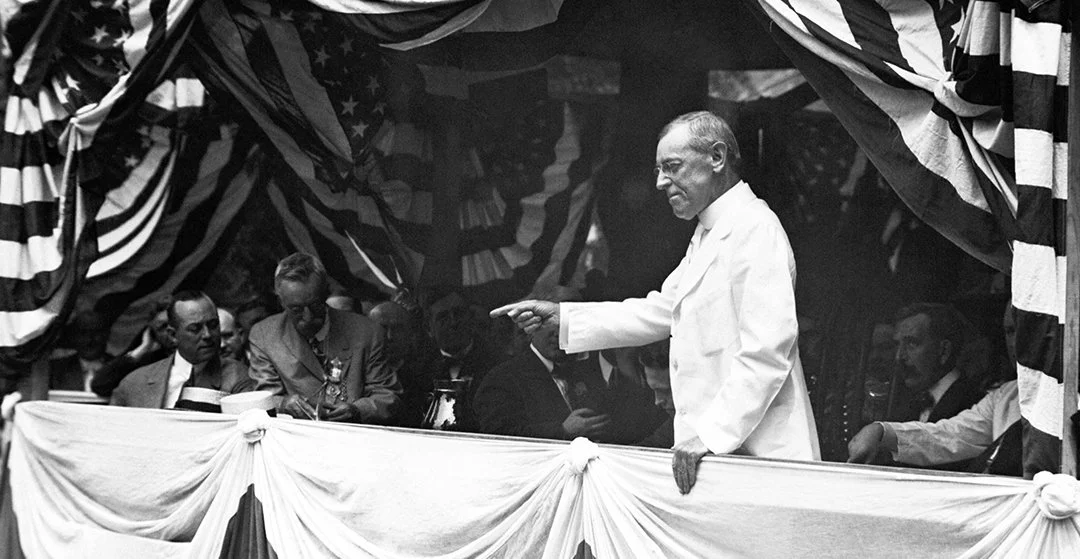
Wilson speaks at Independence Hall, 4th of July, 1914
Much like the Declaration of Independence's preamble, which Wilson lectured on his disdain for in a 1914 address at Independence Hall, the Fourteen Points he'd write four years after his speech asserted universal principles that were only ever intended to be extended to certain people in practice. While the nations of Eastern Europe were given US support in establishing their nationhood, the former overseas colonies of the Central Powers remained under foreign rule as League of Nations mandates. This paternalistic form of government was ostensibly supposed to stabilize the former colonial territories so that they could be granted independence at a later date. In practice though, the mandates were run as colonies in everything but name. However, Wilson’s racist views did not prevent the colonized peoples of the world from demanding their independence on the basis of his Fourteen Points. In one instance, they would bring their demands through the streets of Philadelphia to the very steps of Independence Hall where Wilson had declared the words "all men are created equal" irrelevant to American governance.
Following massive protests against Japanese rule on the Korean peninsula that would come to be known as the March First Movement, Korean independence leaders gathered in Philadelphia from April 12-14, 1919 to hold the First Korean Congress. Likely inspired by the success of Masaryk and other European nationalists in securing US support, Korean independence leader Philip Jaisohn (서재필) sought to prove to American sympathizers that his people were ready for self-rule. He emphasized that many of the delegates were Christians, and promised to model a future Korean government after that of the United States. The delegates advanced strategic and historical arguments to support their claim. Ultimately, these overtures weren’t enough. The conference received no support from the Wilson administration. Japan had taken German possessions in the Pacific and was considered a victor in the First World War. Wilson was unwilling to challenge the international power structure in a way that would upset another allied power, and he was even less willing to do this for a non-European people seeking independence.
III
Wilson did not anticipate that his intervention in Russia and appeasement of Japan would soon bring about the conditions in which the island empire would seize upon its postwar gains and the uneasiness of US-Soviet relations to invade East Asia and launch a sneak attack on the US naval base at Pearl Harbor. After tens of millions perished in the great conflagration of a Second World War that brought the very concept of human civilization into question, the United States would be forced to begrudgingly acknowledge the Korean independence struggle, among the many others sweeping the Global South. Though Wilson's idea of a League of Nations had failed in his own time, the battered allied powers had to reconsider establishing a global governance body, in an attempt to demonstrate to the restless masses of the world that the globalizing international system could be governed rationally and fairly.
With the initiative to construct a United Nations from the ground up came many ambitious ideas about how it should be done. The diplomats and architects of the early postwar era envisioned a proposed UN headquarters as the central fixture of an extraterritorial world city. For this reason, UN planners favored sites on undeveloped suburban land, provided that they were close enough to global transportation and communications infrastructure to be a viable place for international diplomacy. Philadelphia's UN HQ boosters – civil society men led by a newspaper magnate – found themselves losing steam as the fledgling UN gravitated toward locations in suburban New Jersey and New York. Abandoning their original proposal to build the new headquarters around Independence Hall, Philadelphia promoters instead offered the UN nearly half of Fairmount Park's western region, including Belmont Plateau and everything north of it. This proposal was very nearly adopted, but it was ultimately scrapped in favor of the present-day site in Manhattan thanks to the intervention of an older form of power. John D. Rockefeller Jr. had $8.5 million worth of property in downtown Manhattan that he didn't need, and dispatched his politically ambitious son Nelson to arrange its transfer into UN hands. The UN's acceptance of the Rockefellers' Manhattan site necessitated a scaling back of their grand ambitions for a world capital complex. Instead, the center of world diplomacy would amount to little more than a glorified office park.
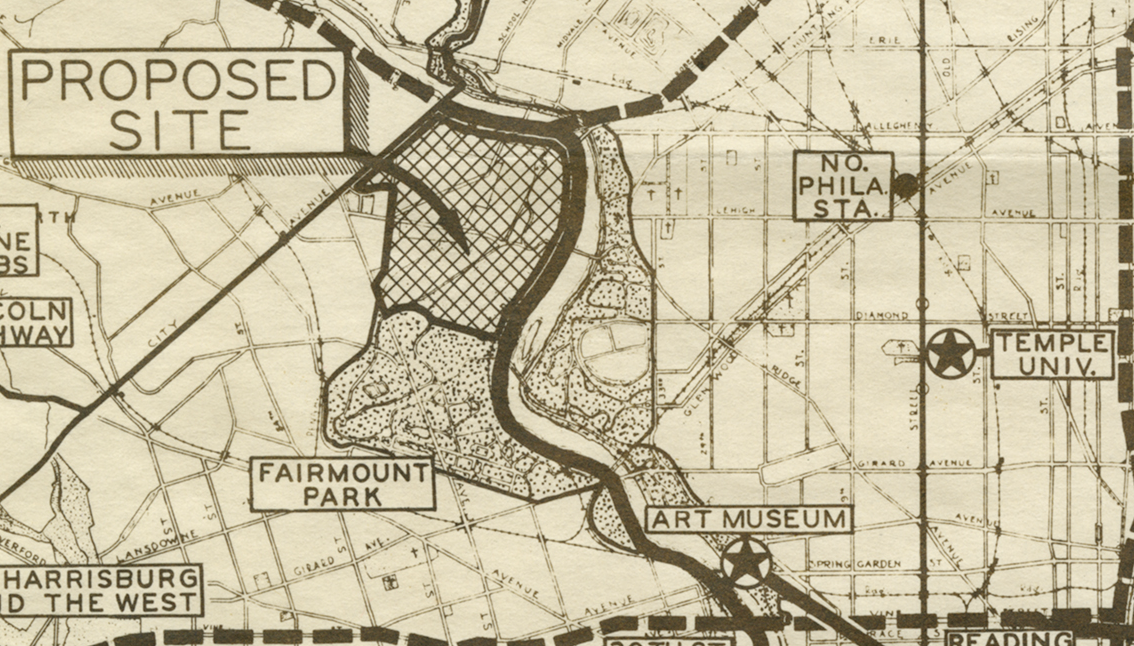
Map of the Philadelphia United Nations Headquarters proposal
The selection of a location for the UN headquarters wouldn’t be the last time that the priorities of the ultra-wealthy would have an outsized influence on the postwar order. The genocidal ultranationalism of the Axis powers was so dire a threat that it made possible a truce between the Soviets and the capitalist West on the basis of their shared humanism. But as the postwar order settled, the stage was set for the successors of Lenin and Wilson to compete for global influence. In time, both powers would end up violating their respective internationalist principles in pursuit of their geopolitical interests.
Writing in 1967, and lamenting the advent of a Cold War in the last decades of his life, the old guard Polish Marxist Isaac Deutscher, a biographer of Trotsky who looked to neither Moscow nor Washington as his guiding light, wrote that "in this last period, class struggle has all too often sunk into a bloody morass of power politics. On both sides of the great divide, a few ruthless and half-witted oligarchies … hold all the power and make all the decisions, obfuscate the minds and throttle the wills of nations … the social struggles of our time have degenerated into the unscrupulous contests of the oligarchies. Official Washington speaks for the world’s freedom, while official Moscow speaks for the world’s socialism. All too long the peoples have failed to contradict these false friends …"
Concretely, this looked like the United States and its allies' intelligence services – often staffed by society boys from Yale, Penn and Oxford – embarking on a world tour, sabotaging national self-rule and propping up unpopular post-independence leaders that aligned with them over the Soviets. Snubbed in 1919, when Korean independence was of no consequence to the United States, an activist who attended the First Korean Congress in Philadelphia – Syngman Rhee (이승만) – would be installed by the United States as a pro-American strongman in South Korea. While Rhee had lived in exile, pretending to be the president of a country under occupation, left-wing guerillas had fought to win their freedom by the barrel of a gun. Though they did not defeat Japan militarily, Korean freedom fighters were able to hold out against the occupation, building clandestine networks that would form the basis for self-rule. By the time the United States had flown Rhee into Seoul, Koreans who had survived Japanese oppression had already declared an independent, unified government. This People's Republic of Korea was a network of people's committees implementing a program of economic and social democracy. The Soviets were initially willing to work with the PRK's local councils, until Stalin acquiesced to a partition to appease the United States, which found Korea's autonomous government unacceptable from the start. In the American occupation zone, the PRK councils were outlawed and an interim government and advisory council was stacked with landowners, business interests and colonial collaborators. The PRK government and most left-wing parties were banned, provoking a general strike in 1946. The quarter of a million workers who laid down their tools were met with the bayonets of security forces, trained by the United States in counterinsurgency methods. Suppression of the strike led to its devolution into a general uprising, subsequently suppressed with even greater force. In the midst of an election which Rhee won handily – with most of his opposition banned, boycotting the vote, or in exile – as many as 80,000 people were killed in the violence of an uprising on Jeju Island, with the overwhelming majority dead at the hands of US-backed security forces.
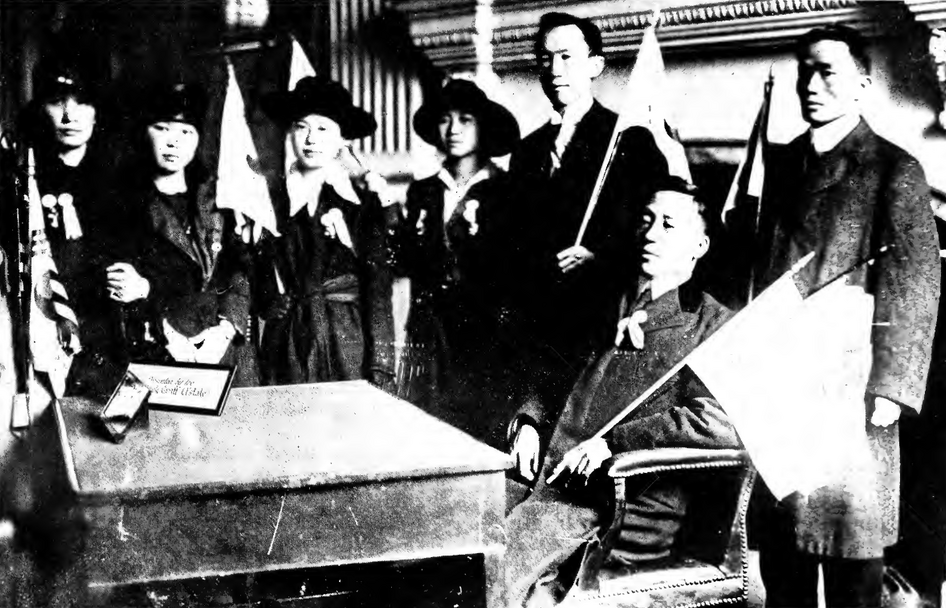
Syngman Rhee sits in George Washington’s chair at Independence Hall, April 1919
The North Korean attack on Rhee's government in the south during the following year must be understood in the context of an opponent who was no longer willing to negotiate. The Korean War was not the first demonstration of Deutscher's lamentation in the burgeoning cold war, but it would be among the bloodiest. Massacres that began during Rhee's counterinsurgency campaigns worsened during the war. When war broke out, as many as 200,000 alleged communists and communist sympathizers incarcerated by Rhee's government were killed to prevent their rescue as the Korean People's Army advanced. Among the worst massacres perpetrated by Americans was on the bridge at No Gun Ri, where from June 26 to 29 a US gunship fired on hundreds of civilian refugees, mostly women and children, who were trapped beneath a railroad overpass. By the end of the war, virtually all major cities on the Korean peninsula were devastated, largely by American carpet bombing, and as much as 15% of the north's population was killed. More than 1.5 million civilians were killed in total; a 74% civilian to military causality rate. In the English speaking world, the Korean War is often referred to as the "forgotten war," and it is true that the preceding Second World War and subsequent Vietnam War receive comparatively more attention from historians. But in reality it is only the American-led devastation of the peninsula that has been forgotten. In Philadelphia, American servicemen have been given a monument that makes no mention of the nation's crimes, and a nearby portion of Dock Street, still paved with cobblestone, is renamed 38th Parallel Place, after the imperious line drawn through a peninsula that remains tragically divided to this day.
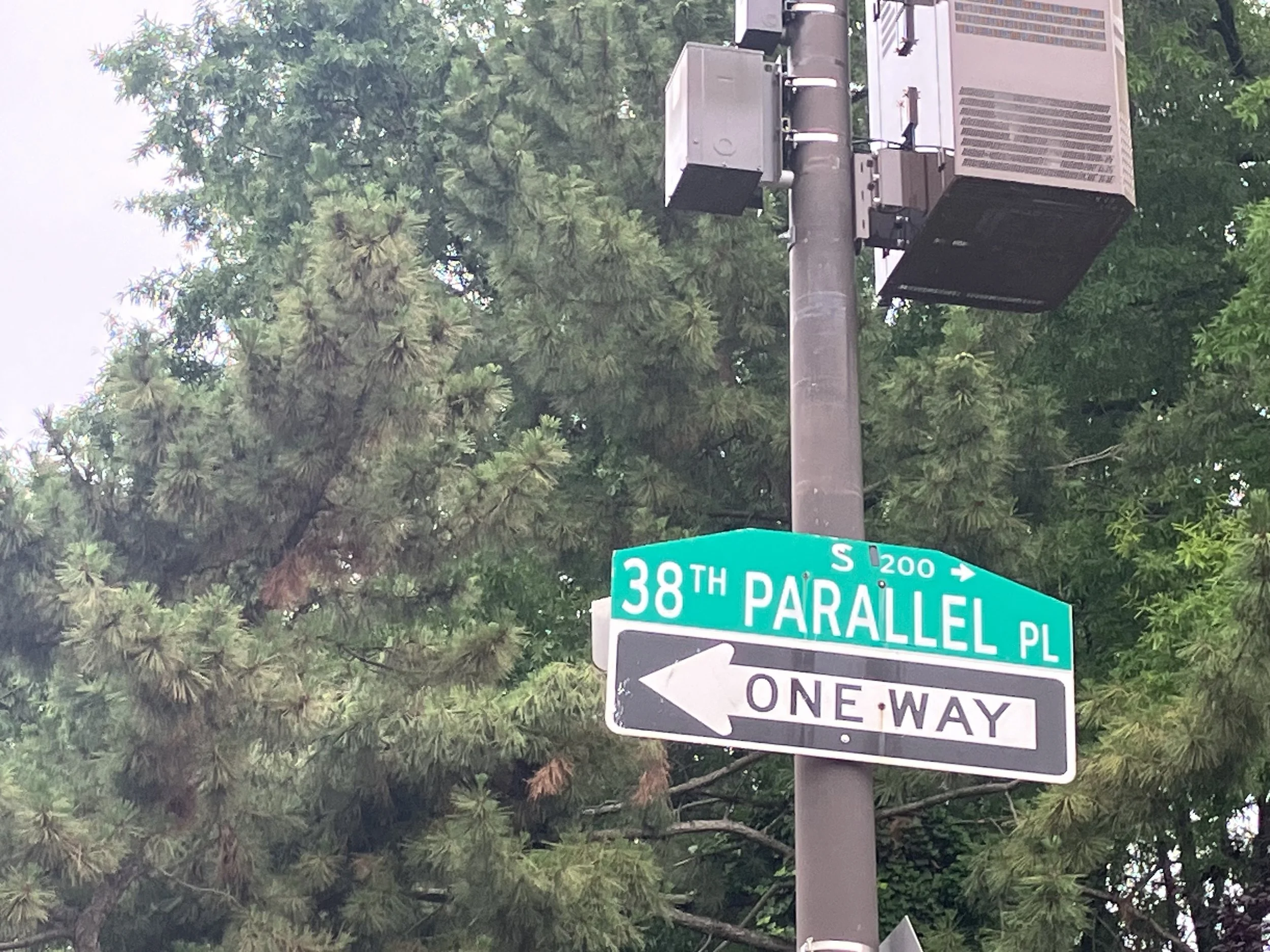
38th Parallel Place in Society Hill, Philadelphia
The Korean War also had a lasting impact on US defense spending policy, reversing the trend toward disarmament that had been expected in 1945. Under the Eisenhower administration that followed Truman, it was the Philadelphia aristocrat Thomas Sovereign Gates Jr. who modernized the military’s preparations for a war that, should it ever arise, would be unlike anything ever seen on Earth. Gates’s main contribution as Secretary of Defense was to organize the US military’s nuclear and conventional targeting playbook, eliminating redundancies between branches and divisions so that each missile would hit a fresh target, maximizing the lethality of the US arsenal. Gates reorganized the US nuclear arsenal into a triad of land-based missiles, bombers, and submarines, ensuring that it could not be destroyed by any single attack. He also ordered the creation of a Single Integrated Operational Plan (SIOP), a system of targeting priorities in the event that the Cold War went hot. The first SIOP, authored under the oversight of Gates, called for pre-emptive nuclear strikes on countries like China and Albania because they had chosen socialism, whether or not those nations joined the war on the Soviet side. Altogether, it was a plan to kill at least 400 million people and let enemy missiles fall where they may, at the discretion of the President, no matter how such a war might begin.
Only a few years before war broke out in Korea, Vietnam's own founding father, Hồ Chí Minh, would read a declaration of his nation's independence from its French colonial overlords, quoting those words written in Philadelphia that so inconvenienced Woodrow Wilson and Harry Truman: All men are created equal. They are endowed by their Creator with certain inalienable rights, among these are Life, Liberty, and the pursuit of Happiness. The Vietnamese would be the next people punished by American bombs for seeking an inconvenient freedom, in another “limited war” in which Gates and Eisenhower’s successors would perpetrate their continued aggression with a finger resting on the button that would end it all. For the first country in the modern era to free itself from colonial rule, denying that same freedom to others represents the highest betrayal of the American Revolution's promise; the nation's original sin, practiced as much today as it was when those very words in the Declaration were written. But there would be no reckoning in the 20th Century. The pattern of American sabotage in the national liberation struggles of the colonized world would repeat itself the for decades as the American war-and-subterfuge-machine refined its methods. America's anti-communist aggression in Indochina is well known, but even leaders that did not align themselves with the Soviet Union could not necessarily count themselves safe from the eagle’s talons. In 1953, American and British intelligence backed the overthrow of the secular, liberal prime minister of Iran, Mohammed Mossadegh (محمد مصدق), who planned to nationalize his country’s oil industry. Just two years earlier, Mossadegh had visited Philadelphia on a tour of the United States. In one photo, he can be seen gazing contemplatively at the inscription on the Liberty Bell while his fingers caress its wounded lip. In his analysis of the 1947-49 US support for Greek monarchists in the Cold War’s first proxy war, the historian Todd Gitlin wrote that “Despite the sophisticated rhetoric, ‘self-determination’ in the official American version disenfranchises not only communists but others who do not think that communism is the devil itself. The world abounds in popular moderates and reformers – Arevalo, Arbenz [in Guatemala], Bosch [in the Dominican Republic], Quat [in Vietnam], Svolos [in Greece], Goulart [in Brazil], and the rest – who have been deprived of legitimate power because their modest hopes challenged American power.”
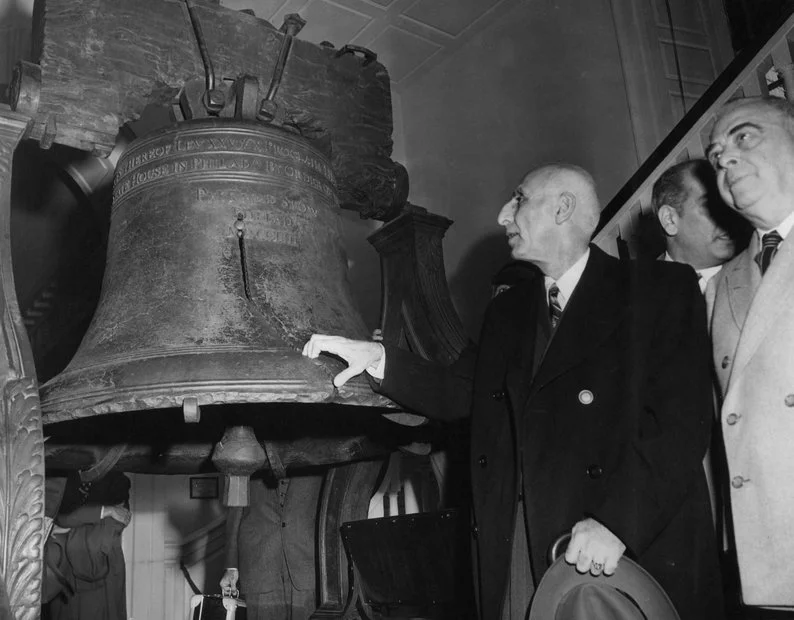
Mossadegh visits the Liberty Bell, 1951
Conversely, the Soviet Union can be assigned its share of the blame for the 20th Century butchering of internationalism. Its over-reliance on force against those still willing to negotiate, its allergy to socialist pluralism, and its underestimation of the role of nationalism in mobilizing public sentiment would contribute to its downfall, with the revolutions in 1989 leading to the secession of most of its satellite republics and precipitating its dissolution.
The collapse of the Soviet Union, for all its many faults, caused much hardship around the world. Nations like North Korea and Cuba, for whom the Soviet Union was a major trading partner, faced severe economic crises. The Eastern Bloc was promised freedom, then plundered as ex-communists and opposition leaders united in a frenzy of corruption. When Deutscher lamented in 1967 that a ruthless oligarchy had come to speak on behalf of the world's socialism, he could not have anticipated how much worse things would get for the workers of the former USSR when that oligarchy dropped even its socialist pretenses. However, in his same essay debunking the myths of the Cold War, Deutscher theorized that despite the emergence of an intense ideological competition between geopolitical blocs, the workers of the world remained uniformly in a struggle against their leaders' lust for power and control, no matter which economic system they were officially living under. Deutscher asserted that freedom struggles anywhere in the globe inspired the masses in other parts of the world to reform their own societies: The broader global context at the time of the Cold War's conclusion seems to confirm this.
At the same time that many Soviet satellites were seeking their independence, a number of US-backed regimes were facing their own democratization movements. In Latin America, Brazil, Chile, and Argentina shook off US-backed military dictatorships in the 1970s and 80s. In East Asia, South Korea, Taiwan, and the Philippines followed suit. By the end of these two decades, it seemed that the winds of change were blowing not just through the Eastern Bloc, but the entire world. One of the most internationally notable of these late 20th Century democratization struggles was the fight against apartheid in South Africa. After the resignation of the hardliner president P.W. Botha in 1989, Frederik Willem de Klerk took the reins of the South African state and its violently enforced system of extreme segregation. Most anti-apartheid activists believed that de Klerk would be no different from his predecessors, and members of his own National Party also believed him to be a staunch supporter of the continuation of white minority rule. In actuality, de Klerk could see that apartheid was becoming increasingly untenable. In the Cold War, many African states had aligned themselves with world socialism after their independence, partially because Lenin and his successors had supported national self-determination for Africans while Wilson and his successors had not. The United States had supported South Africa’s apartheid regime as a bulwark of African anti-communism. US diplomats had used their Security Council veto to protect it from international pressure, while US intelligence agencies had armed and advised the apartheid state.
With the Cold War winding down, de Klerk realized that South Africa would not receive the same strategic support from the United States, nor face the same pressure from Soviet-backed African liberation movements. Putting pragmatism above his principles, de Klerk determined that the only way he could secure a future in Africa for the ruling Afrikaner minority was to liberalize the country and facilitate a negotiated transition to majority rule. To this end, he released Nelson Mandela and other political prisoners from jail, permitted anti-apartheid marches and initiated talks with the African National Congress. On July 4, 1993, Mandela and De Klerk made a joint trip to Philadelphia to accept the Philadelphia Liberty Medal for their efforts to end apartheid. Though it heralded the start of a positive change, this visit proved controversial. A number of political leaders in Philadelphia had led the fight domestically against the United States’s support for South African apartheid, including Reverend Leon Sullivan and Representative William H. Gray III. Sullivan, who worked to educate and train Philadelphia’s Black working class, also authored the Sullivan Principles. These principles were increasingly used by multinational corporations who wanted to promote racial integration in their South African workplaces after Sullivan found himself on the board of General Motors. Gray was a congressman from 1979-1991, and had authored early legislation that would have imposed sanctions on South Africa’s apartheid regime and served as the basis for later bills that would become law. When the Comprehensive Anti-Apartheid Act of 1986 was introduced in the House of Representatives, Gray was given the honor of presenting it. When Ronald Reagan vetoed this bill, Congress overruled him.
Many who had spent the last decades fighting apartheid believed that awarding de Klerk for his role in the negotiations was giving too much credit to a “captain of apartheid,” as Mandela would call him in his own speech in Philadelphia. Gray and Sullivan did not attend the award ceremony, and Lucien Blackwell of Philadelphia’s 3rd District called for the Black community to boycott the event. Mandela, on the other hand, put pragmatism over his politics, just like De Klerk. He was well aware of the immoral nature of the apartheid government, and of the complicity of its leaders. But he had been a political prisoner for 27 years, and from his perspective it was more important to end apartheid at any cost than to pursue a path of absolute moral righteousness. After Mandela’s death in 2012, Philadelphia mayor Michael Nutter said that the former South African president “never spoke of vengeance” after his release from prison. Mandela was certainly magnanimous, but perhaps he merely never spoke of vengeance to Michael Nutter. In Philadelphia, Mandela collected funds to support election monitoring for the upcoming 1994 South African elections – the first with universal suffrage, which were won decisively by Mandela’s African National Congress. William Gray called Mandela’s visit to Bright Hope Baptist Church in North Philly the pinnacle of his political career. In an era of history defined by sectarian and political violence, brutal civil wars and great power conflict that drenched the Global South in blood, the dismantling of apartheid through peaceful, diplomatic means was practically a miracle. It remains an encouraging precedent today, as many nations still struggle to resolve conflict with their neighbors and overcome ethnic and religious divisions.
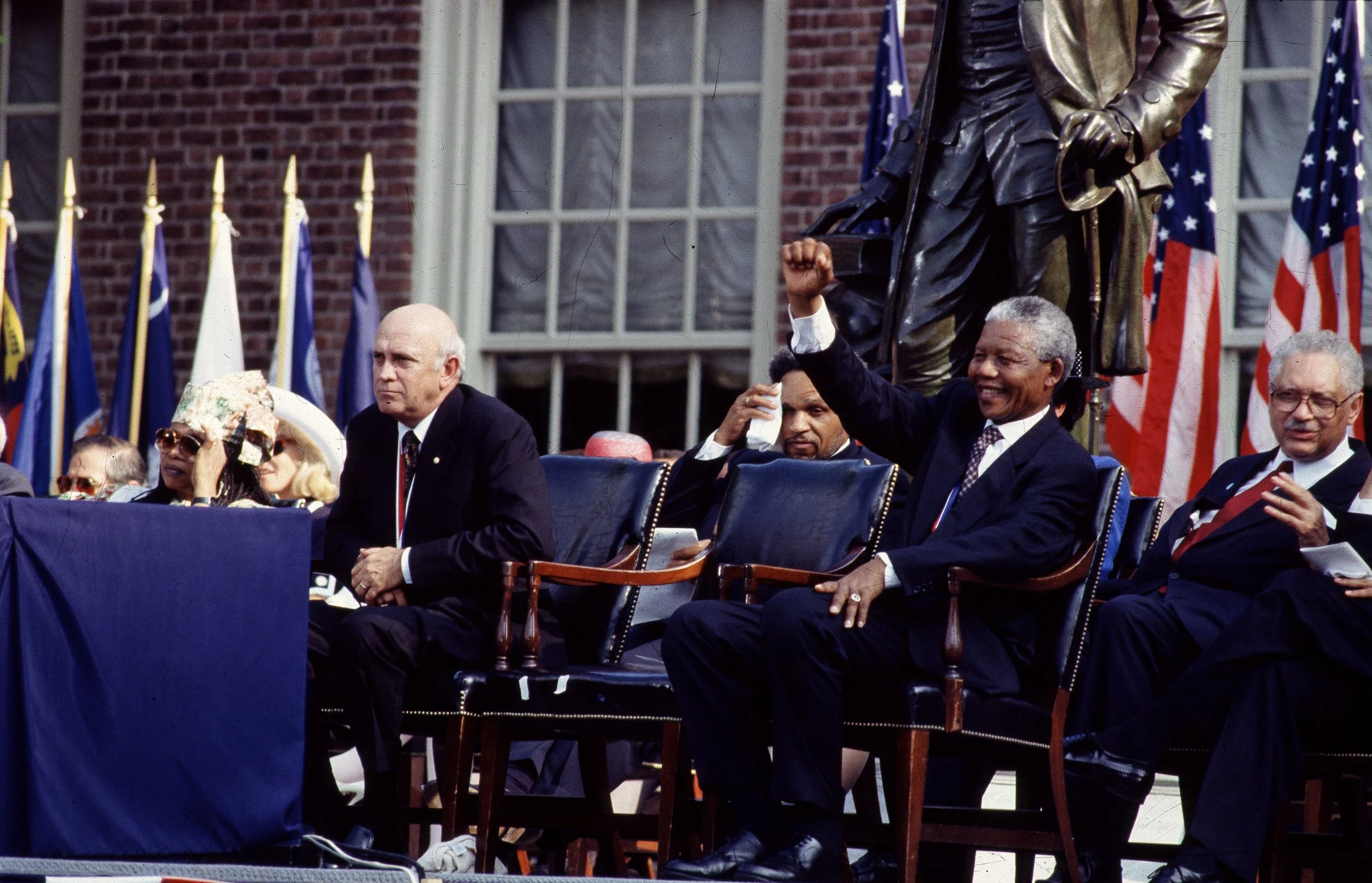
Mandela and De Klerk in Philadelphia, 1993
But in the year 2026, it is hard to look back at the revolutions of the late 20th Century as optimistically as Deutscher anticipated them. Concluding his essay, Deutscher wrote that "once the divisions begin to run within nations [rather than between them], progress begins anew... towards one socialist world. We can and must give back to class struggle its old dignity. We can and we must restore meaning to the great ideas, the conflicting or partly conflicting ideas, by which mankind is still living; the ideas of liberalism, democracy and communism – yes, the idea of communism." This assertion has not come to pass. In the intervening four decades since those optimistic years – triumphantly declared the end of history until history marched on – we have seen what a world looks like that has failed to integrate the ideas of communism, democracy and liberal humanism that defeated fascism and drove the world forward in the last century. Our world today is one on the brink of war and ecological collapse. It is one in which old evils are re-emerging, and geopolitical rivalries are rising without even the ideological struggle that once gave them some meaning. But Deutscher’s formulation that dissent based in a consistent set of universally applied principles is essential to the struggles of the world’s peoples for freedom still rings true. In our world of greed, cynicism, hypocrisy, and capitulation, Philadelphia’s history with international diplomacy calls out to us – in both its successes and its shortcomings – to demonstrate that the only peace that can last is a just peace based in mutual respect and a shared understanding of the common humanity of all the world’s people.
The third in a series on Philadelphia history.