
I
In the spring of 1778, Philadelphia was an occupied city. After defeats at Brandywine Creek and Germantown in the autumn of 1777, George Washington’s army had retreated to Valley Forge, encamping in the snowy hills 20 miles north of Philadelphia. The Continental Congress, America’s provisional government, fled to Lancaster and later York, Pennsylvania. The Liberty Bell was smuggled out of the city and hidden in a basement in Allentown for fear that it would be melted down to make bullets for the occupation. The British soon entrenched themselves, taking the American forts Mifflin and Mercer and making an unsuccessful attempt to finish off Washington’s battered army at White Marsh. With the capture of the continent’s most populous and important city, the American Revolution was at its lowest point. It would have been reasonable to predict at this time that the British Empire would soon defeat its rebellious colonies.
General Howe, commander of the British forces in North America, had taken the success of the Philadelphia campaign as a reason to relax. With their task of pacifying the colonies incomplete, Howe and his officers’ enjoyment of Philadelphia’s urban comforts displeased the crown. He was ordered to return to England so that Sir Henry Clinton could take command of the armies stationed in Philadelphia, and finish the job. In a final act of affection for their commander and debauchery for its own sake, Howe’s officers threw him a going-away party. Known as the Mischianza (the Italian word for “mixture” or “medley”), the festival was to be an elaborate affair that included a regatta in the Delaware River, a jousting tournament, a 17-gun salute by British warships and a ball and banquet complete with a fireworks display. It was chiefly organized by a young, charismatic captain named John André who had friends on both sides of the Atlantic due to his sociability and his many talents. He had designed the party’s exclusive invite tickets and arranged its itinerary, carefully curating an event that would be as much a joy to its participants as it was the envy of its spectators. On the eve of the Mischianza, he had endeared himself to several of the marriageable women from Philadelphia’s loyalist families. Though he chose Peggy Chew – the daughter of the Pennsylvania jurist Benjamin Chew – to be his date for the evening, André also entertained the affection felt for him by Peggy Shippen – the future wife of Benedict Arnold.
The party began at Knight’s Wharf, a pier on the Delaware River off of Vine Street near where the Benjamin Franklin Bridge stands today. General Howe, his brother Admiral Richard Howe, General Clinton and the other important guests sailed down the river and disembarked at the Old Fort near today’s Washington Avenue. They led a procession down the road, passing through triumphal arches and party pavilions. The procession culminated in a gathering outside of the home of the merchant Joseph Wharton, a mansion called Walnut Grove near today’s 5th Street and Washington Avenue. It was one of the nicest houses in the city at that time, and its courtyard was outfitted for a feast, libations and a jousting tournament. Throughout the festivities, partygoers invoked the history and mythology of the European middle ages – knighthood, chivalry, and war with honor. The party channeled a clean, morally simplistic and anachronistic fantasy into an immeasurably complex and rapidly changing world. As the loyalists of Philadelphia partied through the night, the majority of the city’s populace looked on with disapproval or nervous neutrality. Patriot commander Allen McLane, a guerilla leader under George Washington, led a skirmishing party to attack the British lines in Germantown. The party organizers reassured their guests that the cannon fire they heard was just a part of the fireworks show.
According to the historian Morris Bishop, “The Mischianza was an attempt to deny the present world, to realize a dream of chivalry, gallantry, beauty, to re-create a world that had never existed in fact… They formalized battle as a gentleman’s sport, with its reward a lady’s smile, not power or gain. They were suggesting, unconsciously, that war’s miseries are just part of a game, that bullets and bayonets do not really hurt, that after the conflict the dead men will rise up and join in the dance.”
But as dawn returned to Philadelphia, the party had to end. General Howe departed to cross the Atlantic, and within a few weeks the British would evacuate Philadelphia in order to reinforce their other positions on the continent. The strategically valuable city would be liberated without bloodshed, and the victorious Americans would soon hold their own parties and triumphs to honor their war heroes. The attendees of the Mischianza would return to the day-to-day realities of a war of independence that had divided every family and community on the continent. John André, the charismatic captain and party planner, would receive a promotion from General Clinton. In 1778, André was living in Benjamin Franklin’s house, stealing his paintings and wearing down his furniture. Two years later, he’d be captured while undercover behind enemy lines and hanged as an enemy spy. The death of André was widely viewed as a tragedy, including among his sympathizers within the American cause. The loss of countless talented, unique, irreplaceable souls to the hardships of war and political struggle was one of those realities that the party organized by André sought to make forgettable for the night. Peggy Shippen, who André had declined to take as his date to the dance in 1778, went on to marry Benedict Arnold when he was installed as the military governor of Philadelphia after the British evacuation. Benedict and Peggy Arnold enriched themselves, using his office to secure kickbacks and cut favorable deals with Philadelphia’s loyalist business interests, and eventually became André’s associates in his treason plot. Disillusioned with the revolutionary cause and tempted by promises of luxury and prestige, they were discovered while plotting to surrender West Point for £20,000 and escaped to England. Peggy reportedly kept a lock of André’s hair in a box of her belongings until her death, holding on to the memory of a man whose love of the world’s finer pleasures could not save his life.
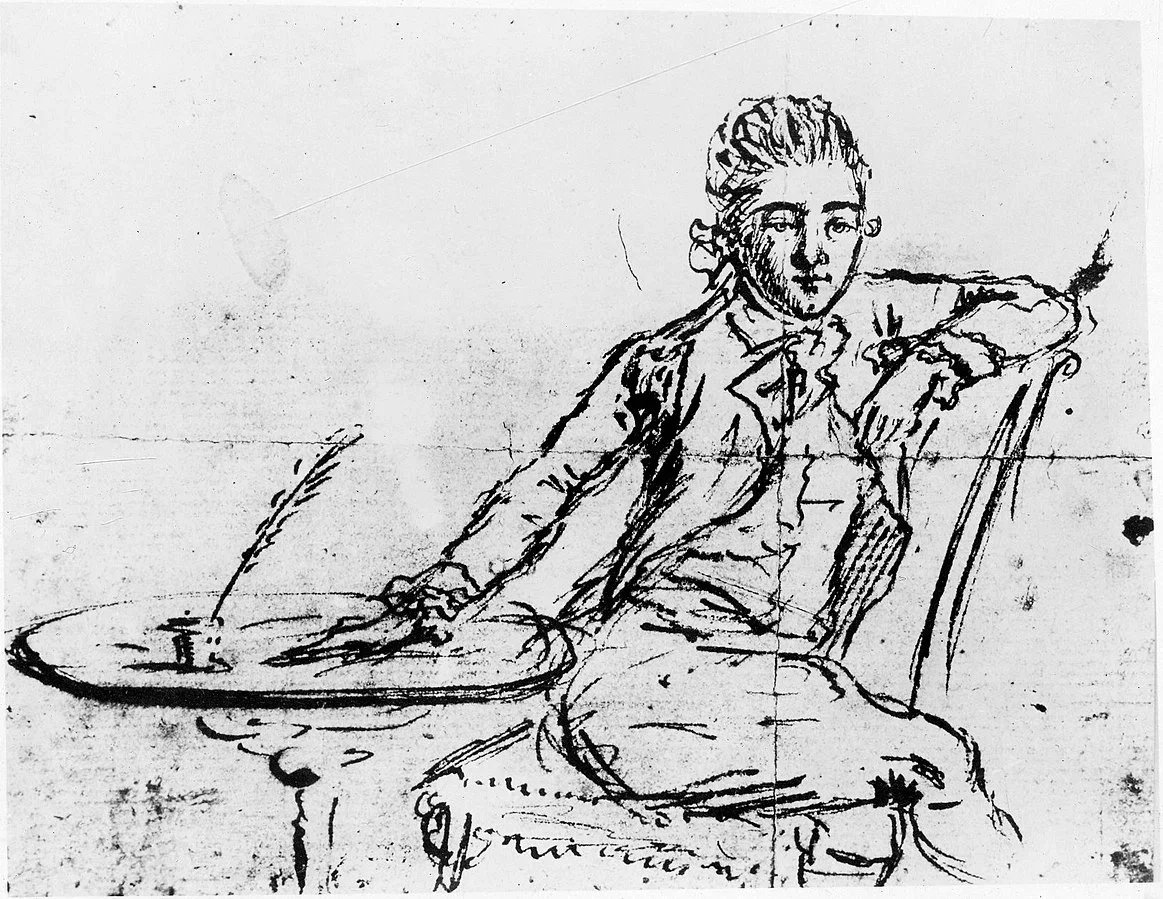
Self-portrait drawn by Andre on the eve of his execution
II
More than 200 years after the death of John André, the United States had become the world’s foremost international power. The 1980s were a decade of tremendous technological and economic change throughout the world – changes that were bringing about a great optimism in the West. At the same time, the world was becoming increasingly complex and interconnected. The Cold War had reached a new peak of hostility after the detente of the 1970s, with the competing international blocs taking more aggressive measures to undermine each others’ stability. The interconnectedness of the world’s socioeconomic systems was leading to crises that traditional political leadership struggled to handle, such as an international debt crisis, the AIDS epidemic, climate change and the nuclear arms race. Faced with the reality of a world full of great suffering and great wealth, two musicians from the British Isles hatched a plan to leverage the interconnected nature of the world’s globalizing economy and culture to address the problems of the day in a way that political leaders could not: Bob Geldof and Midge Ure were going to throw the biggest party in history.
The pair had recorded a hit single, “Do They Know It’s Christmas?” after learning of the ongoing Ethiopian famine – a consequence of the war, environmental change and political instability that defined many regions in the world at that time. But they wanted to go further than that. They envisioned not just a concert, but two simultaneous concerts on two continents, broadcast live with a star-studded lineup. Geldof hoped that he could bypass politicians and governments and take direct action to provide famine relief to Ethiopia by making use of the social and financial influence of celebrities and rockstars. He chose Wembley Stadium in London as one concert venue, and JFK Stadium in Philadelphia as the other. He pitched his idea to all the top stars in the music industry, at times telling one that another had already agreed to perform, then telling the other that the first had done the same. Soon, a stellar lineup was set to play at JFK, including Bob Dylan, Tom Petty, Mick Jagger, Led Zeppelin and the Beach Boys.
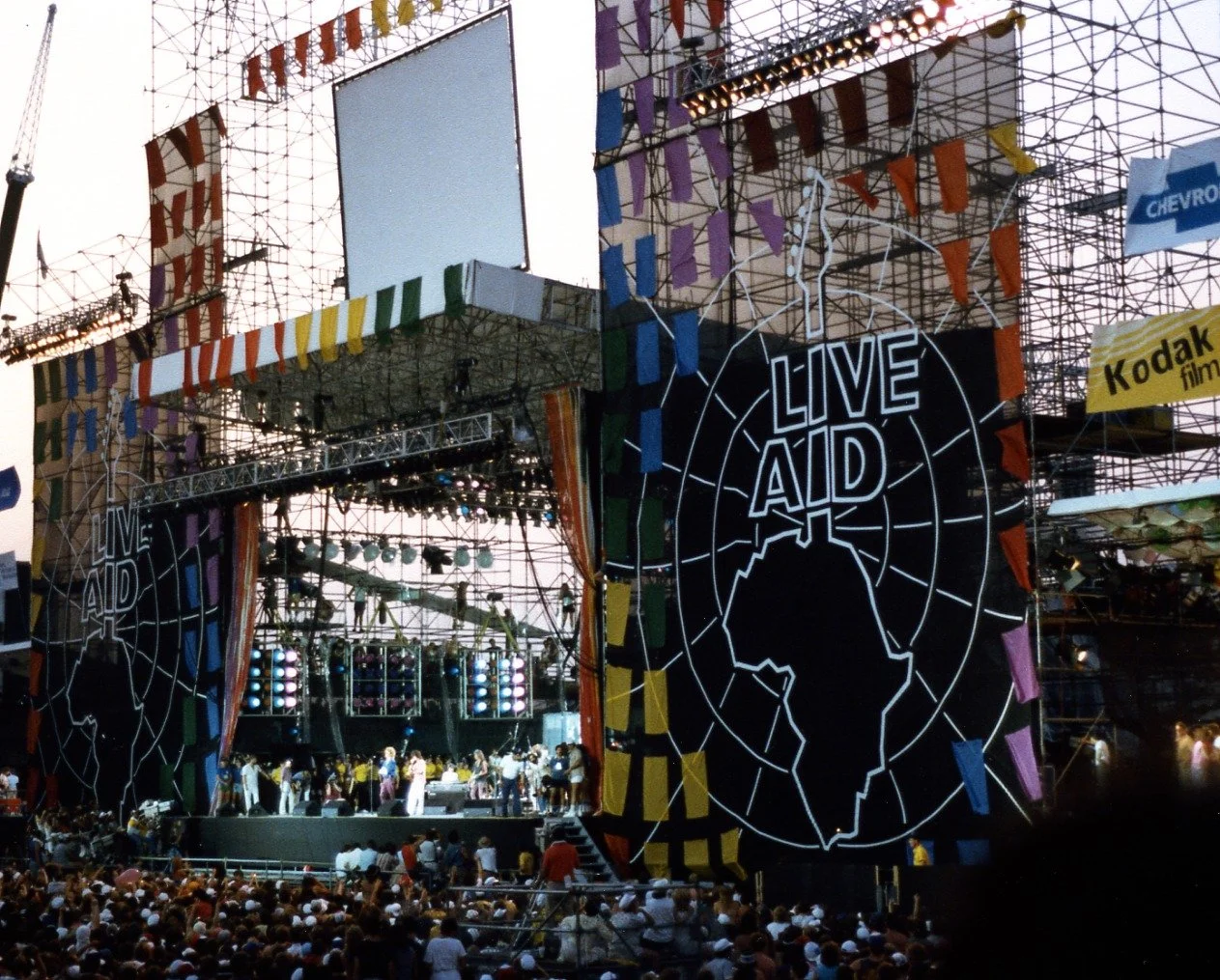
By Squelle - Own work, CC BY-SA 3.0, https://commons.wikimedia.org/w/index.php?curid=4090790
The concert was, from the perspective of an internationally televised entertainment event, extremely successful. 100,000 people attended in person in Philadelphia, paying $35 a ticket. Millions more – as many as 1.9 billion – watched live on TV. Mayor Wilson Goode offered JFK stadium to Geldof for free, and the artists involved charged no fees for their performances. Between ticket sales, merch, and call-in/mail-in donations advertised on TV, the concert raised as many as $150 million dollars for famine relief. More significant than this, though, was the publicity brought on by the concert, which created the political impetus to direct resources from world governments to ending the immediate threat of starvation in Ethiopia. The cultural impact of Live Aid was significant too, in that it brought global humanitarian concerns to the forefront of popular culture.
In 2005, a similar concert was organized by Geldof ahead of the G8 summit in all participating countries as well as South Africa. Rather than addressing a specific famine, Live 8 sought to eradicate global poverty as a whole. Concertgoers from around the country once again flocked to Philadelphia on July 2nd, where the United States held its Live 8 concert on the Benjamin Franklin Parkway. Geldof and Ure declared their mission accomplished, satisfied with the incredible parties they had thrown and their unprecedented social impact. But life is rarely so simple, and as the years went on, the impact of Live Aid became a topic of some controversy. To begin with, the entire endeavor and especially the song “Do They Know It’s Christmas?” was incredibly paternalistic. The concerts featured few African performers, and Geldof and Ure didn’t meaningfully solicit the advice of any African leaders or political figures as to how to approach sending aid to the continent. One of the inadvertent messages of Live Aid and Live 8 was that Western celebrities knew how to govern Africa better than Africans and their leaders did. In 1985, despite his adept understanding of international showbusiness, Geldof showed an insufficient understanding of Ethiopian politics, sending much of the money raised to the Ethiopian government, who could not be trusted to distribute aid ethically and whose war strategy was partially responsible for the famine.
Just as the Mischianza sought to obscure the hardships and realities of colonial conquest and war by constructing a fantasy world of medieval chivalry and knighthood in the streets of Philadelphia, the Geldof concerts sought to bring into being a world where conscientious people could bypass the immense technical challenges of the modern world by influencing the public directly. If enough well meaning people could get together, no political program or serious study would be needed to make change.
Bob Dylan was castigated for a remark he made at Live Aid, when he said that he hoped some of the money raised would go towards helping farmers pay their mortgages in America. His comment was crass and nationalistic, and equivocated between starvation deaths and financial hardship, but there was a kernel of truth to it. When it became clear that Live Aid could not solve the structural problems that lead to starvation and scarcity in a world of material abundance, the effort was revealed as aspirational and insufficient at best, or hypocritical and counterproductive at worst. In 1985, Philadelphians were having the best of times and the worst of times. A vibrant disco and Latin freestyle scene was developing in the clubs and basements of Philadelphia’s music and nightlife scene, and artists like Pretty Poison, T.P.E. and Debbie Deb were putting the city on the national map. As the decade progressed, this innovative musical scene would be ravaged by the AIDS crisis, and many young people would die preventable deaths as the disease spread faster than society’s understanding of it did.
In 1983 the movie Trading Places, filmed and set in Philadelphia, was released to rave reviews and box office success. In the movie, two wealthy elites orchestrate a career swap in order to resolve a debate, recruiting a street hustler (Eddie Murphy) to work as a commodities broker, while their preppy commodities broker (Dan Aykroyd) is fired and forced to try his luck hustling for a living. In a feel-good resolution to the story’s tensions, the pair unite to outmaneuver the rich business owners who are manipulating them, becoming independently wealthy with a single masterful trade. The arc of this film’s plot typifies the hustle, optimism and superficial concern for complex social issues like poverty that was omnipresent in the 80s.
Meanwhile, several blocks surrounding Osage Avenue lay in smoldering ruin after Philadelphia Police dropped bags of explosives on a West Philadelphia rowhome during an armed standoff with the Black liberation organization MOVE on May 13th, 1985. Just months before Live Aid would be held a few miles away.
If there was evidence in the mid-80s that an American victory in the Cold War was around the corner, it was not to be found in Philadelphia. Like many American cities, Philly faced a municipal financing crisis brought on by disinvestment and white flight. Vast swathes of the city’s housing stock lay abandoned and many people who struggled to afford rent simply squatted in those abandoned properties. The documentary Squatters: The Other Philadelphia Story details how, faced with the necessity of resolving hardship and a lack of options to do so, a group of squatters led by Gloria Giles turned to political action and successfully orchestrated a campaign to lobby Washington for national squatters’ rights legislation.
It was not just America’s farmers or Philadephia’s paupers who were deserving of a fairer distribution of the world’s wealth in addition to the Ethiopian famine victims. There were then and still are today many millions of people living butchered half-lives, never achieving their full potential because of their denial and exploitation by systems that make others wealthy. The failure of Live Aid and subsequent international charitable efforts to examine or challenge these systems has consigned untold numbers of people to dependence on their exploiters for the basic necessities denied to them by their exploitation, all while making the well-to-do feel so accomplished in their own philanthropy that they sleep soundly while the suffering they’ve wrought continues.
On the other hand, it’s important to acknowledge that there has never been a party in history that hasn’t taken place in a time of crisis or hardship for someone in the world. Neither the Mischianza nor Live Aid were exceptions to this rule. In a certain sense, festivities and celebrations are a necessary and beautiful part of human existence that help everyday people cope with a world where suffering is commonplace. Parties provide a reprieve from the hardships of life and a way to commemorate good times and events of historic significance. They are a part of the glue that holds our society together. A critical analysis of celebration shouldn’t prevent one from enjoying life’s pleasures with the people who make it worth living. As America commemorates its 250th birthday here in Philadelphia, we will each have to find our own ways to reconcile the joy and the pain of this world and appreciate life in all its fullness and complexity.
The first in a series on Philadelphia history.