
Philadelphia Lawyers and the Cradle of Liberty
I
Though Philadelphia has taken on many forms in its almost 350 years of history, it is often associated with an idealized version of the founding values of the United States. According to the traditional narrative, Philadelphia is the cradle of American liberty – the place where the Founding Fathers and political thinkers like Thomas Paine debated the ideas that would go on to define the nation and distinguish it from the monarchies of the Old World. Proponents of Philadelphia as the birthplace of American liberty point to its early culture of religious and ethnic tolerance, debate, and upward mobility. Its Quaker founder, William Penn, established the city with the intention that it would become a haven for tolerance and temperance: a City of Brotherly Love. Penn and the first generation of Philadelphians made notable efforts toward realizing this goal. They established peaceful relations with nearby Native Americans, petitioned against slavery, and permitted a wide range of religious practices. Philadelphia was a place where many ambitious and capable men outside of the dominant society were able to make their fortunes through hard work and shrewd business practices.
When the United States began its journey from a grouping of colonies to an independent nation, issues essential to a democratic form of government were the subject of heated debate. During the 1735 trial of John Peter Zenger in New York City, a Philadelphia lawyer named Andrew Hamilton distinguished himself as an advocate for freedom of speech and laid the groundwork for what would later become one of the most fundamental American political rights.
John Peter Zenger had criticized the actions of New York’s colonial governor, William Cosby. Shortly after being appointed as governor, Cosby clashed with the colonial council over his salary. When New York’s Supreme Court ruled against an increase, he removed the Chief Justice and attempted to stack the bench in his favor. Zenger’s newspaper, the New-York Weekly Journal, published articles critical of Cosby’s conduct. Cosby responded by charging Zenger with libel. Cosby was determined to railroad the case. When Zenger’s first lawyer, James Alexander, took the stand to defend him, he was charged with contempt of court and disbarred. Fearing similar consequences, no other lawyer in New York would agree to take Zenger’s case. Zenger languished in jail for another eight months, but Alexander had a plan. He called on his friend Andrew Hamilton, a Philadelphia-based lawyer who could not be disbarred by a New York Judge. Hamilton agreed to take the case pro bono.
Hamilton’s defense of Zenger advanced a novel argument. The libel laws of the time held that any speech which damaged the reputation of another was against the law and Hamilton knew that Zenger was guilty according to the letter of the law. Rather than arguing within the framework of the law as it was written, Hamilton hoped to appeal to the moral intuitions of the jury which was composed of common people from the city who overwhelmingly opposed its unpopular colonial governor. Hamilton argued that while Zenger’s publications had hurt Cosby’s reputation, everything he had published was true. He asserted that the jury would need to judge not just the law but the facts of the situation. In a famous instance of jury nullification, the jury returned a “not guilty” verdict despite Hamilton’s truth defense having no standing in the libel laws of the day. Hamilton’s defense in this case laid the philosophical groundwork for the truth defense that would later distinguish American standards for freedom of speech from many other nations’ libel and slander laws. Invoking the planet Venus, which often appears on the horizon before thousands of other stars in the evening sky, Founding Father Gouverneur Morris called Hamilton “the day-star of the American Revolution.” Morris and others would later work to enshrine protections against government persecution of speech and expression into the constitution.
Hamilton’s reputation also contributed to the prestige of Philadelphia’s legal establishment. In the early colonial period, lawyers in Philadelphia often went abroad to England to receive some of the best legal training available in the Anglosphere. In time, a “Philadelphia lawyer” became a slang term for an especially clever or adept practitioner of law. In the nineteenth century, the proverb that a complicated problem would “puzzle a Philadelphia lawyer” became a common saying.
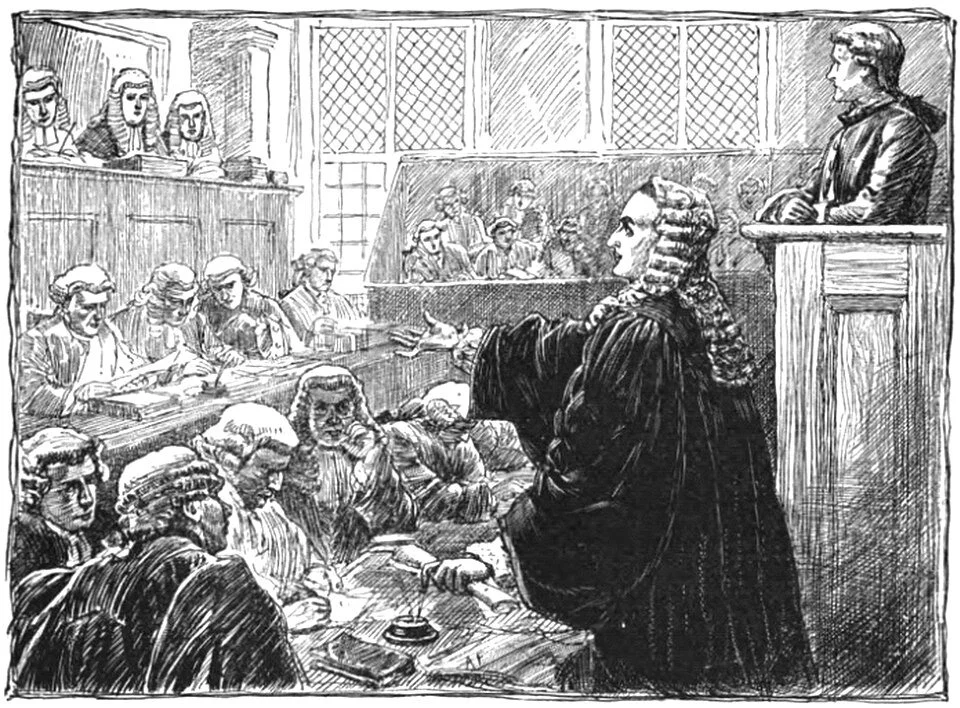
The trial of John Peter Zenger (1734-1735)
Despite the noble efforts of Hamilton and other lawyers of the early republic, there were many historical forces working against the realization of William Penn’s vision for Philadelphia and America at large. Penn’s own sons would trick indigenous leaders into surrendering their land in Northeastern Pennsylvania in the “Walking Purchase” of 1737. Slavery would proliferate throughout the Thirteen Colonies. Philadelphia would become more economically, socially, and racially stratified as it grew in size and influence. A prominent Philadelphia novelist of the early republic named George Lippard wrote about these developments in his 1845 novel The Quaker City, or The Monks of Monk Hall. The novel’s plot is a narrative that could come straight out of the Epstein Files: it follows various Philadelphia elites as they leave their respectable daily lives behind to come together at Monk Hall, an exclusive gentlemen’s club where all the vices and sins of the era are available to those with the wealth and influence to procure them. Eventually, the plot congeals around two murders which occur in parallel and are meant to illustrate the hypocrisy of the standards of fairness held by the Philadelphia elite. In one case, a wealthy man is acquitted after poisoning his wife when he suspects her of carrying on an affair. In the other case, a working-class man is convicted after killing a rich man to avenge the rape of his sister.
Lippard’s conception of American justice as a system of class power was informed by his own experience of destitution on the streets of Philadelphia after the death of his father. In the book’s original introduction, he wrote “I was the only Protector of an Orphan Sister... I knew too well that law of society which makes a virtue of the dishonor of a poor girl, while it justly holds the seduction of a rich man’s child as an infamous crime.” In writing The Quaker City, the 21 year old Lippard initially sought to prove his narrow, rather chauvinistic contention that “If the murderer deserves death by the gallows, then the assassin of chastity and maidenhood is worthy of death by the hands of any man, and in any place.”
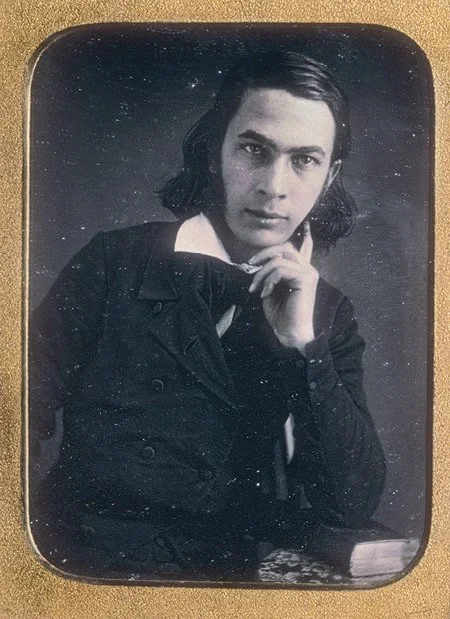
A portrait of George Lippard, 1850s
He would later call his first intention in writing the novel “a sophism that errs on the right side,” because during his years-long writing process, Lippard began to develop a more comprehensive worldview that could explain the fear and suffering he lived with as a young, destitute caregiver. When his mentor at the Attorney General’s office lay on his deathbed, he left his papers to Lippard, detailing numerous crimes in the city which had never been brought to trial. Lippard expanded the scope of the novel to “describe all the phases of a corrupt social system, as manifested in the city of Philadelphia,” exposing not just elite hypocrisy and decadence, but the deleterious effects of industrial capitalist development on William Penn’s holy experiment. However, if the iniquity in Philadelphia was as lurid as Lippard’s writing, there is evidence that the common people of Philadelphia detested it nonetheless. Lippard’s novel was based in part on the true story of a February 10, 1843 murder aboard the Camden-Philadelphia ferry in which, contrary to the outcome of Lippard’s plot, the killer was acquitted on the jury’s belief that his action had been justified by the deceased's misconduct toward his underage sister. While in Lippard's novel injustice against the common folk prevails, in actual Philadelphia, the very populist outrage against the miscarriage of justice that Lippard sought to stoke could sometimes serve as a check against the impunity of the powerful.
II
In the antebellum era, Philadelphia began to develop a reputation as a place where conscientious jurors would take a stand against unjust laws and prosecutorial overreach. In 1851, the people enslaved by the Maryland farmer Edward Gorsuch fled captivity, joining up with a man named William Parker in Christiana, Pennsylvania. Parker was himself an escaped slave, and an advocate of Black self-defense. Parker, other freemen, and the surrounding Quaker farming community sought to serve as a refuge for those escaping the South via the Underground Railroad. Gorsuch, empowered by the Fugitive Slave Act, assembled a posse in Philadelphia and obtained warrants to apprehend the people he had enslaved. But the Underground Railroad had eyes everywhere. A scout followed Gorsuch’s posse and learned where they were going, then rode ahead to warn the freemen in Christiana. Parker and his supporters prepared for a confrontation, arming and barricading themselves in Parker’s house and working with the surrounding community to gather supplies so they could flee if necessary. On September 11, Gorsuch’s posse arrived in Christiana and surrounded Parker’s house.
Deputy Federal Marshall Henry Kline announced his authority to apprehend the escaped slave Nelson Ford. Parker refused to hand Ford over. Tensions rose, and shots were fired. Gorsuch’s son Dickinson urged retreat, but Gorsuch refused. Parker’s reinforcements were already on the way. Before long, 75 to 150 Black freemen and a handful of white townspeople had joined the standoff. Kline assumed that the white onlookers would join his posse in upholding the law. Instead, they told him to leave before blood was shed. Gorsuch felt emboldened to approach the house and confront another of his former slaves, who clubbed him. Both sides exchanged gunfire and before long, Gorsuch was dead and his son was severely injured. The rest of his posse fled, while Christiana’s free Black community frantically packed their bags and sought refuge from retribution in Canada.
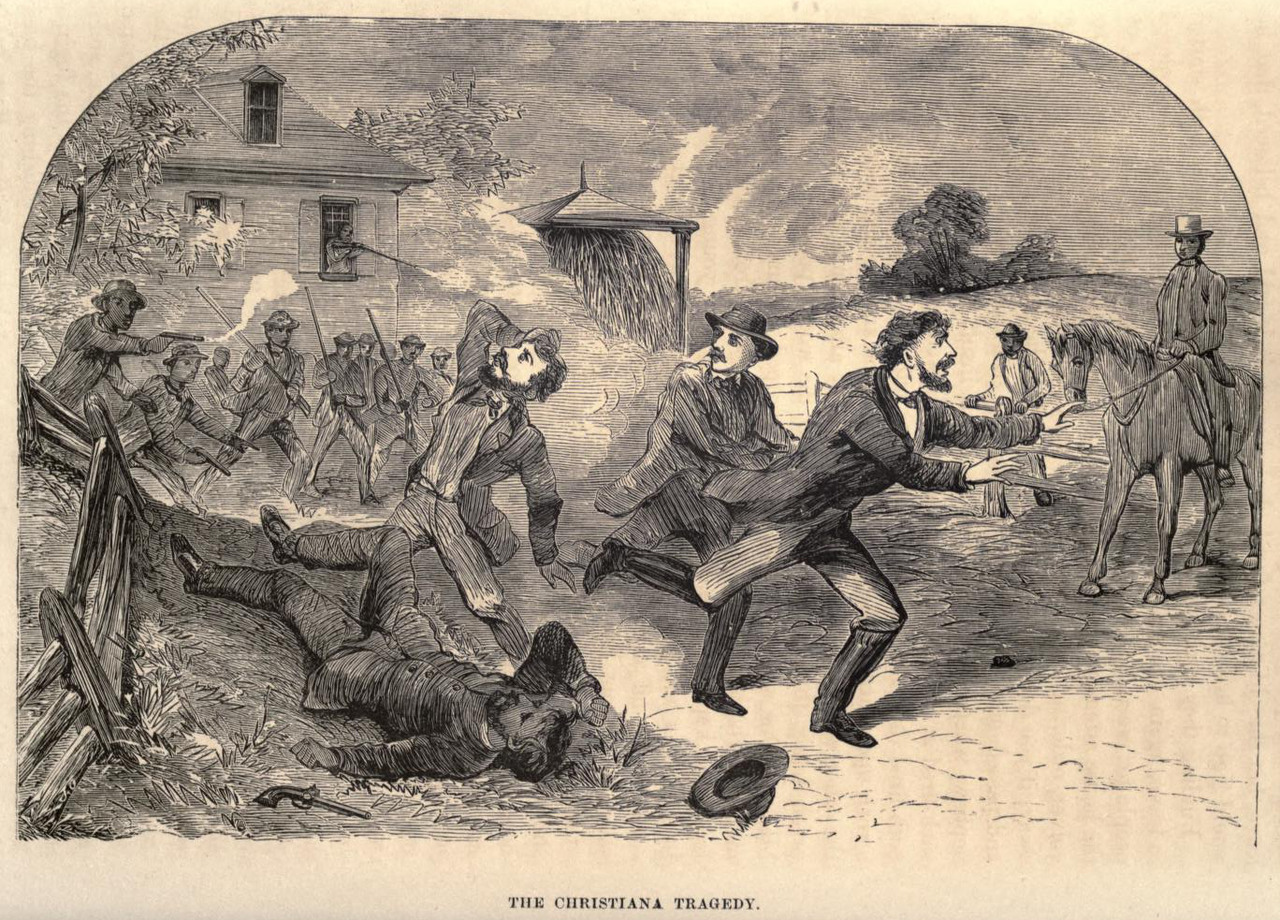
The resistance at Christiana, The Underground Rail Road, William Still (1872)
The resistance at Christiana inflamed passions in the pro-slavery south, and President Millard Fillmore promised swift justice, handing down 41 indictments for treason to be tried in Philadelphia, though many of the freemen who had fled could only be tried in absentia. In the trial, the prosecution portrayed the white defendants as ringleaders of an abolitionist insurrection. The Philadelphia jury, however, would not cooperate. After 15 minutes of deliberation, they returned a not guilty verdict against the Quaker farmer Castner Hanaway, which led the prosecution to drop the remaining charges, fearing they could not win the case.
Philadelphia jurors again supported abolitionists against the enforcement of fugitive slave laws in 1855 when Underground Railroad “conductors” William Still and Passamore Williamson and a group of Black dockworkers arranged for the escape of a woman named Jane Johnson and her children from slavery. Johnson had gone voluntarily on a trip to the north with her enslaver, John Hill Wheeler. Wheeler had been appointed as the U.S. Minister to Nicaragua and wanted to bring the Johnson family with him, but Pennsylvania law did not recognize slavery. Just before Wheeler and the Johnsons embarked on July 18, the abolitionists reached the docks and intervened. They informed Johnson, Wheeler and the crowd that had gathered of Johnson and her children’s right to choose freedom under Pennsylvania law, and hurried them away by coach while restraining Wheeler. Williamson, Still and the dockworkers would soon be put on trial for aiding a fugitive slave, despite the fact that Johnson had not escaped the South as a fugitive. Rather, she had traveled lawfully to a place that did not recognize her enslavement and exercised her right to freedom under state law. The judge who charged the abolitionists, John Kane, dismissed these facts as immaterial and proceeded with Wheeler’s request to prosecute them, provoking a resignation from the clerkship of the court by Kane’s own son. Still and the dockworkers were charged with assault and riot while Williamson, who had a history of feuding with Kane over the issue of slavery, was charged with contempt – as was Judge Kane’s son, Thomas.
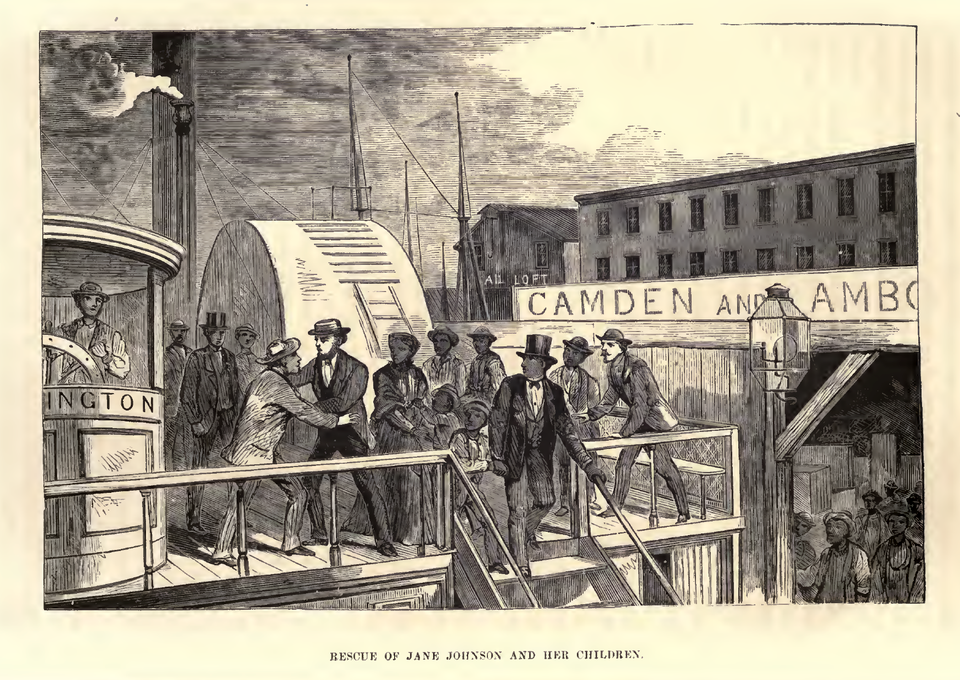
Jane Johnson emancipates herself, The Underground Rail Road, William Still (1872)
The trial of Still and the dockworkers took a turn in favor of the abolitionists on August 29, when a veiled figure approached the witness stand, flanked by several abolitionist women. Jane Johnson had returned from hiding in New York, at great personal risk, to testify that she had not been abducted. She confessed that, although she didn’t expect it in Philadelphia specifically, she had planned to seek her freedom while traveling North. Her testimony led to the acquittal of Still and three of the dockworkers; the remaining two received light sentences, and a court reporter on the scene said that they “would like nothing better than a chance to repeat the offense.” Johnson left the city, pursued by federal marshals, but was aided in her escape by sympathetic local officials. She made her way to Boston, where she and her children lived the rest of their lives in freedom.
III
Almost 100 years after the trials of Philadelphia’s abolitionists, a new contest of values was polarizing domestic and international politics. As the wartime alliance between the United States and the Soviet Union broke down and the countries’ competing international blocs clashed in China and Korea, American politicians led by Senator Joseph McCarthy became increasingly concerned with the influence of communism on the country’s domestic politics and sought to exile real and imagined communist "infiltrators" from public life. McCarthyism persecuted many people who had little or no Communist Party affiliation, but there was in fact a Communist Party in Philadelphia. Philadelphia communists engaged in activities similar to other political groups in the country at the time. They advocated against segregation and for civil rights, organized unions, protested against the Korean War, and sold a daily newspaper, believing that the policies they advocated for were in the best interests of the majority of everyday Americans, who could be won over to their cause. But as tensions with the Soviet Union grew, anti-communist efforts in media and politics kicked into overdrive.
American communists were increasingly viewed as the agents of a hostile foreign power, including by ordinary people. They were blacklisted by employers, expelled from their unions, attacked by vigilantes and surveilled by the FBI. In 1953 and 1954, McCarthy and the House Un-American Activities Committee came to Philadelphia twice, publicly interrogating dozens of people over their affiliations with the Communist Party. Three professors and a research assistant at Jefferson Medical College, a philosophy professor at Temple University, one of the first Black women to work as a city librarian and 32 teachers in the School District of Philadelphia, lost their jobs in the HUAC’s anti-communist witch hunt. On July 30, 1953, the United States government escalated its persecution of Philadelphia’s communists, arresting nine Communist Party leaders and charging them with conspiring to violate the Smith Act of 1940.
The Smith Act was the latest in a series of laws passed in the early 20th Century to address growing concerns over immigration, wartime espionage, anti-war activities and radical ideologies such as anarchism and socialism. The Smith Act set civil and criminal penalties for "anti-government activities" and required all immigrants to register with the government. Immigrants convicted under the Smith Act could be deported. Citizens could be fined and jailed. But the government used these laws to go well beyond the prosecution of bomb-throwing anarchists. During the McCarthy Era, the definition of anti-government activities had expanded to include much more than actual violent acts aimed at revolution by force. Americans were being prosecuted for their mere membership in the Communist Party, an organization engaged exclusively in peaceful civic advocacy. At the time of the arrests in Philadelphia, a major trial of Communist Party leaders had already taken place in New York City. A group of principled lawyers took the case, but much had changed since the days of John Peter Zenger.
The FBI had infiltrated the Communist Party, and the government brought its informants and other paid witnesses to the stand to make claims about the defendants and their beliefs that portrayed them as violent radicals. As with Andrew Hamilton in 1735, the defendants’ lawyers were punished for standing against the state’s case. They were jailed for contempt of court, and several were disbarred. Unlike in the time of Zenger, the public was against the defendants and in favor of a conviction. There would be little chance of a fair verdict, let alone the principled jury nullification that Zenger’s case had inspired. The defendants cynically but correctly believed that their guilty verdict had already been decided and attempted to use the trial to denounce the injustices of capitalism and promote their political positions. In a sense, this was a desperate attempt to repeat the truth defense used so effectively in the Zenger case more than 300 years earlier. But the communists of the 1950s lacked the sympathetic audience that such a defense required.
Given the broader context of the times, it’s no surprise that when the 28-year old Philadelphia defendant Sherman Labovitz heard a loud knock on his door on that sticky summer night in 1953, he feared for the worst. The child of Romanian Jewish immigrants, Labovitz had joined the Communist Party as a youth in part because communists had stood unflinchingly against the rise of fascism when others had minimized or excused it. It had been less than 10 years since the defeat of Hitler in Europe, and Labovitz was among many on the left who worried that the erosion of American civil liberties was the first step toward a Fourth Reich that would repeat of the horrors of Nazism the world had just fought so valiantly and destructively to vanquish. But Philadelphia, living up to its reputation as the Cradle of Liberty, would be the place where the tide would begin to turn on McCarthyist repression.
While Labovitz and his eight co-defendants sat in jail, unable to pay the high bail set to ensure they wouldn’t go free before trial, their wives were turning over every stone in the Philadelphia legal establishment in search of the best possible defense team for their case. Many lawyers feared blacklisting and other negative consequences should they come to the defense of communists, but unlike in other cities, Philadelphia’s unique culture and traditions made it possible for the defendants to secure an all-star legal team. A combination of Philadelphia’s Quaker tradition of tolerance and the ambivalence of its entrenched and comfortable elite toward McCarthyism meant that the pressures isolating communists in other cities were not as pronounced in the City of Brotherly Love.
The renowned Philadelphia lawyer Tom McBride took the lead on the case, assembling a team of clever and ambitious young lawyers who were willing to brave the potential career consequences of representing the unpopular communists. With a scion of Philadelphia’s legal establishment taking the case, many young lawyers who would otherwise have been fearful felt emboldened to stand up for American civil liberties. As the defendants and the lawyers worked together on the case, they began to understand and respect each other more. They unanimously agreed to depart with the existing Communist Party playbook of putting capitalism on trial in the courtroom in order to focus on a defense based in the First Amendment. This was the first Smith Act trial where non-communists defended communists on civil libertarian grounds.
The government’s case depended on the idea that the Communist Party was actively plotting to overthrow the government through “force and violence” so the defense argued that the Communist Party’s view of revolution was no different from that of the Founding Fathers. Communists believe, the defense argued, that the masses have a right to overthrow the government if and only if all peaceful means have been exhausted and a majority of the people support a revolution – the same views held by the patriots of the American Revolution. In his closing remarks, Tom McBride said that “These men are just as solidly based in the Constitution as any citizen in all the land.” He called the idea that the defendants could be sent to prison simply for being communists “one of the most un-American, the most destructive, the most evil doctrines that can enter the mind of a human being.”
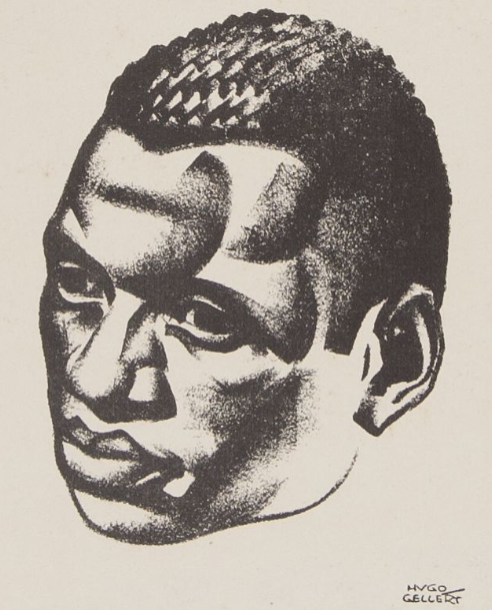
Portrait of Paul Robeson, Hugo Gellert, 1928
Indeed, the doctrine of McCarthyism proved quite destructive in Philadelphia and around the country. Philadelphia’s own Paul Robeson – a generational athletic and artistic talent who held a concert in support of Smith Act defendants in New York – was iced out of his career for decades and never reached the heights he was bound for before his persecution. A city librarian named Marion Stokes, who would later go on to record the most complete archive of television news available to the public, lost her job over her communist affiliations and endured a lifetime of paranoia after being surveilled for her political activities. Despite the efforts of the defense team, in the case of Philadelphia’s nine defendants, the jury returned a guilty verdict. According to Labovitz, August 1954 was “a time for heroic attorneys, but not yet a time for courageous jurors.” The nine men – a poet, a dockworker, a newspaper salesman, and a trade unionist among them – were sent to prison solely for their political beliefs, among more than 100 others around the country.
The reality is that in the 1950s, many of the best, brightest and most justice-minded Americans were communists. America did all its people a disservice by excising them from public life in a country that has often succeeded on the basis of its dynamism and tolerance. In his prepared pre-sentencing remarks, unfortunately never delivered to the court, Labovitz made one last assertion of his innocence: “The politically ambitious prosecutors did not produce one of my neighbors to testify against me,” he said. “Why not? These are the people with whom I live. These are the people who have watched my family grow. These are the people with whose children I played. These are the people who I have tried to influence. These are the people who know I am a communist. Some of my neighbors, I learned recently, addressed themselves to you, Your Honor. ‘Mr. Labovitz is a communist, but Mr. Labovitz is a good man,’ they said. I say to my neighbors and to you, Your Honor, I am a good man because I am a communist.”
Labovitz went on to warn of the serious hazards posed to Americans by his prosecution. “The record in this trial shows how interested our Justice Department is even in the readers of The Worker,” he said, pointing out that the conspiracy charges faced by the defendants could be applied broadly to any dissenter against American policy. “Who, Your Honor, will send to prison every dissenting voice against whom the conspiracy gimmick can be used? Where will they build the new prisons, not to hold thousands, but millions, Your Honor? I have nothing more to say.”
Although the intelligence agencies never quite gave up their plans to round up dissidents in a crisis and continued to use counterinsurgency methods at home and unconscionable force abroad to promote the interests of American capital overseas, the prisons for millions of Americans came only in a more subtle form that postwar communists could not have anticipated. The McCarthy era resulted in much unnecessary hardship, but its high tide resided. This was in part due to the bold stand taken by Philadelphia’s civil society. During the trial, several of the government’s paid witnesses were so badly discredited – from McBride and the defense counsel pointing out inconsistencies in their testimonies – that they could never be used again in a government case. Defense attorneys in Cleveland and California reached out to Philadelphia lawyers to learn from their strategies.
But the harshness of the political climate softened for another reason: a new Supreme Court under Chief Justice Earl Warren reversed many McCarthy-era convictions – including those of the Philadelphia nine – and greatly limited the scope of the Smith Act. Having already dismantled the American radical left, McCarthyism had become a liability. It was too ugly to project a positive image of America in its contest for international legitimacy. The United States would not explicitly adopt the jackbooted thuggery and persecutory paranoia of the Third Reich as its domestic Cold War playbook. Rather, it would use more sophisticated means of bureaucratic management and coercion, refined for a world that had been irrevocably changed by the extreme brutality and technological dynamism of the first half of the century. Prisons for millions would come, in a war on drugs and petty crime, in the ghettos of declining cities, and in many smaller and less perceptible ways, not through a totalitarian crackdown on dissent but through the projection of class power via systems of mass communication and consumption.
Nonetheless, many of Philadelphia’s communists bounced back from their persecution. A number of the teachers fired in 1952 remained lifelong friends, creating mutual aid networks to help each other cope with financial insecurity and the isolation of being persecuted. Fritz Jennings, the president of the communist-aligned teachers union, became a historian of American colonialism. Labovitz quit smoking while in jail, and later became a professor at Stockton University. The youngest of Philadelphia’s Smith Act defendants, he lived until the age of 93, passing away in 2018.
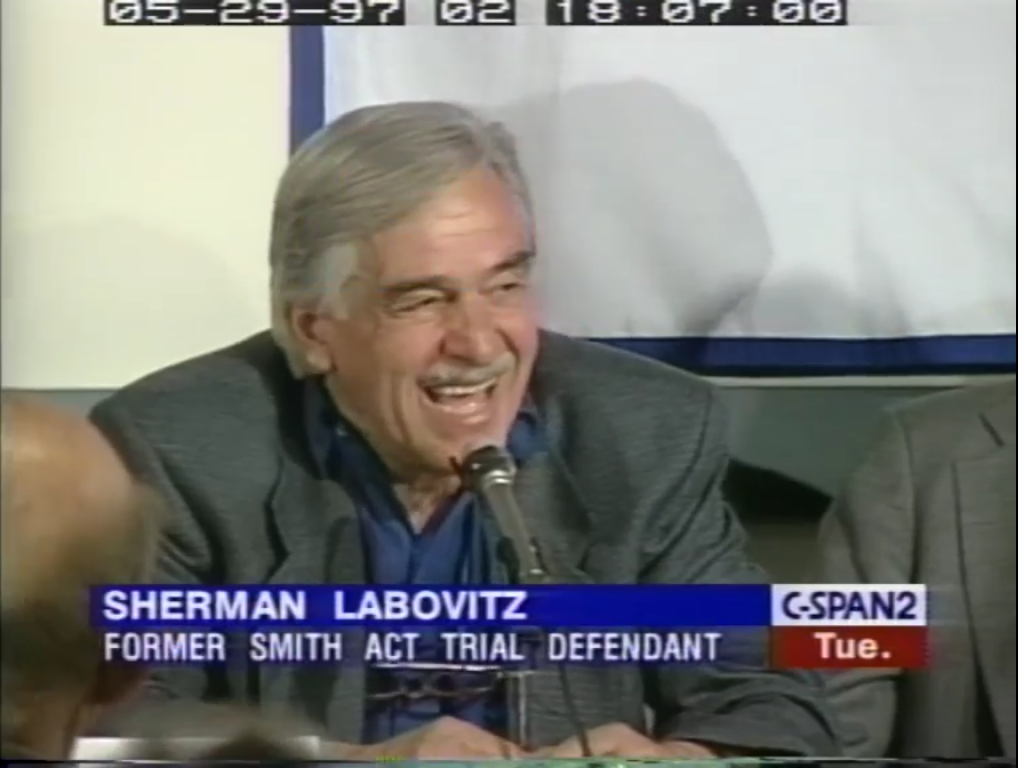
Labovitz on 17 May 1997, C-SPAN panel on the Smith Act Trials
Though he left the Communist Party in 1957, Labovitz, like many communists of his generation, remained a lifelong adherent to the core socialist values of humanism and economic justice. Furthermore, the time for courageous jurors was not far off either. The next generation of activists would see them return. In 1971, when a group of 28 Philadelphia area anti-war activists – led unknowingly by an undercover government informant – broke into the Camden draft board office to destroy military records, a jury nullified the charges against them in protest of the FBI’s underhanded tactics. Two of the defendants in the Camden trial were part of a separate group of Philadelphia collaborators that broke in to the FBI office in sleepy Media, Pennsylvania, stealing files that could prove their suspicions about the FBI’s lawless and unconstitutional infiltration of American left-wing movements. The counter-intelligence programs revealed in later disclosures prompted by the direct action in Media were extensive, exceeding the expectations of the activists who planned the break-in because they had seen surveillance and infiltration in their own lives. The plan to imprison millions that Labovitz predicted would face resistance at every step of the way. Resistance hasn’t always been enough to stop encroachments on American civil liberties, but it has always pulled and will always pull against the forces of tyranny and exploitation. Altogether, what is clear both in Philadelphia’s historic legal victories and in its shameful lapses into persecution and intolerance, is that there is nothing guaranteeing our liberties in America’s historical makeup. Justice and injustice have coexisted in America for as long as America has existed. Maintaining the Cradle of Liberty has been a constant effort that required courageous people in each generation to re-commit to the values that make American justice more fair.
The second in a series on Philadelphia history.