
They’re Lying about Inflation
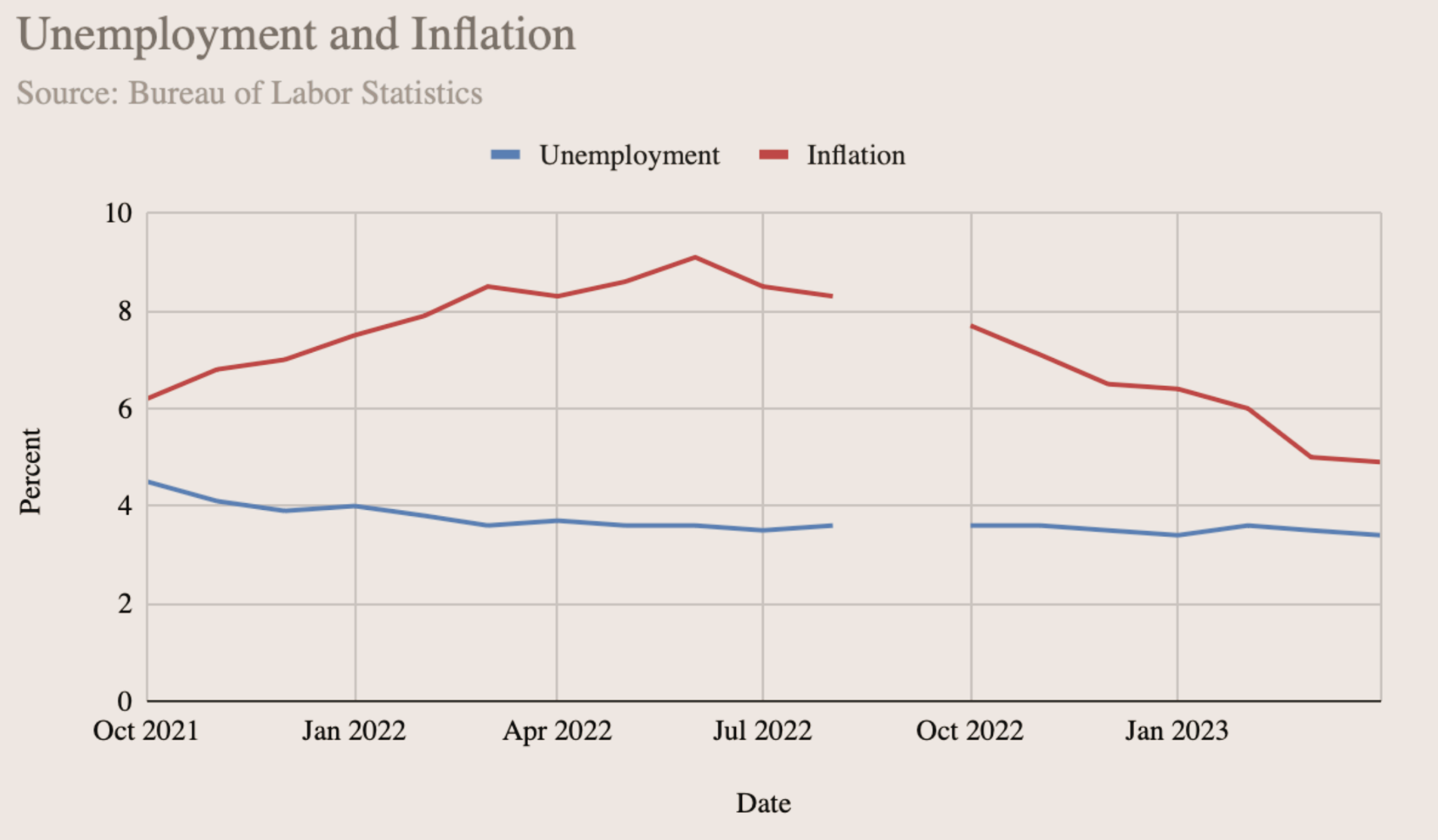
The orthodoxy has failed us when it comes to analyzing inflation. The simplified see-saw, with inflation on one end and unemployment on the other, is a valuable key to understanding inflation, but it’s not the full picture. The stagflation that plagued the 1970s is clear evidence that this dynamic is not consistent. Focusing on employment does not cut it, especially in a situation as unique as a post-pandemic economy. The cause of the pandemic-era inflation was obviously not a glut of employment, as evidenced by the lack of a drastic fall in employment as inflation eased. If you look at the “shape” of the large spike in inflation in June 2022, it isn’t met with an opposite and equal valley of unemployment either, see figure below. So, it’s critical to examine more of the causes of inflation (including supply-side issues and endogenous/institutional factors) to understand the post-pandemic years.
Power structures play a role in how prices are set, how money moves, and how the dynamics of supply and demand are affected. It is not radical to say that the United States is not an unadulterated free market. Government policy and corporate and financial goliaths alter the shape of the economy. Isabella Weber famously, and to the chagrin of enemy of the publication, Paul Krugman, pointed out that the pandemic-era inflation was largely a “seller’s inflation.” She asserts that firms with significant market power are price makers that participate in price hikes when they know their competitors will follow suit. This pseudo “agreement” between firms can be coordinated when shocks like supply bottlenecks occur. Intuitive logic tells us that when supply is restricted (like it was during the height of the pandemic), it does not provide a sufficient foil to demand pressures. The outcome is a rise in prices. This is not the “natural” process neoclassicals may argue it to be. It requires a sort of implicit coordination between high-level firms. The intention is not solely maintenance of the status quo for firms, it is also a gap for opportunistic firms to raise prices higher than necessary to increase profit margins beyond their previous levels. Non-financial corporate sector profits soared during the pandemic while the average American struggled to make ends meet. Exogenous shocks give firms with a large market share a chance to test out their pricing power. These increases reverberate through the rest of the economy. Weber’s assessment is reaffirmed by Hyman Minsky’s work on how the “bigness” of firms allows for increased pricing power.
Minsky claimed that, in addition to the “bigness” of firms, the structural changes in the banking sector have also impacted inflation. The government is not the only institution that creates money, banks (and now, in the modern age, shadow banks) can too in the form of credit-created money. This money is a piece of aggregate demand. Credit-created money is a large part of what underpins aggregate spending (not solely money earned from employment), again attenuating the link between employment and inflation.
Arguably, attributing inflationary pressure to a “too hot” economy or an increase in stimulus as many conservatives claim puts the onus on workers and their supposed unreasonably increased purchasing power post-stimulus, disincentivizes social safety net spending in a time of crisis, makes inflation seem like an amorphous topic, justifies the high unemployment rate as a necessary foil, and takes responsibility off of policymakers which allows for a lazy response. Adjustments of interest rates are a largely fruitless tribute to the idea of slowing inflation.
Inflation is not a simple issue. It must be viewed within the context of both the structure of the economy and current events. Arguably, the COVID-era inflation can be largely attributed to supply shocks and price gouging. When these began to stabilize, inflation rates decreased. Unemployment did not increase in response because high employment creating excess demand was not the issue in the first place.
The ever-increasing trend of solely blaming individuals for the ailing economy allows those in power to pretend there is nothing that can ever be done and sacrifices workers at the altar of capitalist churn. Our present circumstance unveils this dynamic and lends us a valuable opportunity to shift how we view and address inflation, expanding our toolbox from tweaking interest rates and finding a balance within our “see-saw” model to reforming institutional factors, treating issues on the supply-side, and finding alternative approaches to demand management that includes bank-created money.