
Art DiFuria, the Photon Man
Art DiFuria’s music has always been a staple in my life. For ages, I didn’t even know I was tuning in to him in particular. Early Lilys albums, Uptown Bones, Photon Band, the miscellaneous projects in between--I listened to them all but didn’t realize he was the consistent through line.
Me at 6 years old (with a nasty cold) singing a questionable rendition of Photon Band’s “Paper Plane”
He’s ‘90s cool, he’s psychedelic resurgence. Above all, he’s a pleasant guy to talk to:
AD: So we moved, as you know. And with moving I had to thin out my books. Not not that I had to, I'm not speaking with resentment about this. It was an opportunity to thin out my collection of books.
The books were just sitting there on the shelves for fifteen years and then all of a sudden I had to pull them off the shelves, interact with them, evaluate my library, whatever. It established a reconnection for me with some stuff that I had just sort of forgotten was there, hadn't remembered, but that I wanted to read. In the building where I work there's a culture, and I suppose among most literary types, that you buy a book when you're in your twenties and then you just carry it with you until you're like 50 or 60 or retired and then you read it.
This is all a long winded way of saying that when I reshelved the books at our new place, I came across Jude the Obscure and realized I had never read it and was like, “well, what the hell?” Like I'll give the first few pages a try. Immediately upon opening it and reading it, I wanted to read more. And so here I am on page eighty or something of Jude the Obscure. I'm just taking my sweet time.
PT: I think that's good. I mean, I used to be an “I need to devour books” person, an “I'm gonna stay up all night, start to finish, read this fucking book, get it done with” person. I've started to be patient with it, read as far as I can in the twenty minutes of spare time I have. Spend the rest of the next two days digesting that twenty minutes of reading.
I've been reading a lot of Dashiell Hammett lately because it’s totally trashy fiction but it's old trashy fiction so it squares in my head as a sort of middle ground.
AD: No, it's an artifact.
PT: I'm a big mystery person. You know when you've built your identity around one specific thing and you convince yourself that everyone else has as well? Growing up I read all the Nancy Drew books, all the Hardy Boys books, and then all the Agatha Christie books, et cetera.
So in my head I assume everybody approaches everything as if they're a detective. 'Cause I mean, whenever I go out to a doctor's appointment or a walk or go grocery shopping or whatever, and I'll see trash on the ground I’ll say to whoever is with me “we found a clue” and I'll pick up the trash and go through it. People don’t really love when you go through random street trash but I'm like, “there's writing on the back of this receipt. What do you think it could mean? What type of person bought these items? What’s this evidence of?” I don't know. But that's how I approach everything. And I think a lot of people have something like that in their core perception of self.
I approach music like this too– I'll be listening to a song and the chord progression or guitar tone or phrasing will sound a certain way and I need to put all the pieces together. Where did they learn that? What scene were they in? Influences? Whose fingerprints are on this song?
AD: You're so speaking my language. You start with “well which came first?” And then “were they ever in the same region?” Like, “God, they recorded at the same studio.” As an art historian, it's like “this motif in this print is exactly like this motif in this drawing and they're by different artists. How did this happen?”
PT: See now I actually am convinced that everyone thinks of everything like a detective. Everyone. We have a sample size of two, which means I think we can safely extrapolate that to everyone else.
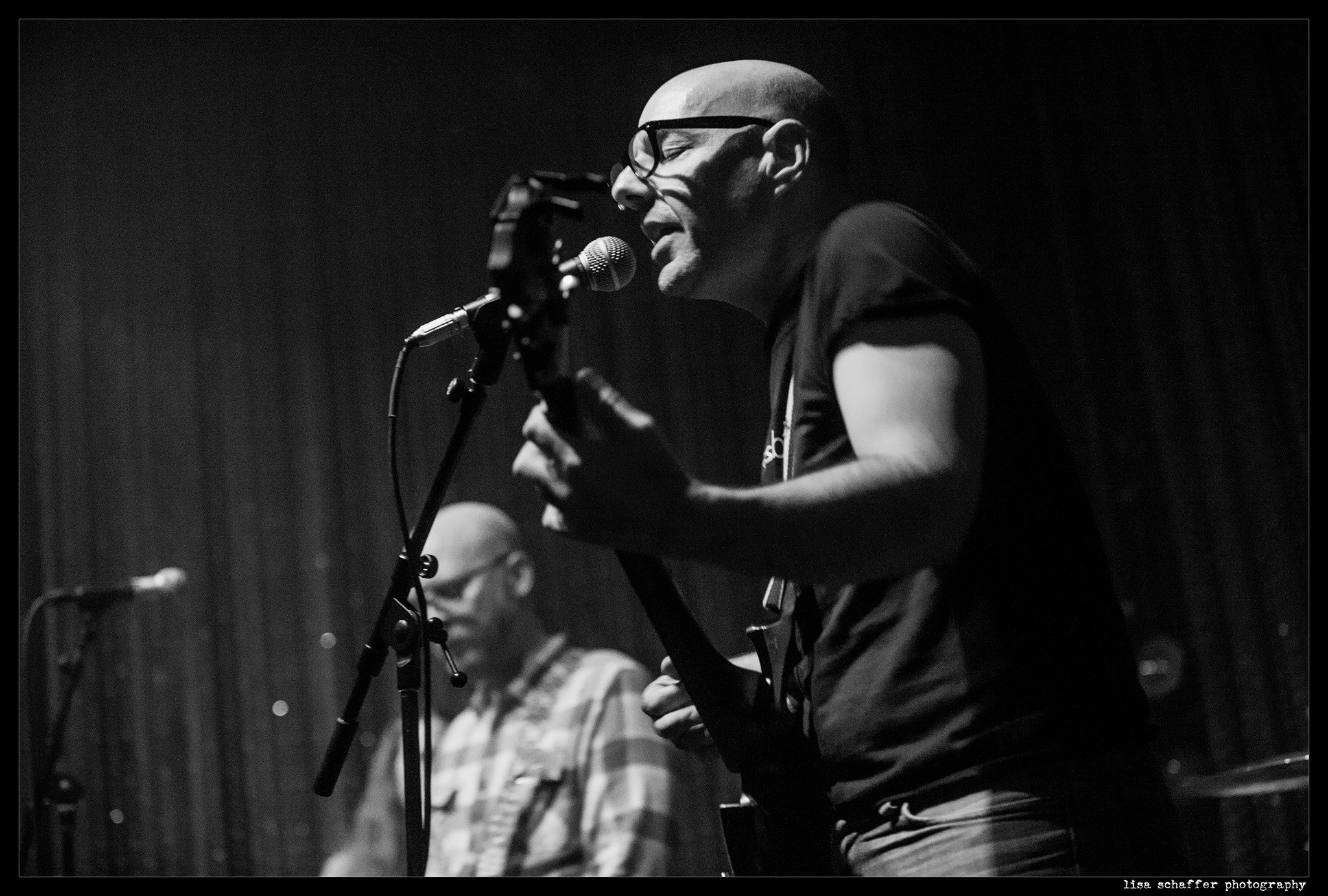
AD: I was pretty busy and didn't even realize it at the time. You know, it's a product of not being able to say no.
PT: People pleaser?
AD: Yeah, but I said no plenty. It mattered to me what Eric and Andy and Charles thought about my decisions. They probably didn't know that, but if somebody asked me to play with them that I thought was cool we were all aligned usually, like, without having to talk about it. And if I received an offer to play with someone that I thought I didn't like, but they did then I still wouldn't do it. But it did matter, you know.
There's a lot of time where it was just like, “this is not a fit for me. These are not my people.” They want me to play bass for them, but I'm not gonna do it because they're not my people. And then sometimes I went out of my comfort zone because the music was good enough.
Playing with Baby Flamehead was way down on the list of people that I would list as being within our sphere. But I didn't care because well, first of all, Dean from The Dead Milkmen was there and he had been super important to me at a much earlier point before I ever met Charles or Eric or Andy or any of those people. When I was in Tons of Nuns, The Dead Milkmen were the first band that sort of championed anything that I had tried to do in Philadelphia. They saw us play and immediately after we were done said, “will you play shows with us?”
PT: You have spanned so many genres, but, also, when I think about you and your career I do think that you've seen art--the art world, music and otherwise--through several distinct lenses. You had your work with The Frizz in Philadelphia, which is more from the production side of things. Then you also were in a million bands, ranging from Uptown Bones stuff to Lilys to Photon Band. Now you're working in academia which rounds out an eclectic perspective. What are you seeing from your point of view right now?
AD: Oh God yeah, the creative economy. This is gonna be an answer to your question but It's gonna be circumspect.
Right now we're doing this series of classes called “research 800” classes, which, in academia, the highest numbered classes are 700-level, so we're sort of, you know, shooting a bit high. In these classes students are meant to put together an insight report that future-casts some aspect of creative production.
Having to sit in a room with an empty whiteboard with the other person that I collaborate with on this and try and think of topics that would be relevant to have an insights report on, it’s hard, right? It has pressed into service all of these pieces of my past: In the nineties trying to record bands, trying to write my own songs, trying to work with other people who were writing songs. Bringing people in to play with that I wasn't sure about, people outside of my comfort zone like I was saying earlier.
But I was also pursuing re-entry back into grad school for art history as early as the Frizz era. I was already making those phone calls because the music world was starting to feel shallow and like I had too many 3 AM drugged out arguments about, like, “which Sonic Youth album is the best album?”
PT: I hate to tell you, it is exactly the same to this day.
It's funny that these stock conversations have kind of stayed the same over time. You’ll go to a house party and be sitting on the porch having a cigarette and there's like three different music arguments that are consistently in rotation wherever you go.
The top one is some guy, inevitably, will go, “yeah, what do you think the first real punk band was?” And he's always just waiting to say the same lame fucking answer of “yeah, I think it was The Stooges ‘cause of ‘I Wanna be your Dog.’” Every single time. I've heard this so often that I’ve started to come up with answers that I know will piss them off. Like, fuck it, “no it’s the New York Dolls” or whatever.
It’s just part of constant scene repetition.
In econ one of the things I studied was the financial instability hypothesis, which is that as a capitalist economy progresses it becomes increasingly more unstable as it becomes more financialized which means you'll have crashes more consistently. So it’s this bubble/bust cycle repeating itself with a tightening timeline. I feel like that's exactly what’s happening with disco. I swear to God, it used to be like every once in a while everyone's like, “hey, remember disco?” Now every six months it’s, “does anyone remember disco? What if we put some in this pop song?”
There's no problem with being referential. It’s just when that happens at a time where artists themselves are a consumable, packaged product. Especially with super large acts who have their music written by committee, it feels like an advertising decision to do on-trend nostalgia-bait.
AD: It's almost like the music is a byproduct.
There were forms of this all throughout creativity's existence, it's like a form of mass codependency where the artist is just sort of othering, instead of just keeping their own side of the street clean by just dealing with whatever inspirations they have and just trying to make shit and put it out there. And who cares if anybody buys it or likes it?
Maintain your integrity in some way. That's why I left music.
There was a point of rupture where I say I left it, but I actually feel like I went closer to it because I left the business side. There was a moment where I was asked to go on tour. It was the most lucrative offer I had received, and it was to go on tour as the sound guy for a band called Brutal Truth.
They were gonna keep me on retainer in between tours and I was gonna have a per diem. They were a band that by all accounts was easy to mix because they sort of mixed themselves and they were nice people. And it was tempting--but it was gonna be half a year out of my time.
Ultimately how we manage our time is how we determine our wellness, not just how much we can produce, but whether or not we're right with ourselves over the course of a twenty-four-hour period. I just didn't know if I could do that on the road. I had already seen myself become too detached from my own creativity. Sitting in the van and, you know, trying to get a piece of that inspiration together so that I could do it later on wasn’t feasible.
I went back in ‘95 to finish my master's degree which I had started and then left because Uptown Bones had a tour booked in the fall of ‘91. I couldn't stay in classes for the master's and quite happily went and pursued that because there was something core and authentic about the four of us and our chemistry. We felt like a real band to me.
PT: I recently got some Uptown Bones stuff on vinyl from Record Grouch in Brooklyn. Shout out Record Grouch. I think the last time I saw you was there actually. For the Hex Enduction Hour release.
AD: Yeah. That was a special day.
PT: But I also just like Sour Candy Suite. I listened to it a lot the summer it came out. When was that?
AD: 2022.
PT: That summer I specifically listened to “Whatamisupposedtodo” a bunch because I put it in my playlist of decision-making songs where every song title was a question. It was right before this Pointed Sticks song, “What Do You Want Me to Do?”
I do this thing with my friends whenever we listen to an album together we go “okay which Beatle is this person's favorite? Can you tell from the music?” It’s a corny and very basic thing to wonder about but I've always thought that you’re probably a Paul.
AD: It's interesting. I'm gonna take a right turn on this question. When Guided by Voices became a thing they would always say Robert Pollard is the John Lennon of Guided by Voices and I never heard that in Pollard's melodies. I always heard Paul. But it just wasn't cool to be labeled as “the Paul” so Bob himself I think pushed the John Lennon thing.
I grew up in a really musical family where I understood “every good boy deserves favor” before I could put a complete sentence together. I understood, just intuitively, melody and harmony and all that. And that's like that's more Paul's domain. The Sour Candy Suite Changes the blueprint for me which was like “this is a pop song venture.” Like the previous albums were songwriting songs where Sour Candy Suite is like, okay, sometimes you've gotta open the windows and let everything fly in and out. And so who cares if the song doesn't have a bridge? Who cares if it lasts for twenty minutes?
PT: Man, hell yeah, I love the nine-minute solo in the middle of it.
AD: And maybe it's not even really a solo, you know? When I played it for JT he was like, “yeah, that's great, but where's the guitar solo?” I was like, “well, I never even really thought about it, but I guess it kinda doesn't have one.” It just has a bunch of noodly tracks but there isn't a, y’know, a fucking solo.
Anyway, yeah I'll admit that there's a lot of Paul you're not wrong.
PT: I hear Paul more than anything else. Not that everything can or should be classified through a Beatles lens, it’s more a silly exercise, “which Beatle did you like as a kid” more or less. And, I mean, as a bassist, Paul is low-hanging fruit.
I grew up steeped in a lot of your music, my folks were always playing your stuff.
Growing up we’d listen to all of the classics, you know, the cultural canon of sorts for music, but we also listened to a lot from the east coast punk and indie scene, especially coming out of Philly. And so as a kid I was like, “yeah, everyone knows Photon Band. Everyone knows Uptown Bones.” It's kinda like my “everyone's a detective” thing. To 7-year-old me these were the biggest bands in the world.
AD: It has taken me the better part of the last five years to disabuse my children of the idea that everyone knows who Photon Band is and then we were in the car not long ago and “Jealousy” was playing on the station on Sirius XM that’s the only one worth listening to and my daughter was like, “see?”
No, you don't understand. That’s probably the first and the last time that either of us will ever hear that song on this radio station.
PT: To close us out I’m gonna ask you a super classic, annoying music interview question: what have you been listening to lately?
AD: So my wife is on a kick, she got into that show called American Routes and discovered that you can stream all of it. And boy, it's such a lesson in the ways in which there's so much great American production. And I have a lot of this stuff in my own collection too. And then it also tells the story, unwittingly, of just how awful capitalism is, how it’s fucked musical creativity in this country. And so four out of every five songs are just agonizingly industry-oriented, so inside the box. It's like a simulacrum of an authentic experience. I don't know any other way to describe it.
So, I've been listening to that and it’s caused me to go back into my collection and find the stuff that I own along those lines and play that and be, like, you know, we're sort of in this dialogue.
Let me back up one more time, sorry. As the dean of the School of Liberal Arts here I'm also in charge of the library, which is you know, that's nice, but I'm also not a librarian. So I very much wanna respect the librarians and their know-how, don't wanna be a bull in a china shop over at the library.
But when they renovated the ground floor, they built a new space that’s a listening lounge for the students. The chief academic officer was like, “look, it's lucky that you're a music guy too, because we need you to, you know, populate this listening lounge with as much vinyl as possible.”
So that's been great. But anyway, it was the fifty-fifth anniversary of the release of What's Going On by Marvin Gay. So I had a listening session where I played a bunch of like isolated tracks for them, you know, the alternate take of the lead vocal which didn't get used and stuff like that. And then we got this beautiful, posh, fluffy, big, fat stereo system installed there and we played the vinyl and just listened to it. And it was so good.
But it's funny you mentioned Stereo Lab earlier because when I first heard the most recent one I thought it was fantastic and kept digging back in and now it almost feels like there were parts to that album that I imagined were there and aren't there for me anymore or something. Like it's not holding up.
PT: Sometimes you deplete the album. Sometimes you listen to an album too many times and you just suck the energy out of it for yourself.
AD: That, wow, that happened really fast and I feel if that happens that's on the album, not me.
PT: Yeah, that's not on you. You're not powerful enough to do that to an album. There had to be something structurally wrong with it.
AD: Yeah, yeah, it's Stereo Lab's fault. I don't know.
PT: No, I was listening to it and it didn’t capture me. If you’re feeling the francophones you should check Family Fodder. They have this one song, “Savoir Faire,” and it's fucking awesome. The rest of their discography is hit or miss. But this one song, it's just so ahead of its time.
Past few months I got a little bit too far on a Frenchy kick and I was like, “I gotta pull myself out. I'm gonna become the worst person at every party.”
AD: You should listen to the Clientele album that has all their early singles. It's called Suburban Light.
They're a little precious. And the further on they get in their lives or their careers, the more precious they become. But in this they're a real band firing on all cylinders.
PT: Have you ever listened to Broadcast? Similar space to Clientele.
AD: I love Broadcast. When I was in Rome doing research, Tender Buttons came out.
PT: I love “I Found the F” on that. That song is killer. The tension is insane. Super eerie but still catchy.
AD: I'll never forget where I was when I first heard that song.
Art performing at the wedding of Eric and Beth of Easy Subcult, R.P.O.T.S, xPOEMSx, and various other projects. Video ripped from a very damaged VHS tape.
Full spread in the 2026 summer print edition of Poison Tree.
Check out his most-recent releases here.