
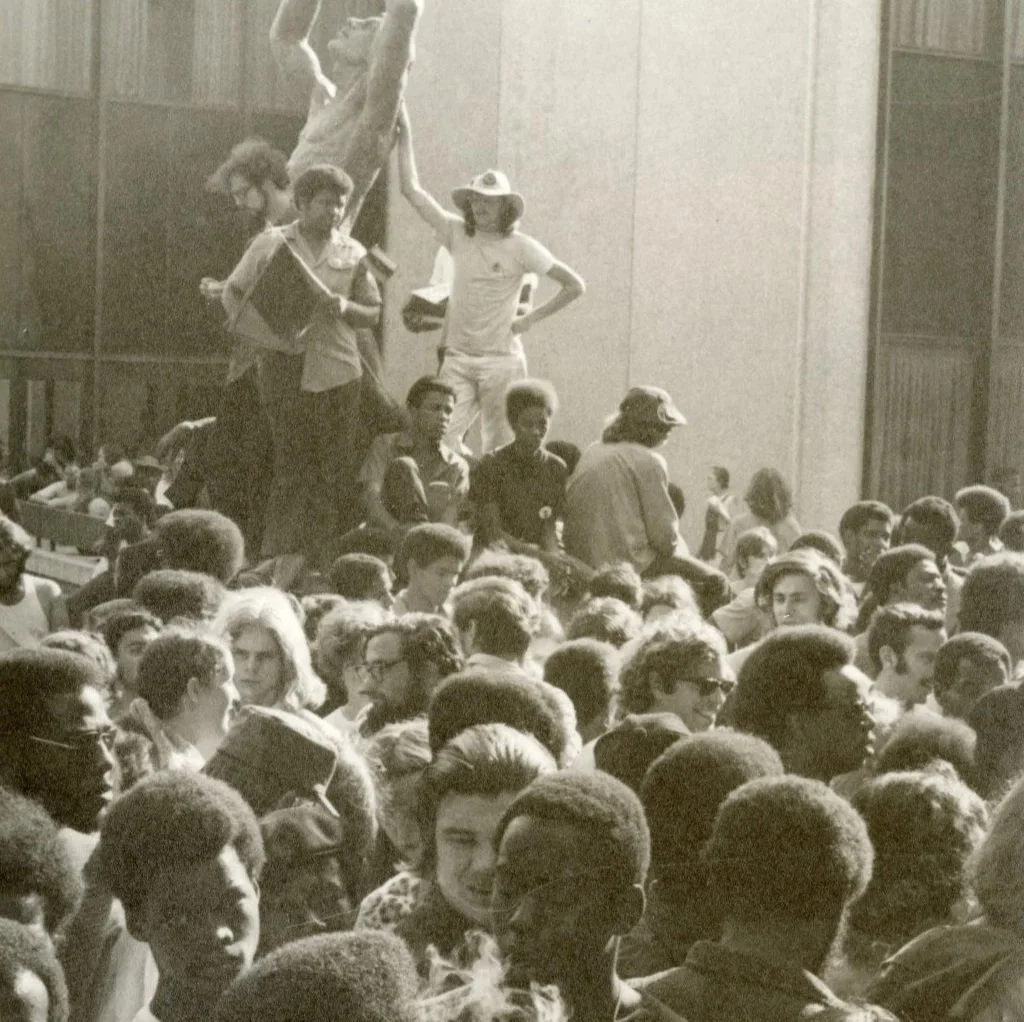
Flags of the New Left raised at McGonigle Hall; Photo by Phil Mayer in Friends Historical Library, Swarthmore College
On a warm autumn day in 1970, unusual flags flew on the flagpole outside Temple University’s McGonigle Hall in North Philadelphia. As a gathering of as many as 15,000 people assembled on the campus, the American flag had been pulled down and the image of a Black Panther prepared to strike flew in its place. The flag of the National Liberation Front of South Vietnam had been draped over a statue. Crowds far larger than anyone expected had come to what was once the cradle of the United States Constitution for the Revolutionary Peoples’ Constitutional Convention (RPCC), intending to write a blueprint for another revolution. The four-day convention was a plenary session, intended to produce a number of statements and declarations that could be compiled into a new constitution and ratified at a second convention in Washington, DC. It was September 5th; 196 years to the day after 56 delegates from 12 of the 13 North American colonies gathered in Carpenters’ Hall for the First Continental Congress.
The Panthers’ Place in History
The date chosen for the RPCC could have been a coincidence — Labor Day weekend is as good a time as any for a mass gathering — but it just as easily could have been intentional. There is no direct confirmation of the Panthers’ intent to align the dates of their congress, but evidence of the importance of history to the Panthers’ program is abundant. The Panthers’ ten-point program invoked the Reconstruction-era promise of 40 acres and a mule; The inaugurating rally of the RPCC was scheduled for Juneteenth, invoking that holiday’s central message — enforcement of the Emancipation Proclamation — by using the Lincoln Memorial as a backdrop. But the Panthers’ grounding in history didn’t start or end with their program, or with actions related to the RPCC. The pages of the party newspaper during the month of the RPCC featured a serialized investigation into the failed 1822 slave revolt of Denmark Vesey. Party co-founder Huey Newton had his political awakening when he immersed himself in a self-directed study of Western political thought and American history — according to his autobiography, he taught himself how to read, then set about learning to think critically with a copy of Plato’s Republic. Eldridge Cleaver, another prominent Panther, assigned a great importance in his thinking to the way that history is understood in the present. In his 1968 memoir, he asserts that the rebellions of the postwar world had shattered the hegemonic historical narrative of Western civilization, creating an opportunity:
“There can be no applause now, not while the master still holds the whip in his hand! Not even the master’s own children can find it possible to applaud him — he cannot even applaud himself! Slave-catchers, slaveowners, murderers, butchers, invaders, oppressors — the white heroes have acquired new names.”
In the years since its founding in 1966, the BPP’s critique and reclamation of history had become an essential part of the awakening in Black America that followed the civil rights movement. Black Power blossomed just as the struggle that had preceded it was cresting its peak and the promise of civil rights progress was being withdrawn; it quickly became the most far-ranging and incisive critique of the existing order, and a profoundly mobilizing force.
In Philadelphia, Black Power preceded the Panthers. 21 year old Muhammad Ahmad (then known as Max Stanford) was well ahead of his time when he founded the Revolutionary Action Movement (RAM) in 1962, a precursor to the Panthers that focused largely on the civil rights era priorities of fighting discrimination in employment and education. Next came the Black Unity Council (BUC), which initially focused on community food drives and brokering truces between rival gangs. Their long-term aspiration was to acquire a building that could be turned into an alternative school and cultural center. Group compositions and affiliations were loose during this renaissance of Black political organizing; committed activists often held memberships in several organizations, while others in the community worked alongside them without affiliating. Organizations regularly merged or became defunct, either consolidating due to mutual goals or disbanding in attempts to evade state repression. By 1970, several of Philadelphia’s Black Power organizations were under the Panther umbrella to some degree or another. And the vast majority of work performed by the Philly Panthers in those days — even moreso than other branches — was not gun-toting bids at revolution, but community service. The Panthers played the role of open-ended neighborhood problem solvers, lobbying the city for services, pressuring employers, assisting with pregnancies, protecting tenants, and more.
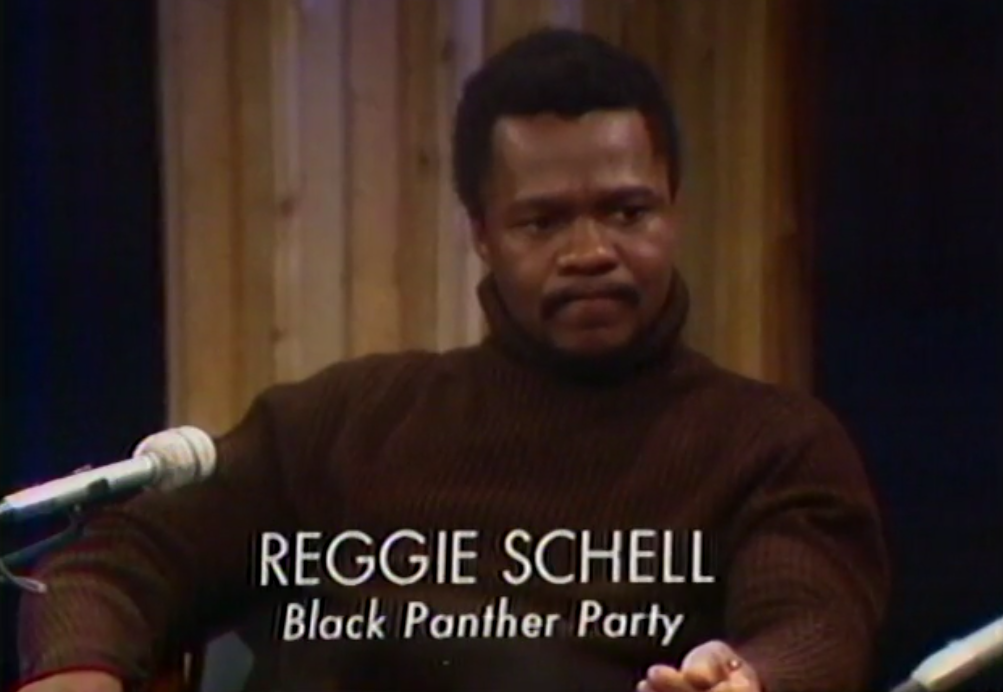
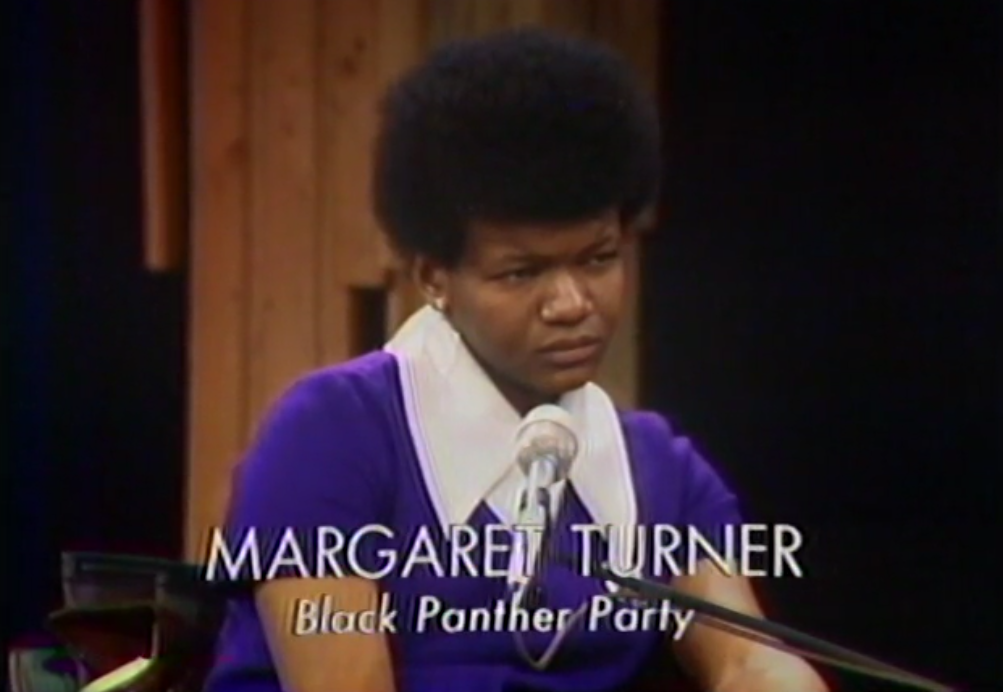
Astute Panthers may have been aware that they found themselves in a similar position in 1970 to the one that the Patriots of 1774 were in when they called their first congress. They were the advanced guard of a popular mass movement, aligned with the international spirit of its times, making great strides toward a change in society, but they were not in power and had not yet won the revolution that they hoped would bring them there. The Panthers were, in fact, quite far from power. They were in a state of siege. The FBI’s counterintelligence programs had begun to target them more heavily than any other domestic organization. Though the existence of COINTELPRO would not become provably known until it was exposed by Philadelphia-area activists in 1971, Philly Panthers would have been ambiently aware of the designs on them by authorities. They knew that 21 year old Fred Hampton — whose Rainbow Coalition had served as a model for the sort of cosmopolitan solidarity that the Panthers hoped to pursue in Philadelphia — was assassinated by the Chicago police less than a year prior. They knew that indictments were coming down around the country. Panther newspapers contemporaneous with the convention feature coverage of trials against members in New York, New Haven, Los Angeles and elsewhere. Philadelphia organizers had not yet been hit with similar repression, but could anticipate it coming. Though they did not want to give up on their above-ground organizing, Philadelphia’s Panthers, groups like the BUC, and ordinary community organizers began to acquire the means to defend themselves in a war that was already being waged against them.
It was not just politically motivated attacks against Panthers in other cities that pushed Philadelphia organizers to prepare for an armed confrontation. Philadelphia’s police department, under its notoriously brutal and authoritarian chief Frank Rizzo, had long been engaging in what could plausibly be called a form of irregular warfare against the city’s Black population, and anyone else he saw as a threat to polite society. Rizzo saw himself and his police department as the only thing maintaining public order and holding back the chaos of a society changing more rapidly than many could keep pace with. But Rizzo’s version of law and order was far from pure legalism — in Rizzo’s bigoted worldview, dissidents, deviants and petty criminals were cut from the same cloth of moral decay; they all merged together in his mind until every dissident became a deviant criminal. On live TV, he bragged about having the names of 18,000 local activists on file. The continued hegemony of the dominant society was so self-evidently important to them that for men like Rizzo, any means necessary for its preservation were justified. In at least two separate points in his career, he publicly promised to use policing tactics that would “make Attila the Hun look like a faggot.”
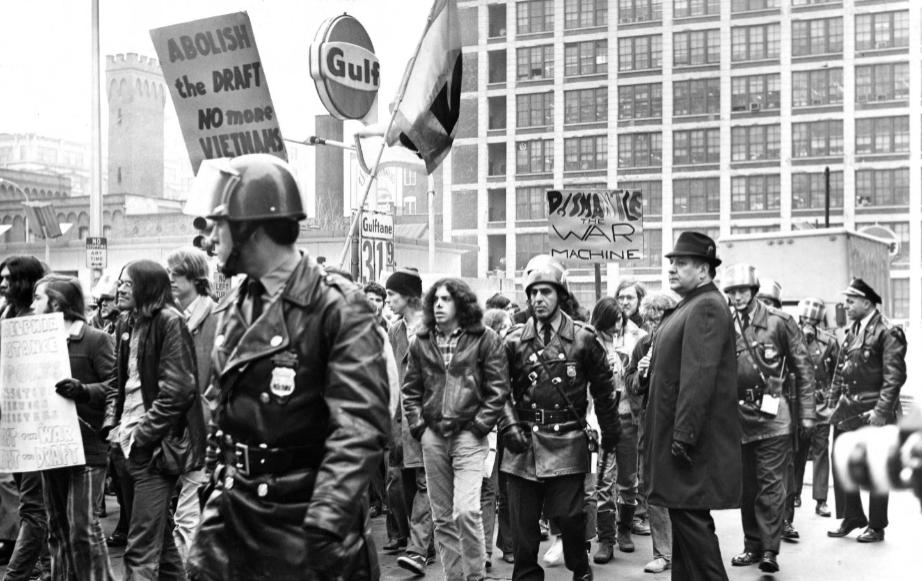
Rizzo looks on as police corral an anti-war march in 1970; Photo by Dominic Ligato, Temple Urban Archives
His officers tossed long-hairs out of Rittenhouse Square, cracked down on gay “cruising” by banning left-turns on certain blocks from midnight to 5 AM, lined the streets outside Girard College with a thousand officers in response to protests against its segregated educational program, and routinely beat and tortured detainees within the walls of the police headquarters downtown. “Bozo” Rizzo’s “boars,” as Huey Newton called them, worked hand-in-glove with pimps, bookies, after-hours club owners and organized crime networks; a 1974 investigation found more than 400 officers of all ranks receiving kickbacks in the form of cash, meals, and even sexual services. Altogether, Rizzo embodied a law and order ethos rife with paranoia and common to his era, which protected but did not bind its enforcers and beneficiaries, while binding but not protecting anyone outside the American mainstream.
But the worst of Rizzo’s brutality was being directed at young Black men. In his posthumously published memoir, Black Unity Council member Russell Schoatz recalls an incident, probably in 1968 or 1969, when the police chased a boy into his own home and shot him in front of his mother, as the reason why the BUC first decided to arm itself. At the beginning of 1970, Philadelphia had seen another rash of police killings. Fifteen-year-old Robert Clark was shot in the back in January 1970 during a traffic stop; not even a month later, seventeen-year-old trumpet player Harold Brown was pulled from the passenger seat of a car after a high-speed chase and beaten to death. But there were even more victims of police brutality in Philadelphia whose names have been lost to history; in a May 1970 TV segment, Philly Panther captain Reggie Schell puts the number of people killed locally by police in recent years at five or six.
The police were murdering Panthers in other cities and teenagers next door with impunity, and it made Philadelphia organizers’ avoidance of direct confrontation increasingly untenable. Schoatz says that once the RPCC had been announced, he and other local organizers began to receive insinuations from the Panthers’ national leadership that Philadelphia’s Black militants would need to do something that would demonstrate to Rizzo that any attack on or sabotage of the Panther leaders who planned to attend the convention would come at a high cost. But the high cost of militant confrontation would prove two-sided. Events in the final week of August would lead to a crackdown that exemplified Rizzo’s law and order lawlessness and terrorized Philadelphia’s Black neighborhoods.
The Blood of Tyrants?
On August 29, a group of boys returning from basketball practice saw a man flag down a police patrol vehicle in Cobbs Creek Park. Hearing gunshots in the dark, they rushed toward the guard house near 63rd and Catherine Streets staffed by veteran park police officer Frank Von Colln, who sent two other park policemen to investigate the danger that the boys had warned them of. When those patrolmen approached the emergency van that had been flagged down, they found officer Joseph Harrington badly wounded, having been shot twice in the jaw. They managed to return fire at a suspected assailant, who ran away into the dark. Shortly after, Von Colln was shot five times at the desk of his guard house. The boys who had witnessed the initial gunfire were found huddled together in terror in a side room of the shack, while Von Colln had collapsed next to his desk, and died.
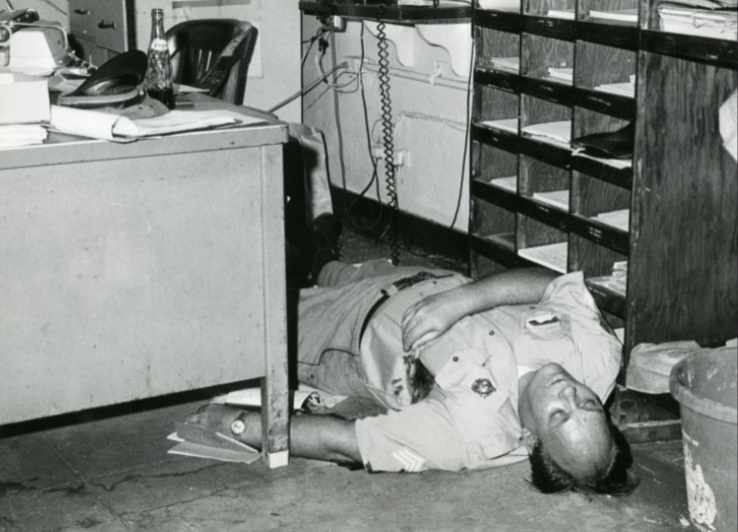
Frank Von Colln’s last watch; Photo by Robert L. Fox, Temple Urban Archives
The time and place for armed action was hotly debated within the Panthers and the broader movement. if not undertaken with great caution and discretion, it could be dangerous, reckless even. It could give the authorities the pretext they need to crack down on lawful political activity, and could isolate militants from the mass support they rely on to survive on hostile terrain. Schoatz recalls the moment in the late 60s when the BUC decided to prepare for armed struggle. After several of its members had seen that young boy murdered by a cop in his own home, his mother, in the throes of her grief, had attacked her son’s killer with a kitchen knife before being subdued. The entire neighborhood watched helplessly, incandescent with rage, as the boy’s body was dumped on the sidewalk while the officer was treated for his minor wounds. And yet, according to Schoatz, the women of the BUC, many being mothers themselves, opposed the group’s turn towards a paramilitary trajectory: “Nothing, not even the gift of hindsight, can tell me whether or not we made the right move,” he wrote, “All I can say is that it was a decision taken exclusively by the men.” But for the Panthers and their sympathizers, the question of armed struggle was moreso a tactical question than a moral one. In addressing the murder of Von Colln one Philadelphia-based alt-weekly called The Plain Dealer, true to its name, did not mince words:
“The white racist mentality finds the death of [Von Colln] ‘senseless’ but sees the murder of Harold Brown as ‘normal.’ That’s because racism transforms the reality of Black oppression and white power into a self-serving fantasy of Black criminality and white innocence. Sgt Frank’s death was not senseless or irrational. The police force is not an odd collection of good guys and bad guys... it’s a colonial army. To people who are daily victimized by that army there can be no good guys. Maybe Sgt Frank was a good family man, but he signed up for a hitch with the oppressor nevertheless. Maybe he could have changed and we should mourn that he didn’t. But Black people won’t wait in bondage on the slim chance that the oppressor will humanize himself.”
With respect to this position, the Panthers were no different from the Patriots of the first American Revolution who themselves enacted vicious punishments, even tarring and feathering Loyalist officials when given the chance. Across nearly 200 years, these revolutionaries — who would have agreed on little else — all believed that with the backing of the masses and when all peaceful means have been exhausted, the tree of liberty must from time to time be watered with the blood of tyrants.
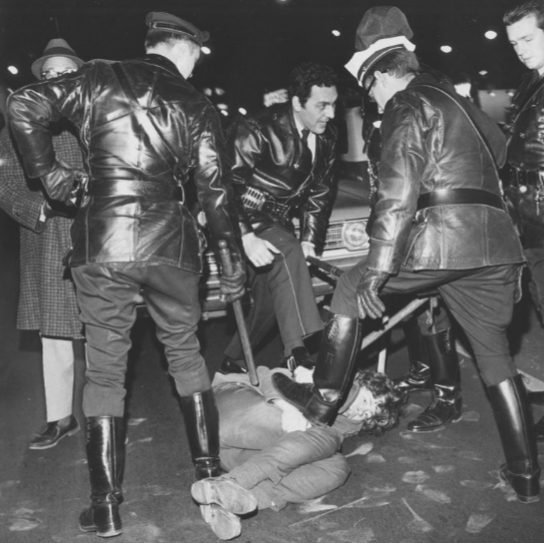
Police beat up a Yippie, February 1970; Photo by Salvatore C. DiMarco Jr., Temple Urban Archives
The final weekend of August 1970 saw the highest concentration of violence against police officers in Philadelphia’s history, with several other officers wounded in gunfire incidents around the city. Mystery swirls around the many versions of the story of that bloody week that are told today, and wrapping one’s head around a coherent version of events is very challenging despite decades of hindsight. What is known today is that six members of the BUC — Russell Schoatz, Hugh S. Williams, Robert and Alvin Joyner, Fred Burton and Richard Thomas were charged with the killing of a man who was shot only five times. Williams was arrested near the scene, and police brought his wife to the station for questioning. She was separated from her children and held for sixteen hours, forced to make a confession while she could hear her husband being beaten in another room. After Mrs. Williams was forced to give convincing names, Hugh’s associates were hunted down. The Joyners were arrested within days; Burton surrendered after a month, and Schoatz remained in hiding until 1972. Those five men were convicted of Von Colln’s murder, while Thomas remained underground until 1996, and was acquitted. Court records show that the felony-murder rule — whereby anyone associated with a murderer can be convicted as if they pulled the trigger, so long as a jury is convinced they had some role in or knowledge of it — was essential to several prosecution cases.
Details about the officers wounded in subsequent incidents are even less clear. The number of police casualties in the last week of August is most commonly listed as six or seven — that number includes Von Colln and Harrington, and some sources refer also to three others wounded on August 31st as a part of that count. Some modern retellings of that weekend claim that two highway patrolmen were shot in Cobbs Creek on the 29th while investigating Von Colln’s murder, but contemporary press accounts do not corroborate this. This is likely a misinterpretation of the wounding of two officers on that day — Thomas Gibbons Jr and John Nolen — who were shot in pursuit of petty criminals with no political affiliations. However, Schoatz also claims that a separate attack occurred. One countercultural paper said that a cop may have injured himself when his gun went off during an argument with his girlfriend.
When Von Colln’s body was not yet cold, even less was known about the situation, and this atmosphere of ambiguity favored Rizzo, described in Shoatz’s memoir as “a man who believed not in the divine right of kings, but in the divine right of cops.” The king’s version of history here serves the king well: the six suspects in the Cobbs Creek attack had intended to attract some number of cops to the guard house and blow it up, and each subsequent incident in late August in which a cop was wounded was linked to the activities of Black guerillas. This version of events gave Rizzo the pretext he needed to declare that he was fighting an insurrection and enact collective punishment throughout the city. Rizzo deployed hundreds of officers into the city’s Black neighborhoods. Armed with long guns and quite possibly sporting their signature leather jackets and stormtrooper helmets, they unleashed Gestapo tactics indiscriminately, lashing out in a paranoid rage. They turned over every stone, and each new discovery was seized upon as further confirmation of what they had already declared. Shoatz details the “strange and unlikely arsenal” the police found while rampaging from Cobbs Creek to Tasker and Sharswood:
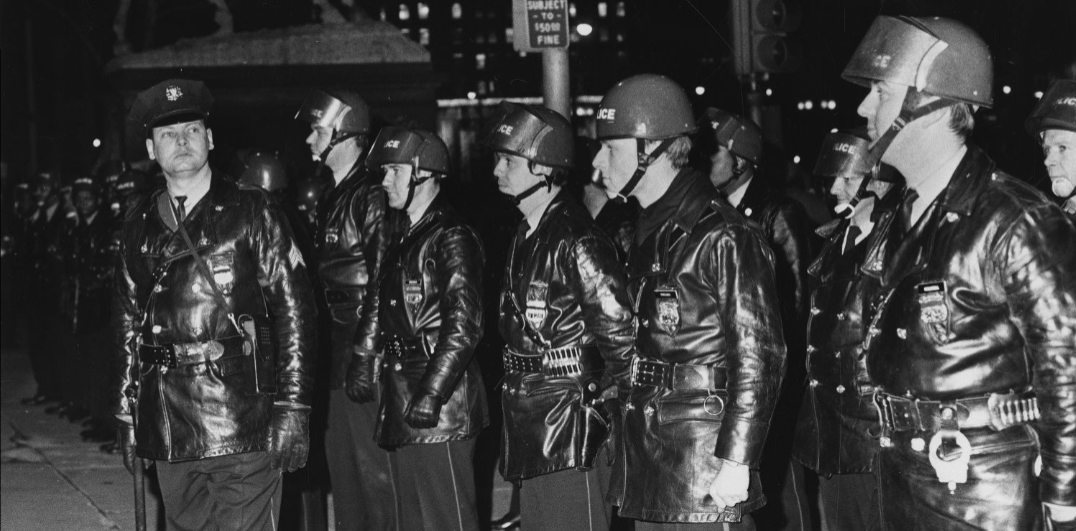
Philadelphia police in riot gear, 1970; Philadelphia Evening Bulletin, Temple Urban Archives
“a loaded six-shot .22-caliber revolver concealed in a brown paper bag; a foreign-made 7.65- mm automatic revolver wrapped in a pair of trousers tossed by the side of Cobbs Creek Parkway. In a respectable home on Fifty-Sixth Street and Osage Avenue, a loaded .30-30 rifle, boxes of ammunition, and three hand grenades; a fourth grenade, identical to the others, lying in a car parked on Market Street. On their hands and knees underneath another parked car a few streets down, police found a plastic bag holding a .32-caliber automatic pistol, a cartridge belt full of bullets, and yet another live fragmentation hand grenade. Upturning a large shaving kit on his desk, an unsuspecting officer was confronted with a loaded .38-caliber revolver and a live grenade with a string attached to the pin. As the police fanned out across Philadelphia, they came upon suitcases containing a pound of C-4 and an M-16 army rifle, and other suitcases holding a .45-caliber Colt, a .36-caliber cap and ball, a .38-caliber revolver, and a .38-caliber Brazilian pistol.”
Thanks to their extensive surveillance and infiltration practices, the police must have known before they started looking that they would find people in the ghettoes of peripheral Philadelphia who were armed to the teeth with Vietnam-era implements, prepared to defend themselves and no longer willing to rely on the conscience of their oppressor. In the mind of a paranoid strongman cop, anyone who could be tied to this network for liberation was as guilty of the murder of Von Colln as whomever it was that had actually pulled the trigger. The evidence connecting these miscellaneous weapons to the suspected insurgents was flimsy, and the precedent of police conduct in a 1969 raid on Philadelphia labor activists suggests that some of the discovered explosives may have even been planted by the police. But details don’t matter to a boar on a rampage. On August 31, Rizzo ordered simultaneous, violent pre-dawn raids on the Panthers’ offices throughout the city. The Panthers could foresee that this crackdown was coming, and made the necessary preparations. They sandbagged their windows and took aim at the backs of their doors, readying themselves to reply to the battering at their hinges with gunfire.
In their West Philadelphia office at 3625 Wallace Street, party members held off police snipers and raiding parties for a half hour, until the building was saturated with tear gas, then surrendered to protect the health of a pregnant upstairs neighbor. At 2935 Columbia (now Cecil B. Moore) Avenue, Panthers returned fire against the police for an hour, with a helicopter circling overhead, until they too were overwhelmed by tear gas. Their shots from the second floor staircase added three to the weekend’s count of wounded officers. The crowd of neighbors that had gathered in protest of the brutality may have been the only thing that saved the cornered revolutionaries from the worst possible retaliatory excesses. Some of the cops entered and looted the office, while others fired “warning” shots dangerously close to their adversaries, who had already yielded. Then, having tipped off the media to the raids before they happened, Rizzo ordered the surrendered Panthers strip-searched in the presence of news cameras, boasting that images of the “big, bad Panthers with their pants down” would soon be in newspapers across the country.
This act of state-backed public humiliation, paired with the destruction of the Panthers’ physical presence in the city, went some way toward fulfilling its purpose of inflicting terror on convention organizers and attendees, but it was ultimately not enough to prevent the gathering. Although the raid left the Panthers with only a week to pick up the pieces of their shattered offices while navigating the trumped up charges against their members, a week was enough time for a federal judge to intervene, issuing an injunction forbidding the Philadelphia police from infringing on the free assembly of convention-goers. Arguably, the brazen display of unrestrained brutality backfired, provoking both an institutional outcry that hamstrung the police and forced them to drop the frivolous charges against the uninvolved Panthers, as well as a grassroots outcry that boosted attendance among many progressive elements in society.
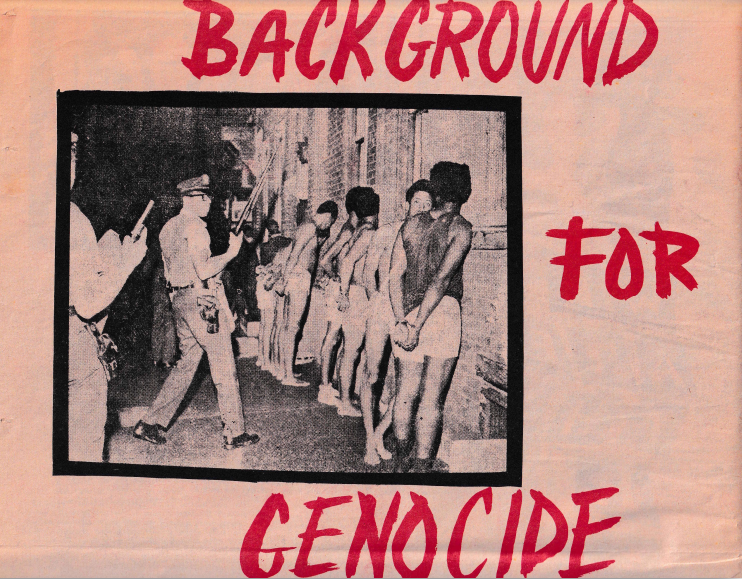
Background for Genocide; Philadelphia Plain Dealer
In 1774, news of the Continental Congress circulated alongside reports of British injustices in underground letter-writing networks called Committees of Correspondence. In 1970, the New Left’s underground press played much the same role. The Plain Dealer plastered the photo of police holding guns over defenseless young men on its back page, with the caption Background for Genocide. “Sixteen brothers and sisters were taken to the pigs headquarters at 8th and Race with the charges being: assault with intent to kill, conspiracy and possession of deadly weapons,” The Plain Dealer wrote, “The real charges, though, are obvious. These sixteen men and women are members of a revolutionary organization who are trying to destroy the machinery in America that has wantonly oppressed people for hundreds of years.”
The Black Panther connected the photo to the legacy of slavery, and the analogy needed little explanation on the streets of North and West Philadelphia, where ordinary members of the community took the initiative to repair and re-open the Panther offices without permission. Meanwhile in white America, there were many young people — gay men, pot-smoking hippies, savvy students — who fell outside the lines of conformity enforced at the end of a nightstick in 20th Century America. They saw their own oppression — or simply injustice toward others that they could not countenance — in the image of those scared, humiliated young men. It was exactly the Boston Massacre that this incipient revolutionary convention needed to bring the ranks of a fed-up nation to McGonigle Hall.
Steel Forged in Water
Historian and RPCC participant George Katsiaficas explains that due to the tone set by Rizzo’s raids, “tension and anxiety were the companions of everyone contemplating the trip to Philadelphia.” It was not just recent events in Philly that had raised political tensions and given prospective attendees a reason to fear for the worst. The period from May to September of 1970 was a time of intense political turmoil that threatened the entire socioeconomic structure of the United States as several of the nation’s major protest currents converged on a summer of action.
The Philadelphia area, as elsewhere in the nation, saw massive mobilizations against the Vietnam War in 1970. A nationwide student strike in protest of the war’s expansion into Cambodia was organized for May 1st. Things began quietly in Philly. On the first day of the strike, an M48 tank belonging to the National Guard broke down on North Broad Street, attracting a swarm of Temple students who decorated it with flowers and anti-war slogans before being chased away by the police. But only a few days after the strike began, with hundreds of universities and hundreds of thousands of students participating, it was met with a gruesome response. The Ohio National Guard opened fire on a student march at Kent State. Organizers in Philadelphia received the news of the four dead during one of their own rallies, and quickly organized a response. That evening, 16,000 students and other opponents of the war joined together in a march on Independence Hall. On May 8th, demonstrators marched across the Ben Franklin Bridge, closing it to traffic. The following week, killings during violent crackdowns against Black protestors in the South, first in Augusta, Georgia and then at Jackson State, further heightened tensions and brought Black and anti-war students closer together through the shared blood of their martyrs.
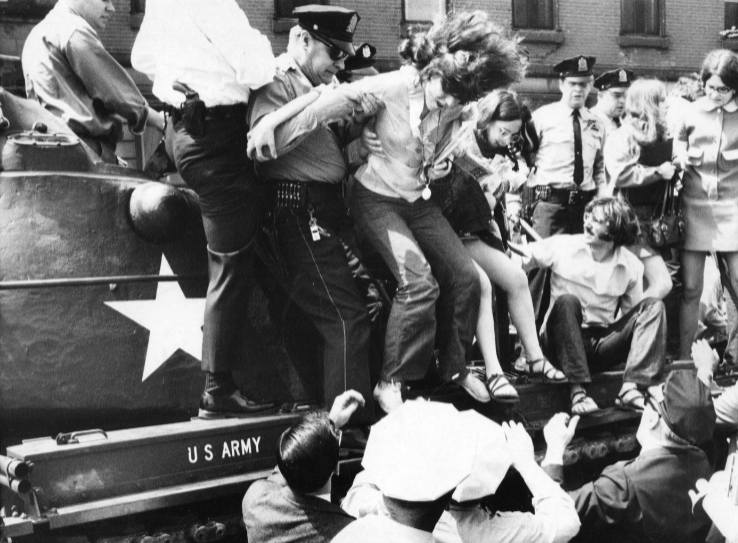
Police clear demonstrators from a National Guard tank, May 1970; Philadelphia Evening Bulletin, Temple Digital Collections
Altogether, more than 100 protestors were killed or injured nationwide in the month of May, and more than 2,000 were arrested. With the academic year ending in bloodshed, a handful of dogged fighters against racism and militarism escalated their attacks, spurred to act by the state’s escalation. At least 169 instances of arson and 95 bombings took place on campuses before the end of the school year. At the same time, revolt poured forth from new segments of society. On the anniversary of the 1969 Stonewall Riot in late June, the first gay pride marches took place in New York, Chicago, Los Angeles and San Francisco. A Philadelphia chapter of the Gay Liberation Front had recently been formed. It had held a fundraising dance at Temple and was organizing sit-ins in Rittenhouse Square, asserting the right of its members to be gay in public through group self-defense against gay-bashing assailants. Because organizers wanted to strengthen the march on Christopher Street in New York instead, Philadelphia would not see a pride march in 1970, but the Annual Reminder pickets held in each July 4th outside Independence Hall from 1965 until 1969 were some of the earliest LGBT demonstrations in the country and contributed significantly to the growth of a movement that could hold its own against police repression at Stonewall.
Also underway was an unprecedented anti-war rebellion within the ranks of the US military. Discontent against the war among the soldiers expected to fight it had been brewing for years, and reached its apex alongside the various domestic struggles that hoped to converge around a second American Revolution. In Vietnam, entire companies wore black armbands and refused orders in support of the peace movement at home. As morale worsened, more than 65,000 soldiers deserted while others sabotaged or hijacked military equipment. The most severely disillusioned soldiers even “fragged” their commanding officers, with more than 200 friendly fire deaths of officers reported in 1970. On July 4th, a thousand infantrymen stationed in West Germany assembled in protest of the persecution of Panther leader Bobby Seale. The GI rebellion made its way to the Philadelphia region when Vietnam Veterans Against the War — an organization which had doubled in size in 1970 — held a four day anti-war march called Operation RAW (Rapid American Withdrawal) in Valley Forge over Labor Day weekend, simultaneously with the RPCC. The GI marchers were through with the timid, bespoke foreign policy formulations of earlier moderate opponents of the war. A pamphlet handed by marchers to onlookers in Solebury, Pennsylvania captured the genocidal nature of America’s war machine in a way that only those who had seen it with nothing to hide their illusions behind could:
“A U.S. infantry company has just come through here. If you had been Vietnamese, we might have burned your house, shot you and your dog, raped your wife and daughter, burned the town and tortured its citizens.”
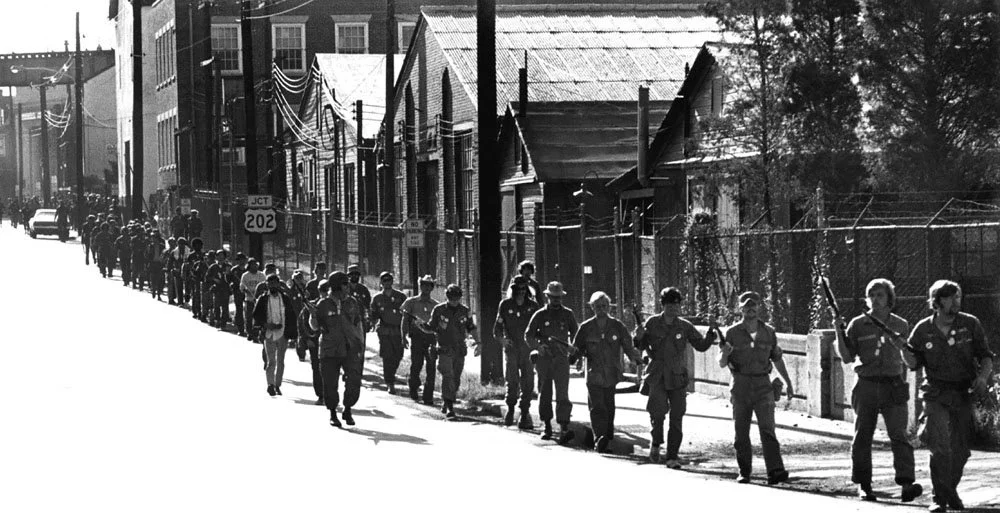
Operation RAW, September 1970; Vietnam Veterans Against the War
Meanwhile the Black Power movement was finding itself a part of a global emergence — at the best of times, a coalition — of anti-colonial, anti-racist and anti-militarist movements, each applying the defining characteristics of 20th Century left aspirations to their specific context. In Philadelphia, this emergence was in its infancy in some of the city’s other ethnic neighborhoods. As of early September 1970, organizers in Philadelphia had only recently established a chapter of the Young Lords in the city. According to a column in The Plain Dealer, the Philly YLP had established their own free breakfast program, was hosting political education courses, and was coordinating joint patrols and gang mediations with the Panthers in an attempt to lower neighborhood tensions. According to The Black Panther, Philly’s new Young Lords featured prominently in the convention milieu. Though the Marxist organization I Wor Kuen, out of New York’s Chinatown, is said to have attended the RPCC, no similar organization yet existed in Philadelphia. The urban renewal projects threatening to encircle Philadelphia’s Chinatown provided plenty of cause for discontent among its residents as their neighborhood found itself strangled by commuter amenities that catered to white affluence, but in 1970 the defense of Chinatown was still largely being coordinated by older, more traditional and moderate actors. Within a few years, this would change as the struggle over the Vine Street Expressway escalated. The RPCC also hosted international delegations from Africa, Germany, Columbia, Brazil and Palestine.
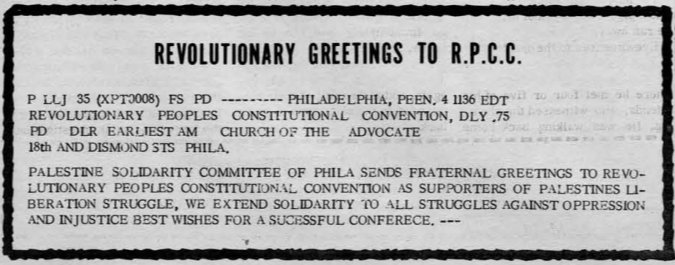
Greetings from the Palestine Solidarity Committee of Philadelphia
The Black Panther, September 12th, 1970
Finally, one of the most rapidly growing new social movements of the decade was the women’s liberation movement. Women in Philadelphia and around the country had begun to congeal around politics that recognized and fought against sex-based social and economic oppression. Issues uniquely harmful to women such as rape, sexual harassment and the criminalization of abortion entered the public consciousness in an unprecedented way thanks to the insistence of a new generation of feminists. At the time of the RPCC, the greatest success of this new women’s liberation movement had been the August 26th Women’s Strike for Equality. Scheduled for the 50th anniversary of women’s political enfranchisement, the strike saw more than 100,000 marchers nationwide. In Philadelphia, thousands gathered on this occasion in Rittenhouse Square. By 1970, radical feminists had gained a predominance in the women’s movement. They asserted the worth of women against male chauvinism as fiercely within the movement as they did in mainstream society. They found themselves rebuked at times by men of all colors and classes, but remained undeterred, and would bring a strong, autonomous non-Panther presence to the RPCC.
In Philadelphia, where Rizzo’s brutality had driven vacillating moderates into the hands of the left, the movement received considerable support from the local civil society, clergy and religious organizations. McGonigle Hall was Temple University’s brand new gymnasium, and it was secured for the convention through the efforts of North Philadelphia clergyman Paul Washington. Washington was the widely respected rector of the Church of the Advocate, and since his appointment in 1962, he had built up the historic church as a sort of headquarters for the city’s progressive movements, particularly for the civil rights and Black Power movements. He was someone able to simultaneously maintain the conscience of a revolutionary and the respect of polite society — the perfect representative of his movement when its militant vanguard needed a favor from a fence-sitting liberal. According to Temple’s student newspaper, Washington secured this favor from Temple president Paul Anderson by concealing the extent of the Panthers’ involvement in the convention. The Temple News wrote that Anderson, who was “going through his latest urban consciousness period... in the mood to say we want to help our neighbors,” did not learn about the gathering’s militancy until weeks after he had agreed to it, when he began to receive calls from the Center City press. By then, Anderson must have concluded that despite public and government pressure against the convention, it would be too costly to Temple’s — to America’s — reputation if he were to back down and deny the Panthers their right to assemble. “He is not a Kingman Brewster [Yale’s president, who supported the Panthers in their New Haven trial]... But still he did not back down. He may have felt a little ill, but he did not back down,” Temple News wrote.
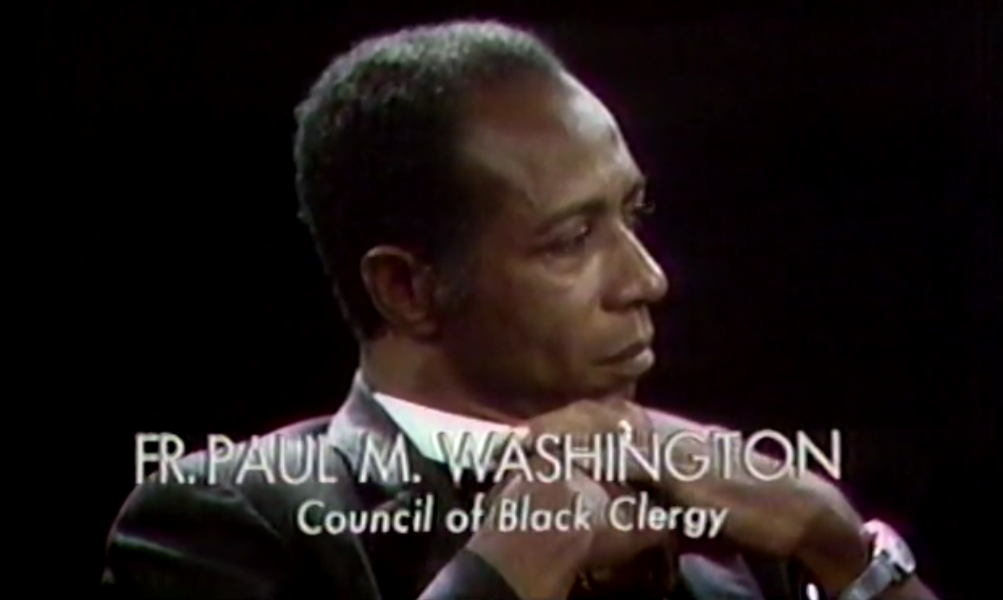
Paul Washington on WCAU’s Input, 1969; Marion Stokes papers, Internet Archive
And then, in the leadup to the long weekend, Quaker canvassers had knocked doors throughout Center City, soliciting volunteers who would open their homes to convention delegates and attendees. The apparent contradiction between Quaker peace testimony and the Panthers’ practice of armed self-defense did not go unnoticed at the time — it was the cause of some controversy in the local decision making process of the region’s various Quaker meetings. When Friends paid the bail of one of the Panthers arrested in Rizzo’s raids, a heated debate over the compatibility of Quaker and Panther values ensued. The recalcitrance of a contingent of old guard Quakers against any open alignment with advocates of revolution by force meant that Friends could not explicitly, organizationally put their support behind the convention. Still, the historic Arch Street Meetinghouse was opened to sojourners, hosting more than 400 people on its grounds. Philadelphia’s Friends’ Peace Committee also put together makeshift ambulances, stationing them at two North Philly neighborhood medical centers, and dispatched teams that supplied water and first-aid.
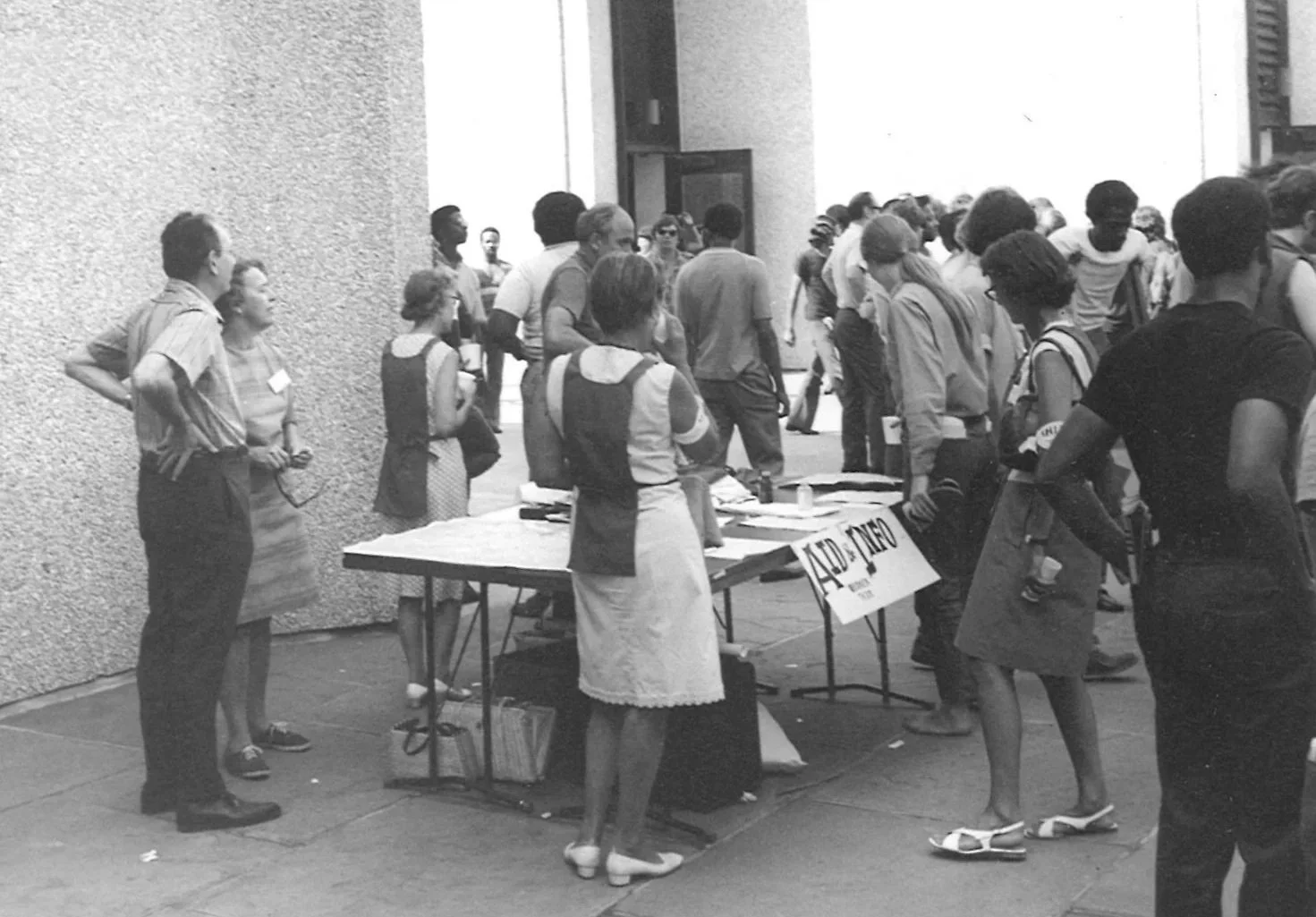
Quaker aid table; Photo by Phil Mayer in Friends Historical Library, Swarthmore College
Instead of attending the convention as a delegation, the FPC organized a contingent of around 200 observers to support the convention as “a friendly presence” of third party observers. An ostensible neutrality seems to have mollified enough critics to get the initiative approved, but even that was met with objections. One objector was Darlington Hoopes, a Pennsylvania state senator and old-time socialist presidential candidate — he got so few votes in 1952 that the Socialist Party decided to stop running presidential candidates altogether — who sent a self-important letter to the Friends’ Peace Committee explaining the impossibility of his assistance given his busy schedule, instead offering his unsolicited skepticism about Black claims of police brutality. In spite of these objections, the Quaker observation team organized a sort of pacifist wargames to prepare its participants for de-escalation in contexts ranging from a meetinghouse takeover by activists to the deployment of tear gas against the convention. Then, on September 1st, recruitment calls and mailers went out to select individuals that the Peace Committee considered well equipped for the action. “We are specifically NOT asking everyone, or the young or untrained or hotheaded, etc [to participate]... Frankly this could be a difficult, even dangerous assignment.” The intention of this presence, as expressed in a retrospective report, was that in the event of a violent confrontation, Quakers in attendance would “at least observe intently in order to help build a record in Court or the press or elsewhere as to exactly what happened. At the maximum it was expected that members might intervene with their bodies in a crisis.”
By Friday, September 4th, it became clear that Rizzo’s last-ditch attempts to halt the convention had been insufficient, if not counterproductive. The Panthers’ months of planning and deeply rooted connections to the masses and civil society had won the day. Katsiaficas wrote that Black churches, homes and storefronts in North Philly similarly welcomed the convention, offering their hospitality to attendees and posting signs greeting the Panthers. “The streets,” Katsiaficas wrote, “[were] alive with an erotic solidarity of a high order.” Over 10,000 more people were in attendance than had pre-registered as delegates.
Convention attendees arrived to the Friday afternoon check-in and found themselves unexpectedly well-fed by the conference’s organizers. Shoatz explains that the armed expropriation of a refrigerated meat truck was one tactic employed for the purpose of feeding conference-goers. At the same time, food and other amenities were also donated to the convention by Panther chapters and movement allies from up and down the east coast. Relief began to wash over those assembled. A Quaker observer wrote that “nothing happened and no one had a chance at the Purple Heart, thank God.” What followed was overwhelming jubilation. The movement had beaten the threat of repression and asserted their inalienable rights through a mass popular mobilization, and won for itself a sliver of time and space in which it could speak to itself, and articulate its revolutionary vision for a new, better society.
The Firebrand Fiend and Professor Newton
The opening speech of the plenary was given by a New York Panther with a remarkable origin story. Michael Tabor, 23 in September of 1970, was born in Harlem in 1946. He was a heroin addict from ages 13 to 18; a biographical detail that might sound hyperbolic to those who haven’t read the pamphlet he wrote in 1968 which brought him to prominence: Capitalism Plus Dope Equals Genocide, which explains that of over 900 dead in New York from drug addiction that year, “210 were youths ranging in age from 12 to 19.” The Panthers promoted him as having managed to kick his habit with the help of Marx, Engels, Lenin and Mao — the “revolutionary fiend” as The Black Panther calls him: a model of the community uplift made possible by the explosion in initiative, energy and willpower that the Black Power movement brought to the ruins of urban America. Of this phenomenon, Katsiaficas writes that:
“It is difficult to overestimate how much the Panthers transformed young African Americans. Under Panther influence, hardened criminals rose before 6:00 AM to serve free breakfasts to thousands of schoolchildren; drug addicts kicked their habits and worked to expel dealers from the neighborhoods; and men used to having their way with women learned to listen and respect their female counterparts.”
Tabor speaks for over two hours, giving an analysis of American history that was at the bleeding edge of progressive thought at that time. The sheer amount of self-directed learning that must have been required for a young man — who would have lost five crucial years of his already insufficient schooling to addiction — to reach this level of historiographic sophistication is astonishing. Had the Panthers’ revolution succeeded, Tabor’s remarks at the RPCC could easily have been recognized as one of the great speeches of history. The speech is worth listening to in its entirety, but its essential arguments are excerpted below.
Tabor’s speech begins like the Declaration of Independence: with a list of grievances against the oppressing power: “The pigs of America are guilty of mass murder; they’re guilty of genocide on an international level; they are guilty of persecuting every minority group in this society... and we say that as punishment for those crimes, the only fit place for them is in the graveyard of history!”
And then, Tabor invokes the Declaration by name, calling it “a hell of a wolf ticket [slang for an audacious bid] at that time,” coming from a “two-bit and a chump ass colony.” And then, he invokes its central promise, already upheld by Panther practice: “They went on to say that whenever any form of government comes down foul... and when they show beyond a doubt or contradiction that they have no intention of righting those wrongs, then the people have a right to off ‘em, to off ‘em!” The crowd cheers.
Tabor moves on to his analysis of the Revolutionary War. “It ran down to us that they fought nobly, that they fought valiantly, that they were courageous, but that was bullshit, they was punks, because George Washington fought that whole war in retreat! And the only reason they was able to win was because Holland, France and Spain declared war on England at the same time... they was trying to take care of business, enslave and oppress people all over the world, and they got jammed.” An apt lesson for dissidents fighting at the core of an empire overextended in a global ideological struggle.
And after the war, as everyone learned in school, the Framers sat down to write the Constitution, in 1787, in the City of Brotherly Love whose name had been made meaningless by Rizzo’s brutality. But who were the men at the Constitutional Convention? “They weren’t slaves, they couldn’t have been slaves, because they owned slaves. They owned property too. They controlled the shipping, they controlled the industry, they controlled every sector and aspect of the economy at that time. They were quite simply, the ruling class... And when they sat down to draft that document, they had one thing in mind: creating a society that would protect their property rights.”
“And it was not until 1791 that the pigs were forced to sit down and include the so-called Bill of Rights, that section of the constitution which supposedly guarantees certain liberties to every man woman and child who is a citizen of this country... When we look at it, it seems some kind of a beautiful thing, but when we check out the reality of it, we find that nowhere in America do any of these things exist... They only included the Bill of Rights upon threat of being overthrown.”
Tabor skips ahead through the antebellum era, making a brief stop at the reprehensible Dredd Scott decision and the Fugitive Slave Act. But he skips another crucial decision: Marbury v. Madison, in which the court granted itself the right of judicial review, vastly increasing its power beyond what was strictly allotted to it by the constitution. Indeed, elevating its power above the plain text of the Declaration of Independence and the Bill of Rights, granting itself the authority to decide whose rights are unalienable and who is without rights that the law is bound to respect.
Tabor condemns the Emancipation Proclamation as a false promise, pointing out out its political and economic necessity and its hypocritical, pragmatic exemptions for the loyal slave states of the Border South. He instead credits the abolition of slavery and the Union’s victory to its Black soldiers. He condemns the Reconstruction Amendments, a monumental change to the Constitution, as having been spun from ulterior motives: “The main reason why we got the Thirteenth, Fourteenth, and Fifteenth Amendments was because at that time the Republicans were representing the interests of the Northern capitalists, of the financiers, the industrialists, and of the bankers, and that group... wanted to expand their power, move into the west, set up railroads, and build industries, but in order to do that, they would have to have absolute control over the government.”
In other words, Tabor asserts that Reconstruction was merely a ploy to secure a permanent Republican majority. This is one of the few points on which Tabor is out of step with modern historiography, but only in the sense that Republicans acquiesced to the reinstatement of the pre-war white supremacist power structure more quickly than Tabor emphasizes, by half-heartedly garrisoning southern states during their occupation and quickly re-admitting them into the union, jeopardizing their partisan dominance to preserve white ruling class unity. Though this complicates Tabor’s argument in the details, it does not overturn his central conclusion about the period. He goes on to say that:
“Anyone here today who is under the delusion that the problems, economic, political and social, that afflict Black people can be solved by way of having Black representatives functioning in the traditional political arena, all you have to do is look back at Reconstruction... when the ruling class of this society decided that Black people had outlived their usefulness, all they did was they just squashed it all... and the next day we found ourselves in a worse trick bag than we were in during slavery... Every dealing, every form of relationship we’ve had to this society... has resulted in nothing more than a lot of meaningless promises made, and nothing came of those promises, and the end result was a flim-flam, and more persecution and more oppression. Every promise that they’ve made has only served to put us to sleep!” This line of argumentation put the Panther view into stark distinction with the views of the Black moderates that rivalled them, making pointed use of history to support the Panther interpretation of the present.
Tabor takes the audience through the formal imposition of Jim Crow, from 1896 to 1954, but scoffs at the idea that the courts have fixed much of anything, with so much discrimination and inequality still permitted even after the major formal gains of the 60s. And then, he turns his incisive gaze toward the present. He laments the state of modern America — war, stagflation, repression — but he cautions against the assumption made by many that America has fallen from its pedestal.
“[Liberals] say that Nixon has brought disgrace and scorn upon the Founding Fathers, but when we look back at American history... that’s bullshit, when we start looking at repressive laws... when we wanna find the beginning of it, all we have to do is look back to the Founding Fathers.” He draws a straight line from the Sedition Act to the Smith Act. “The repression we’re experiencing in this country today, it’s nothing new. That’s old hat.”
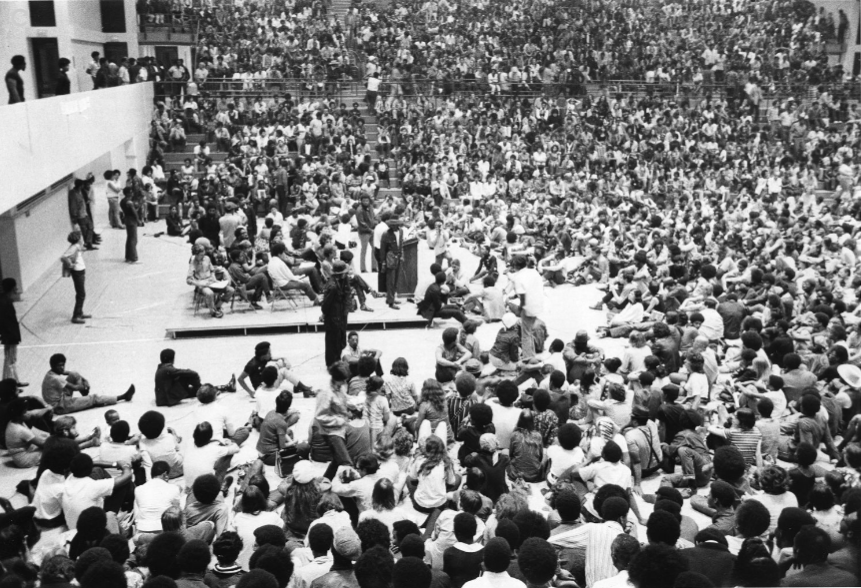
Delegates gathered in McGonigle Hall; Photo by Salvatore C. DiMarco Jr., Temple Urban Archives
“We cannot look upon the United States of America as simply being a nation... it is in fact the most ruthless, the most bloodthirsty, the most oppressive and the most exploitative empire that has ever existed in the annals of history. The United States is in fact the number one threat to the continued existence of the human race!”
So what is to be done? “From the islands of the Philippines, to the swamps of Southeast Asia, to the jungles of Africa, to the arid deserts of the Middle East, to the Bolivian tin mines, to the cities of South America, all up to the colonized ghettoes of Babylon, all over the world, people have risen up and they’re moving like a mighty tidal wave, and they’re saying that it is our duty, it is our obligation to humanity to destroy that very force which is responsible for the enslavement of the planet!”
“The people all over the world, their eyes are focused on the United States of America at this time. Because they know far better than a lot of us here in Babylon, that the only force... capable of dealing a death blow to the monster known as America are those who live right here, within the belly of the beast!” The crowd goes wild, with chants of “Off the pigs!” They’re ready to fight.
Tabor asserts that the struggle ongoing in America is unique, and unprecedented in history — not just a class struggle but a struggle based in ethnicity, gender, and sexuality — an early articulation of intersectionality, and an optimistic one at that. “The same beasts who are exploiting women, who are exploiting Black people, who are exploiting everyone else, are the same beasts.” It’s easy to scoff at this oversimplification today, when much ink has been spilled over the various and complex dynamics of oppression faced by different identity groups, but Tabor issues a warning about the dangers of disunity that remains as true today as it was when he spoke it: “The various groups opposed to [Hitler] were not fighting him in a unified manner... everybody was fighting everybody else, and when they looked up it was January the 30th, 1933... and it was too late, too late, too god damn late.”
He compares the vacillating hesitance of American progressives to the Jews of the Warsaw Ghetto Uprising: “They fought heroically; the fight that they put up was a monument, a testimony, to the will of the people to survive, but it still doesn’t obviate the fact that they waited too long! Now what we find in America is that too many people are waiting too long, waiting for the concentration camps to be open, the concentration camps are open!” The camps he’s referring to are institutions in America’s vast prison archipelago, which confined around 360,000 people at the time: Allenwood, El Rio, Avon Park, Tull Lake, Wickensburg. No one knew it at the time, but this was just the tip of the iceberg; by the peak of mass incarceration in 2009, the total number of people in some form of confinement in America approached 2.3 million, with millions more under some form of correctional supervision.
If anyone could have anticipated this development aside from the people who planned it, it was Panthers like Tabor who warned of a creeping, modernized fascism already present in America: “We have to understand that nobody’s gonna stop it but us,” Tabor said, “If we’re not going to take the initiative... to end right now and bring to a grinding halt the diesel train of fascism that is rolling across the land, look here come the end of the 20th Century, Jack, we’re all gonna be dead.” Yes, they weren’t going to — they didn’t — just allow mass incarceration to happen. Everyone in that room knew that Seale was facing death in a gas chamber or the electric chair, and Newton had just narrowly escaped such a fate. The Panthers and others in the movement fought the cruelties of the American prison system with everything they had, by any means necessary, no matter how hopeless their odds. 17-year-old Jonathan Jackson exemplified this will to resist — in August, he had been killed leading an attack on the Marin County Courthouse. He was attempting to free his brother George from the indeterminate sentence that he was serving for stealing less than $20 from a gas station. Tabor uses the words of an old American revolutionary to justify this bid for freedom:
“That’s the same thing that racist Patrick Henry was talking about. What did he say? He said give me liberty or give me death. Now in school they say that was right on, they say that he was a righteous freedom lover, a servant of humanity... but when Jonathan Jackson and them brothers said it, they didn’t say that. They said that they was criminals. Who are they trying to fool?”
Then, Tabor begins to wrap up. “So we are down here today to put our hands together, to put our minds together, to begin the process of drafting a new document, a new constitution, that will in fact serve as the legal basis for this society... A document that will in the end result in the power being placed in the hands of the people, where it should have been from jump street, but where it has never been.”
“If we are serious about drafting up a new constitution, we also have to be ready to defend it... We say that anything we do to defend ourselves from... reactionary violence is justified... and that’s what that boils down to. So we ain’t even gonna get hung up over whether we’re going to be violent or not, because the fact of the matter is, we don’t have no choice... because the entire fate... and the destiny of humanity is dependent on — to a very large extent — how effectively we do our job here today and in the days to come. All power to the people and right on!”
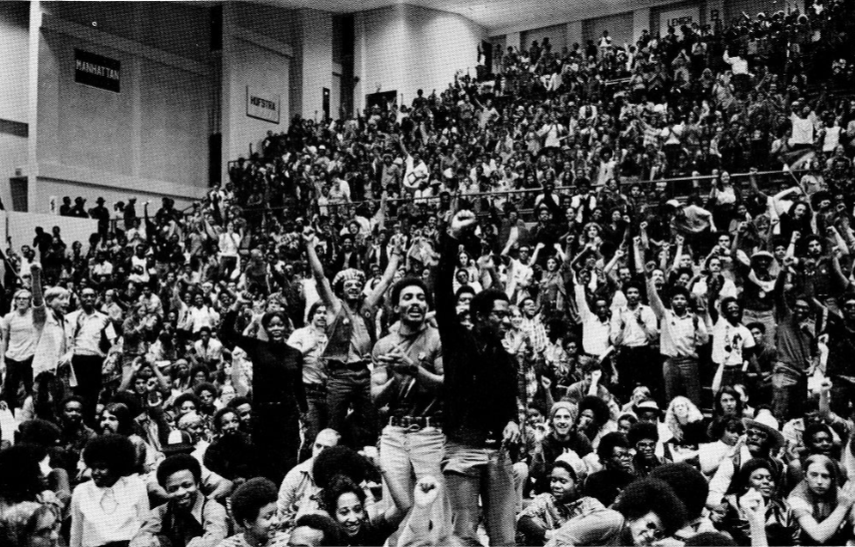
The crowd cheers at the RPCC; Liberation News Service, Temple Urban Archives
At this point, the crowd is electric, chanting and cheering, but Tabor’s rash revolutionary talk — “murder-mouthing,” as Panther Chief of Staff David Hilliard calls it — was making some of the leadership nervous. The Panthers were in constant danger of losing control over the people they’d inspired; the recklessness of others often exposed the leadership to danger. Adding to the pressure, the crowd’s expectations were sky-high for what would come next: Two intermediary speakers’ words may be lost to history; those of Audrea Jones from the Boston BPP and of the activist lawyer Charles Garry. The momentum could have been building or faltering as the keynote speech of Huey P. Newton approached, but in any case the proceedings were running late. The stakes were as high for Newton as the crowd’s expectations of him were. Cleaver was in exile and Bobby Seale was still in jail; Newton was the only leadership figure in a position to govern the party, and this was his first major public appearance since his release from prison a month before the RPCC. Thousands of people across the country, including many in attendance at the convention, had campaigned for Huey’s freedom since 1967.
That he had won his appeal and made it out of prison to address the convention was itself a victory worth celebrating to many in attendance. But there was a problem: a mismatch between Huey the myth and Huey the man. As Katsiaficas recalls,
“Huey was everyone’s hero, but once he took the microphone, we were stunned to discover he was not a charismatic speaker. In a high-pitched, almost whiney, voice he went on at length about US history, using abstract analytic arguments.”
Newton’s speech, like Tabor’s, has been preserved as an audio recording, and that recording largely confirms Katsiaficas’s interpretation. Newton’s remarks are a speech written in the form of a philosophy paper, and he reads them verbatim from a script. He stutters and fumbles the delivery of some key lines and and at times the crowd seems unsure when to react or applaud. Writing about another similarly unsuccessful speaking engagement of Newton’s, Hilliard, who was his close confidant since childhood, wrote that “Huey's speech made perfectly clear to them that he was indeed not the poster on the wall.”
Yet at the key points of his speech at the RPCC, when a mass response is obviously desired, the room thunders nonetheless. It’s clear that even if many attendees were disappointed or unsure about Huey in the flesh, there was still a great deal of goodwill felt toward him. Huey’s admirers in the gymnasium are many, and they cheer for him regardless, on the basis of their love and hope for him. And yet, the reaction of the crowd upset Newton; Hilliard says that Newton was against the convention from the start — he questioned the wisdom of holding one when the Panthers were nowhere close to controlling any territory on which to govern. The revolution-ready attitudes of many at the RPCC strengthened Newton’s conviction that the movement was getting several steps ahead of itself, charging boldly into danger without the strength to withstand it. Once he had spoken, he felt even more alienated: “These people have no analytical sense,” he told Hilliard. “They’re hung up on slogans... and revolutionary talk.” Unbeknownst to the thousands in attendance, the pair ditched the conference for dinner and libations at a Philadelphia Panther’s house, where they decided to forget the entire constitutional convention. But the proceedings continued without their participation or endorsement.
The People Make History
When Huey Newton was shot and then imprisoned in 1967, the Black Panther Party had twelve members and was sliding toward a terminal decline; when he walked free in August 1970 it had over 4,000 active members with daily commitments to its cause across 33 chapters, a widely read newspaper, and survival programs so obviously needed and easily implemented that they threatened the state’s legitimacy. For more than a year preceding the RPCC, the entire Panther leadership troika — Seale, Newton and Cleaver — was in jail or exile. And still, it was driven forward by the masses — by hundreds taking individual initiative and thousands standing behind them, learning from their example. The theory of change which held that any person was capable of becoming a militant scholar — of pulling their weight in the tug-of-war of history — the same theory of change that had brought the Panthers to prominence — was being put into practice at the RPCC by a broad coalition of the masses, in service of the crucial task of defining coherently the aspirations of a movement that urgently needed to join together, or die.
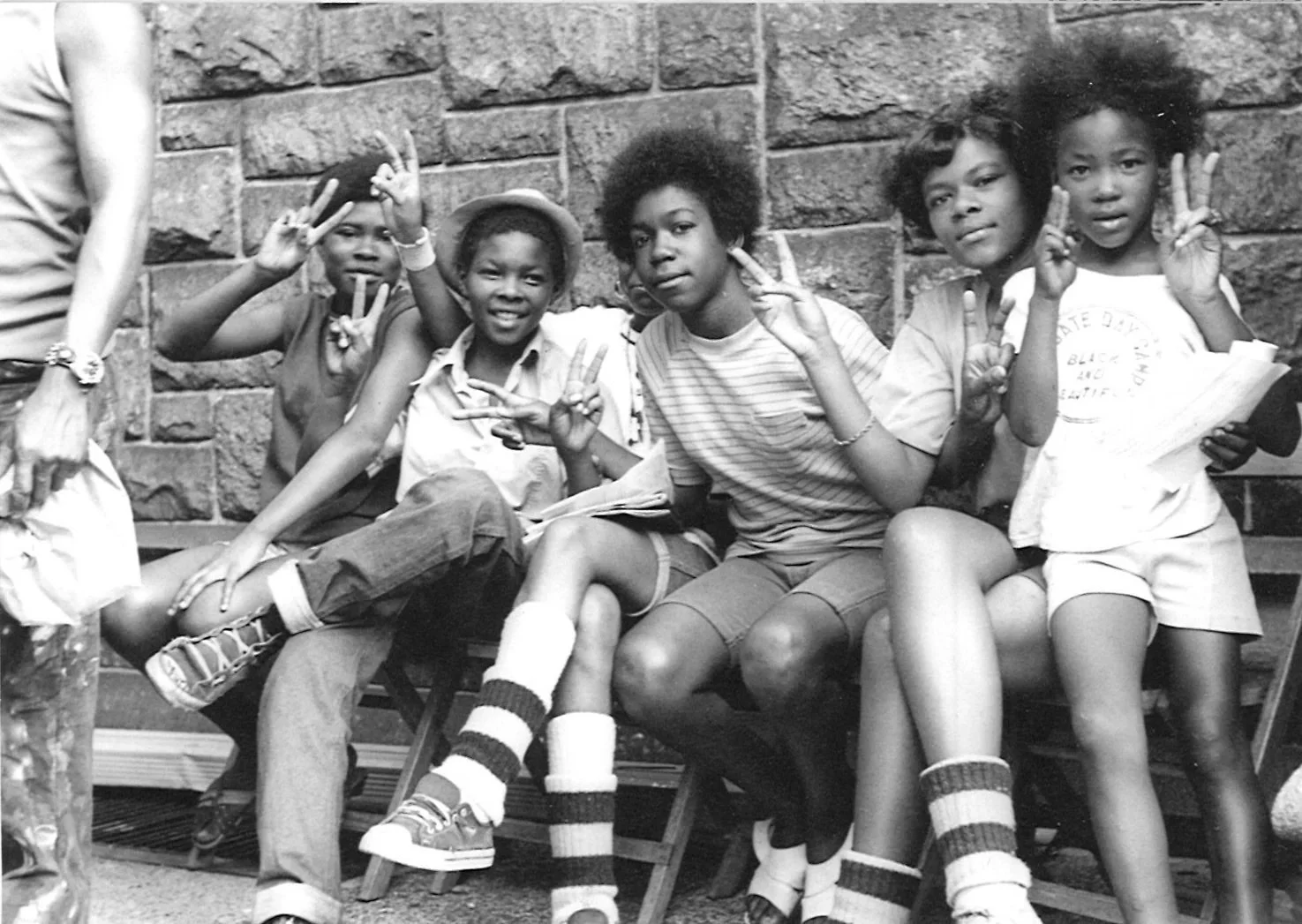
Children at the RPCC; Photo by Phil Mayer in Friends Historical Library at Swarthmore College
The convention’s attendees seem to have uniformly understood the precious and sacred nature of their task. The Black Panther reported profound changes in the personal habits of some of those in attendance at the RPCC: “At 9 AM, the lines of black and brown people wait, the Quacker [sic] observers arrive. 9 AM, the time announced, ‘colored peoples’ time,’ that is, poor peoples’ time, is coming to an end. Why did time matter now? Because there was a future.” Of the considerable number of children in attendance, the paper wrote that they “were not boisterous. The children were to be for the three days like the adults, infected with a kind of mad sobriety... Beware the quiet children and the poor people on time.” Several Quaker participants remarked on the cleanliness and personal responsibility of the delegates — despite inadequate sanitation infrastructure, they had altogether managed to leave behind very little in the way of trash. On Sunday morning, after an evening of galvanizing speeches, a group of Detroit Panthers led attendees in a callisthenics routine on Fairmount Avenue. Then, the people prepared to get down to the work of deliberating on and writing their constitution.
The plenary’s original schedule, published in The Plain Dealer, said that workshops according to social groupings would be held on Saturday, before the opening speeches. The Black Panther says that the delegates were told to divide into ten working groups — Third World peoples, women, soldiers, college students, high school students, workers, lesbians, male homosexuals, welfare people, and street people. Each faction and identity in this new popular front was supposed to have been given the task of addressing the issues they knew best and were most affected by. However, due to the logistical and security requirements of the conference and the prioritization of Newton and Tabor’s speeches, the Saturday workshops were postponed.
On Sunday, when the work of writing a constitution really began, participants seem to have largely broken out into the Panthers’ intended groupings, but documents preserved through the archival efforts of Katsiaficas reveal a certain level of confusion and debate over whether to meet in social groupings, as was intended for Saturday, or in topical workshops, as the schedule for Sunday said to do. There also seems to have been some initiative on the part of the delegates in formulating these workshops and the scope of their task according to the actual composition of the room. In the end, what the conference produced was a mix of reports from topical workshops — international relations, the legal system, the educational system, control and use of military and police, health — and reports on the interests of a particular social grouping — women’s self-determination, gay liberation, the self determination of street people. There was also a small workshop on revolutionary art, which was not called for in any itinerary. Retrospectives on the RPCC have critiqued the breakout session plan for its poor awareness of the multiplicity of identities, which forced, for example, a woman interested in the health system, to choose between the two workshops relevant to her.
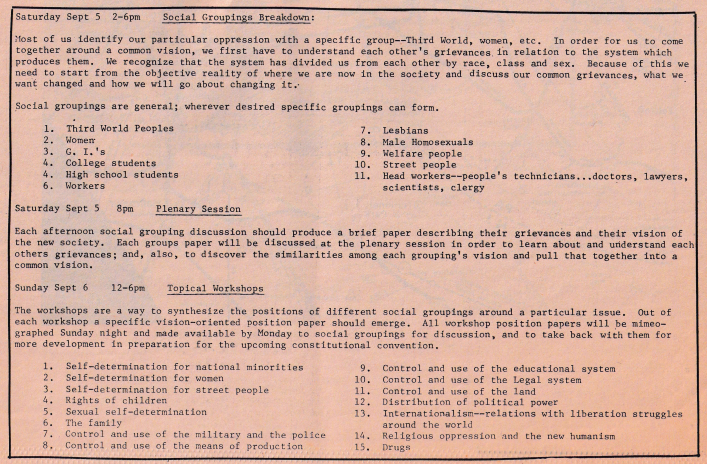
The convention’s original schedule, printed in The Plain Dealer. Most of the workshops in the first grouping were cancelled due to time constraints.
But the varied scope of the documents produced at the convention reveals that the time crunch created a more fundamental disagreement over the format of the workshops. It seems that a significant portion of the attendees were interested in tackling a certain aspect of the whole of society, such as the education system, and were willing to forego meeting as a social grouping to do so. Others wanted to prioritize writing a blueprint for a revolution in the issues affecting them as women, or as homosexuals, and were willing to forego, though sometimes reluctantly, the topical workshops in order to meet as a social grouping. The conflict that attendees were facing was not merely one of choosing between their multiple identities. Rather, it was a conflict between prioritizing universalism or particularism. While the siloing of radical feminists and gay liberationists into their own workshops is cited as evidence of Panther prejudice in some accounts, it’s important to note that there were significant impulses coming from these very communities for such an arrangement. A space for groups like lesbians, and gay men to meet among themselves was something that these groups wanted and demanded at the RPCC and in the broader movement at that time.
The distinction between social grouping and topical workshops also defies easy classification. A clear example of the complex relationship between the two can be seen in the report from the gay mens’ liberation group. Gay men at the RPCC did not merely want their freedom as a sexual minority; they wanted to apply their experience as homosexuals to the task of restructuring all of society’s view of sex and sexuality. This anti-minoritarian intent can be seen in its several universal demands, which include “that all modes of human sexual self-expression deserve protection of the law and social sanction,” and, entirely unrelated to homosexuality, “that technology be used to liberate all peoples of the world from drudgery.” Similarly, the statement from the workshop on the self-determination of women makes its participants’ universalist vision clear, in articulating their demands for “a socialist system that guarantees full, creative, non-exploitative life for all human beings” and “equal status [for women] in a society that does not exploit or murder other people.”
Altogether, this exercise in prefigurative politics had a profoundly positive impact on many of its participants. Before any aspect of the new constitution had been written, the format of its plenary session was already a revolutionary exercise. This was not, like the First Continental Congress had been, a meeting of less than 100 ruling class men — the convention’s format as a mass gathering of thousands, broken down into deliberative sessions, was a successful execution of the concept of participatory democracy that was so integral to New Left aspirations, and a model for a democratic, socialist, egalitarian future that many of the convention’s delegates hoped to bring about. One unnamed Panther concluded after the proceedings that “There is going to be a revolution in America. It is going to begin in earnest in our time… To have believed in a second American revolution before Philadelphia was an act of historical and existential faith. Not to believe in a new world after Philadelphia is a dereliction of the human spirit.” A gay liberationist from Minneapolis concluded that the RPCC showed that “Blacks, Women, and Gay people can be united and can act together under one philosophical commitment to human dignity and self-determination.”
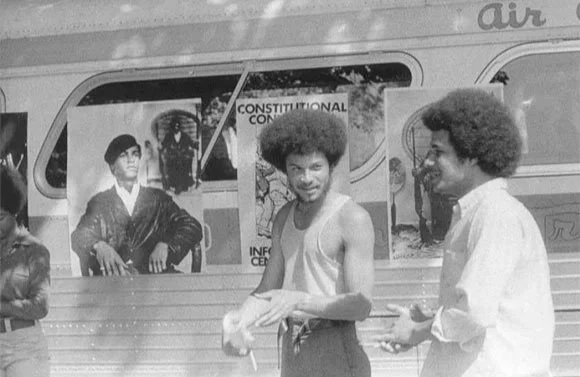
Convention delegates in front of a chartered bus; unknown author
Quaker observers also spoke positively of the convention, expressing joy at the opportunity to make contact and exchange ideas with different kinds of people. An older Quaker reported that several of the younger observers had affixed Panther buttons alongside their Quaker aprons and armbands. Perhaps they were trying to suggest something about the duality of man. On his own feelings toward the event, that same man said “I wouldn’t have missed it for anything... I don’t think I have ever seen such a varied group of people in my life… Even the few seconds required to give someone a drink of water is enough to have a significant interaction with that person.” This man challenged himself to try and engage with each person who approached his table, and found that quite a few Panthers were willing to entertain a discussion on the merits of violence. “I often had the feeling,” he wrote, “that even the more vociferous upholders of violence were somehow addressing their arguments primarily to themselves in an effort to justify violence as the only workable course — they frequently seemed dissatisfied with their own words.” He didn’t feel that he had won any converts in these discussions, but hoped that he had planted some seeds.
One woman gave a dime to a young man with 30 cents who needed 35 for the trolley fare to Powelton Village — she was touched that he dug into his bag to return a nickel to her, taking no more than he absolutely needed. She later gave the remaining four dollars in her wallet to another young man who said he lacked gas money to drive back to Ohio. “I am certain that the Black Panthers would have strongly objected to his approaching me in this manner,” she wrote, but she was unconcerned. Perhaps surprised that someone had agreed to help him out, the young man gave her a kiss on the cheek. Another woman on the first-aid team recounted an unexpectedly tender moment with a “particularly ferocious looking black man with heavy boots, tight pants, vest open on bare chest and an African horned ornament on a chain... He must be a real revolutionary, I thought. Suddenly, he loomed over me,” she wrote. And then, he asked if she had a band-aid for a cut that had torn his fingernail. “We fixed a bandage out of gauze... [the cut] was really not very big.”
Things Fall Apart
At the end of the convention, each group elected spokespeople to record their ideas and present them at a concluding session. The drafted constitution was like nothing ever written in history. It called for an international bill of rights, world redistribution of wealth, a ban on genocidal weapons, prohibitions on excessive military spending, the replacement of standing armies and professional police forces with civilian-controlled peoples’ militias, proportional representation for women and minorities, redistribution of university resources and knowledge, universal healthcare, shared housework, the eradication of sexism and male supremacy, and “the right to be gay, anytime, anyplace.” Altogether, these proposals formed the basis of one of the most progressive constitutions ever written.
In his reflection to the Friends’ Peace Committee, a Quaker named Rob Tucker — a socialist from a previous generation though, unlike Darlington Hoopes, a sympathizer with the RPCC — wrote insightfully about his observations at the convention. He rejected the commonly held belief that the high-minded, pacifist Quakers were optimistic by comparison to the revolutionary youth:
“So many outward commentators explain youth and black radicalism in terms of the bomb, the hell humans are making of this planet, the ‘disillusionment’ of youth… [Quakers] have looked at these same phenomena and ended up with the bleakest possible view of man’s nature and what he can hope to do unaided... we are forced to the conclusion that it is not man’s job to save the world, God will save the world, and he may use us in doing so if we can truly learn and practice discipleship and faithfulness... But the young radicals at this convention DO believe man can redeem himself, that’s what they were there working on, and they were intensely serious about it... Since from my viewpoint I know there is no hope, or not their way, my chief feeling for them is one of profound sorrow. They will all learn the hard way.”
And learn the hard way they did. Katsiaficas writes that “when Newton and Hilliard left the plenary after Huey’s speech, no one knew it at the time, but the high point of the movement had passed.” Already, signs of an unravelling were emerging. The greatest documented cause of controversy during the proceedings of the RPCC had occurred when a group of around two dozen radical lesbians from New York walked out in protest, due to changes in the schedule that they felt had marginalized the “women-identified women” at the conference, whose highest priority was a women’s revolution. They wrote about this experience in an early issue of the feminist periodical, Off Our Backs.
The Panthers had initially agreed to a demand by radical feminists that a “Third World sister” with “a heavy woman’s consciousness” be given a keynote speech alongside Newton and Tabor. Off Our Backs reported that she was denied entry to the building when the time came. The lesbians perceived this as a bait-and-switch and, along with the cancellation of the social grouping workshops, it set a bad tone for Sunday morning. The presence of male Panther guards in the women’s self-determination workshop further increased tensions, and the lesbians found themselves marginalized by other women within the workshop. Their advocacy for family abolition was poorly received by Panther women, who were more likely to associate families with resilience to oppression. Many would have been all too familiar with state efforts to destroy the Black family. Instead of condemning the family in all forms, the workshop focused its criticism on the capitalist and patriarchal aspects of the nuclear family and called for “alternatives to the patriarchal family.”
Marc Stein, a historian of LGBT Philadelphia, argues that by doggedly promoting their women-first position within the pluralistic space of the RPCC, the radical lesbians were making a bid to be the movement’s vanguard. If this is the case, the lesbians vastly overestimated the appeal of their message. But they were not totally unreasonable in this presumption. The women’s movement had a uniquely strong claim in favor of its own primacy: patriarchy was not as historically contingent a fact as capitalism and many of the other more specific evils imposed on the world by centuries of European hegemony. Patriarchy had been imposed in heretofore nearly all comparable societies in history; it predated capitalism and post-dated existing socialism; it was the mode of operation not just within the dominant society but in the counterculture, the movement, and in each oppressed community within this widening coalition. If radical feminists at the RPCC could convince the women in attendance that patriarchy, rather than race or class, was the “primary contradiction,” and that a women’s revolution was the first step forward, they would have a powerful constituency that could outmaneuver the Panthers. Maybe a women-led revolution could have succeeded where the bid of the Panthers came up short.
But the radical lesbians were unable to win over the constituency they needed, even within the women’s self-determination workshop. The output of the RPCC workshops suggests that the vast majority of women in attendance were interested in a pluralistic revolution, even as they articulated many of the demands associated with second-wave feminism. The workshop on the self-determination of street people, for example, was clearly influenced by feminist thought in how it formulates its demand for an end to organized crime, identifying pimping, prostitution, sexism and rape, alongside acts like theft, gambling and dope pushing as acts perpetrated against people on the streets. Their marginalization at the RPCC made some women’s liberationists retreat further into separatism. Incensed that the women’s self-determination workshop had fallen short of their demands, the radical lesbian group decided to leave early. “We had attempted to negotiate on enemy territory,” they wrote, “and found it oppressive and unworkable.”
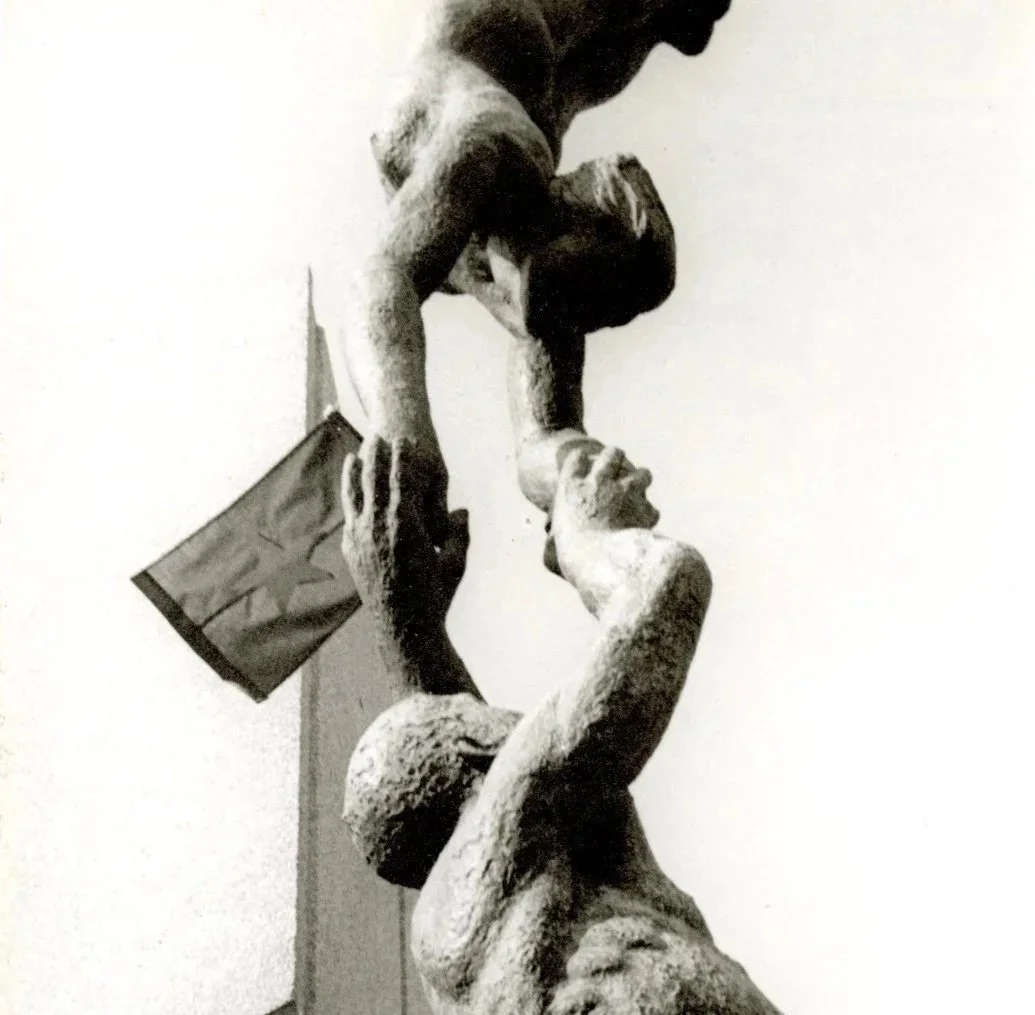
The National Liberation Front of South Vietnam flag affixed to the Two Athletes statue outside McGonigle Hall; Photo by Phil Mayer in Friends Historical Library, Swarthmore College
The role of the vanguard was a coveted and much-debated position among the New Left, not least because the vanguard was presumed to have some level of authority vis-a-vis other factions in the movement. The Panthers were able to bring the various New Left factions together in Philadelphia only because enough of those groups’ members put their faith in the BPP. But not everyone did. Hilliard recalls a frustrating instance in 1969 in which, during coordination with anti-war protestors:
“We're denounced — only six months after being exalted — by segments of the white left. The Panthers are only part of the vanguard, they say, not the vanguard. Later for that, we say. We don't need to be told who we are. We know: the people creating revolution, the main targets of the state.”
Worse, some in the white left tried to channel the Panthers’ hype into their own issues, taking attention away from their deadly serious fight for survival against the bleeding edge of state repression, or presumptuously assumed that Panther firepower would take care of the dirty work of revolution. Speaking directly to Newton’s disillusionment with coalition-building following the RPCC, Hilliard recalls:
“They like us picking up guns and shooting it out with the pigs. But they don't want us as theoretical leaders... Seeing a movement fragmented into gay groups, women's groups. Third World groups, et cetera, Huey proposes a general theory to define this phenomenon and channel its energy. The movement replies by telling him he's boring and irrelevant.”
The Panthers were not without their own problems. Panther cadres were renowned for their discipline, and in most cases, the discipline they exercised was extraordinary. But at times, “murder-mouthing” that jeopardized the party’s reputation, and the reckless actions of “jackanapes”, in Hilliard’s words, couldn’t be contained. In Philadelphia, after the RPCC left town a handful of well-meaning residents whom Quaker canvassers had convinced to open their doors to convention attendees felt their generosity had been taken advantage of. Despite an explicit prohibition in the Panthers’ written code of conduct that forbade members to “steal or take from the people, not even a needle or a piece of thread,” the Philly underground newspaper The Distant Drummer reported at least four cases where residents who gave their homes over to “revolutionaries” found them cleaned out of valuables upon their return. Others were alarmed to find that their guests had arrived heavily armed, and feared that their homes might become the site of the next skirmish with state power.
Premature armed struggle was a grave threat to the Panthers’ survival, and something Newton and Seale tried desperately to keep in check. But the state’s relentless repression of the Panthers and the ongoing brutality against their communities invited an armed response. At times, Panther credibility hinged on their ability to stand and fight. Hilliard recounts that, after the assassination of Martin Luther King in 1968, he was unable to dissuade Cleaver from leading an assault against the Oakland police which ended in disaster, with the killing of 17 year old Bobby Hutton and Cleaver’s exile to Algeria.
The killing in Cobbs Creek Park that preceded the RPCC was another case that demonstrates the high price of armed struggle. Five men are serving or have served life sentences over the death of Von Colln. They are some of the longest serving political prisoners in the world. They haven’t been forgotten by their families and community — in 2020, protestors against police brutality occupied Von Colln Field in Center City, renaming it “Camp Maroon” after a name Schoatz had given himself in prison — and they haven’t been forgotten by Von Colln’s descendents, or the Philadelphia police, who are determined to make an example of them. In what one of the jurors on his appeal called “the worst thing we’ve ever done” after decades of reflection, Fred Burton was convicted of murder merely because he might have been at a meeting where an attack was nebulously discussed, and other defendants can be presumed to have made their confessions to conspiracy under the threat or actuality of police violence behind the station doors. The wife of Hugh Williams, who first named members of the BUC as accomplices, later made a written disavowal of her forced confession. Despite questionable aspects of some of their convictions, appeals in their cases have been uniformly unsuccessful. Schoatz died in 2021, after nearly 50 years in prison.
The Panthers’ centralized command structure made the efficacy of its disciplined cadres possible. Imperfect as this discipline was, it counted for something, but it too came at a cost. The great responsibility placed on Panther leadership because of their high individual authority made the Party as a whole more easy to infiltrate, incapacitate, and manipulate. The intelligence agencies exploited every human weakness they could identify in the Panther leadership, smashing big egos against each other, stoking paranoia, torturing people behind bars until they fell apart. The split between Newton and Cleaver that deeply wounded the BPP is commonly understood to have stemmed from their disagreements over the prioritization of armed struggle versus community survival. Cleaver was clearly in the wrong in his belief that an armed struggle against the US government was winnable without a minimum of years, even decades more base-building than the movement had achieved by 1970. The entire counterculture, not to mention its politically active subsection, was dwarfed by mainstream society to an extent that many militants, in their self-importance, could not grasp.
Newton’s change in approach after the RPCC, his turn towards self-sufficiency and strong local fundamentals, could charitably be called an astute understanding of this reality. Less generously, it could also be called a prioritization of his own authority over the strength of the movement, a turn away from the masses and toward a trusted circle of collaborators in the face of life-and-death stakes. Certainly, some of his actions during this time cannot be justified — copyrighting the party newspaper, exerting autocratic control over the organization, and limiting its ideological and geographic extent to a far more isolated space — all precipitated its decline. Katsiaficas writes that “like a mad genius artist who destroys his canvasses, he ripped up the party in fits of anger.” Furthermore, he argues that “the Panther program Huey wrote had pointed toward the RPCC. Although Newton could not understand it, Cleaver’s implementation of the Panther program was part of his desire to follow the leadership of Newton – not, as subsequently maintained, an attempt to overthrow him.” Cleaver was wrong about the prospects for armed struggle, but Newton’s desire to purge the party entirely of his influence left it without ties to a popular front that could have given it cover from the war of attrition and sabotage which precipitated its demise.
Drugs posed another problem, within and outside the Panthers. Hilliard, writing his memoir after the demise of the BPP, after crack tore through cities that used to be bases of Panther power, finally on the other side of his own addiction that brought him low, recalls how Michael Tabor, eager to impress, would bring a bag of coke to Oakland whenever he’d visit, despite the Panthers promoting him as a man gone clean for the revolution. Hilliard recalls how Huey would drive him nuts when they’d light up together, going on about grandiose ideas, convinced that his sharp mind would always have the final victory, no matter how much he deteriorated. Mainstream accounts of the RPCC report that during the plenary’s closing session, the loudest applause was heard when the street peoples’ workshop read out their conclusion on dope. “Hard drugs are counterrevolutionary,” they said. “The seller of hard drugs must be eradicated from the community by any means necessary. The user must be helped to rid himself of addiction by the people.”
However, “psychedelic drugs (acid, mescaline, grass) are important in developing the revolutionary consciousness of the people… there should be no law made against them.” In a sense, this policy is laudable. It is certainly preferable to the prohibition model that has fueled mass incarceration and been used to justify overpolicing. But anyone who understands an addict’s rationalization process — the weakness of human willpower in the face of the brain’s own chemistry — can see the bargaining behind these words. The second edge of the sword that is the war on drugs has been the impact of the drugs themselves, in spite of the war. Too many brilliant minds and too many lives — including Huey Newton’s own — have been lost to the downward spiral of addiction. The hardships of a life given over to the demands of political struggle left too many in the movement especially vulnerable to the temptation to use — a weakness that the authorities knew well how to capitalize on.
The months after the RPCC saw a fracturing in the coalition it tried to build. Its most frustrated elements radicalized, giving in to separatist impulses or taking stances and actions that alienated the public. When it comes time for the intended second session of the RPCC in Washington, DC, the Panthers’ logistical luck has run out. The FBI was breathing down the neck of any institution that would dare associate with the BPP. Howard University backed out of hosting. A small, committed group convened in the streets, sticking out like a sore thumb. “In six months the massive popular appeal of the antiwar and radical movement has vanished,” says Hilliard. “Kent State has scared away the thousands who last spring seemed ready to become revolutionaries.”
“Now the people who attend only want to promote their own programs… In the past, conferences would attract new people. This is a scruffy-looking, mangy crew. They don't inspire confidence. I wouldn't want to join them.”
Paul Lyons, a historian of the Philadelphia region’s left movements and a professor at Temple during the crisis of 1970, identifies several tendencies within the New Left that accelerated its demise: millenarianism, which pushed it toward premature action; romanticization, which fueled an unrealistic view of global liberation struggles, and the misapplication of their successes to non-applicable contexts; reductionism and ideological arrogance, which drove the movement into infighting, exclusivity, and separatism. “That New Leftists misread the political landscape is indisputable and tragic. That they had difficulty in understanding how their own confrontational style was playing into the hands of those like George Wallace, Richard Nixon, Ronald Reagan, and Frank Rizzo is perfectly clear,” Lyons writes.
All told, there is plenty of blame to go around. But the pressure and urgency of a crisis come too soon helps to explain these missteps. Lyons captures the urgency of the moment where it all went wrong:
“Black people were dying on the streets of Newark and Detroit, [and] being beaten in front of Philadelphia's school board building. Soon there would be a state of emergency and martial law in nearby Wilmington, and the war in Indochina, despite a rising crescendo of protests… continued to grind on, the death toll mounting... It is no wonder that the movement responded with desperation and often lost its way. How could one focus attention on the painfully slow work of political education and institution building when there was such an immediate need to act, to stop the war, to end racism? And how could young people, never renowned for their patience, take the longer view?”
The unraveling of the New Left and the collapse of the Panthers’ revolutionary moment resulted from the intensification of a crisis in the American experiment that the forces of order were better prepared to survive than the movement against them was. According to Katsiaficas, “the revolutionary crisis unwittingly strengthened the stranglehold of the rich on American institutions and the system’s capacity for domestic violence.”
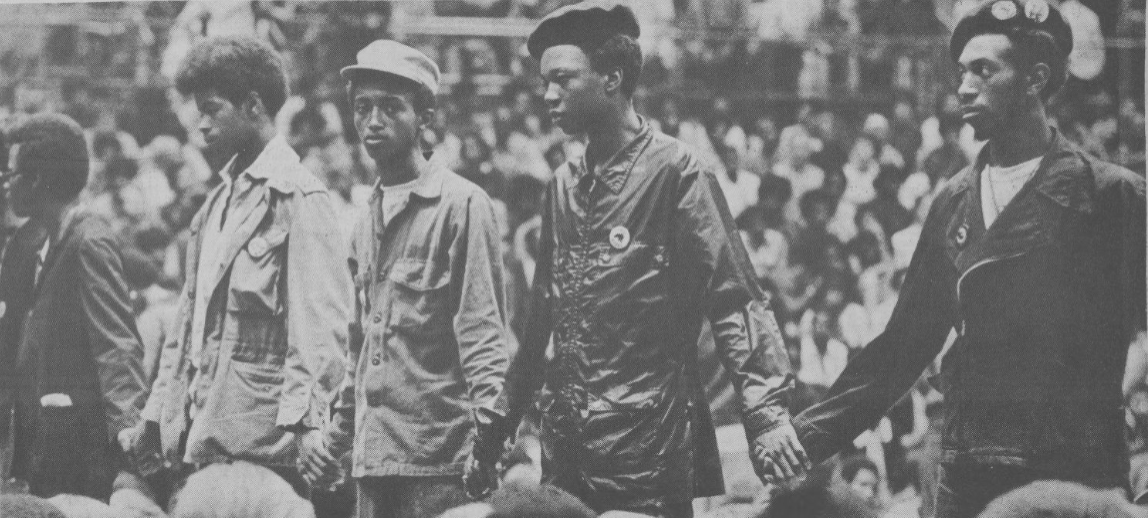
Young Panthers link hands in McGonigle Hall; Mitchell Toll, The Temple News
Looking back on the RPCC from an America that has lurched to the right again, seemingly having weathered another crisis of conscience over the very same issues that brought the convention together – the tendency of the US empire toward genocidal war and racist violence – the Panther Constitution’s righteousness also shines through a bleak half-century of defeats as a north star: had even one of its tenets been adopted between 1970 and the present, the world we are living in today would be immeasurably better for millions of people. Instead, ours is a world that remains mired in the same violence, inequality, environmental degradation, and stratified forms of social organization that the New Left defined itself in struggle against.
In the context of the present, Tabor’s warning on the urgency of action is chilling: “We have to understand that nobody’s gonna stop it but us,” Tabor said, “If we’re not going to take the initiative... and bring to a grinding halt the diesel train of fascism that is rolling across the land, look here come the end of the 20th Century...” In 2003, Lyons dismissed Tabor’s invocation of fascism as alarmist and hyperbolic; in 2026, it is not so easily scoffed at. Is it “too late, too late, too god damn late?” Was it ever possible to rid our societies of violence, inequality, waste and stratification? If it wasn’t, or isn’t, would that absolve us of the obligation to strive that the course of human events might be righted by right action? An ancient parable tells the story of a united humanity, punished when they strove to build a tower to heaven together in Babylon — punished according to the laws of the very universe that made them as they were. If that is our fate — if that is what we are — creatures who are born to struggle — then there is no alternative but to learn the hard way, again and again, together. So that one day, all power might be vested in the people.
The fourth in a series on Philadelphia history.
Philadelphia’s Famous Festivities
Philadelphia Lawyers and the Cradle of Liberty
Philadelphia: City of International Diplomacy
Further reading on the RPCC:
Organization and Movement: The Case of the Black Panther Party and the Revolutionary People's Constitutional Convention of 1970, in Liberation, Imagination and the Black Panther Party; George Katsiaficas
Revolution in the United States? May to September 1970, in The Global Imagination of 1968; George Katsiaficas
This Side of Glory: The Autobiography of David Hilliard and the Story of the Black Panther Party; David Hilliard and Lewis Cole
I am Maroon: The True Story of an American Political Prisoner; Russell Schoatz and Kanya D’Almeida
City of Sisterly and Brotherly Loves: Lesbian and Gay Philadelphia, 1945-1972; Marc Stein
The Black Panther; Vol. 5 no. 10-13
The Plain Dealer; September 3rd, 1970