
In the wake of David Lynch’s passing, I felt compelled to watch more and try to understand what made him so transformative to the people who watched his work with so much reverence. My only prior experience with him as a director had been a showing of Mulholland Drive at the Prince Charles Cinema in Soho, a wonderful experience but one slightly marred by the audience. They struck me as smug, happy to be in on extratextual jokes as much as they were to be seeing a modern classic on the big screen, not a chance often afforded. The snickering throughout felt emotionally jarring and took me outside of the film, the worst possible thing to happen with a film of Mulholland Drive’s nature, one where you must surrender entirely. As such, I sat myself in a pitch-black living room late at night and put on Blue Velvet, the film that really introduced his particular brand to the masses after the success of the more broadly palatable The Elephant Man. In between that night and the final rewrite of this little discursive piece, hopefully more of a review and should be bereft of ‘spoilers’ that might put people off from experiencing it themselves, I also watched Eraserhead to see if my personal analyses of Lynch held true deeper into his works and thankfully they do to an extent.
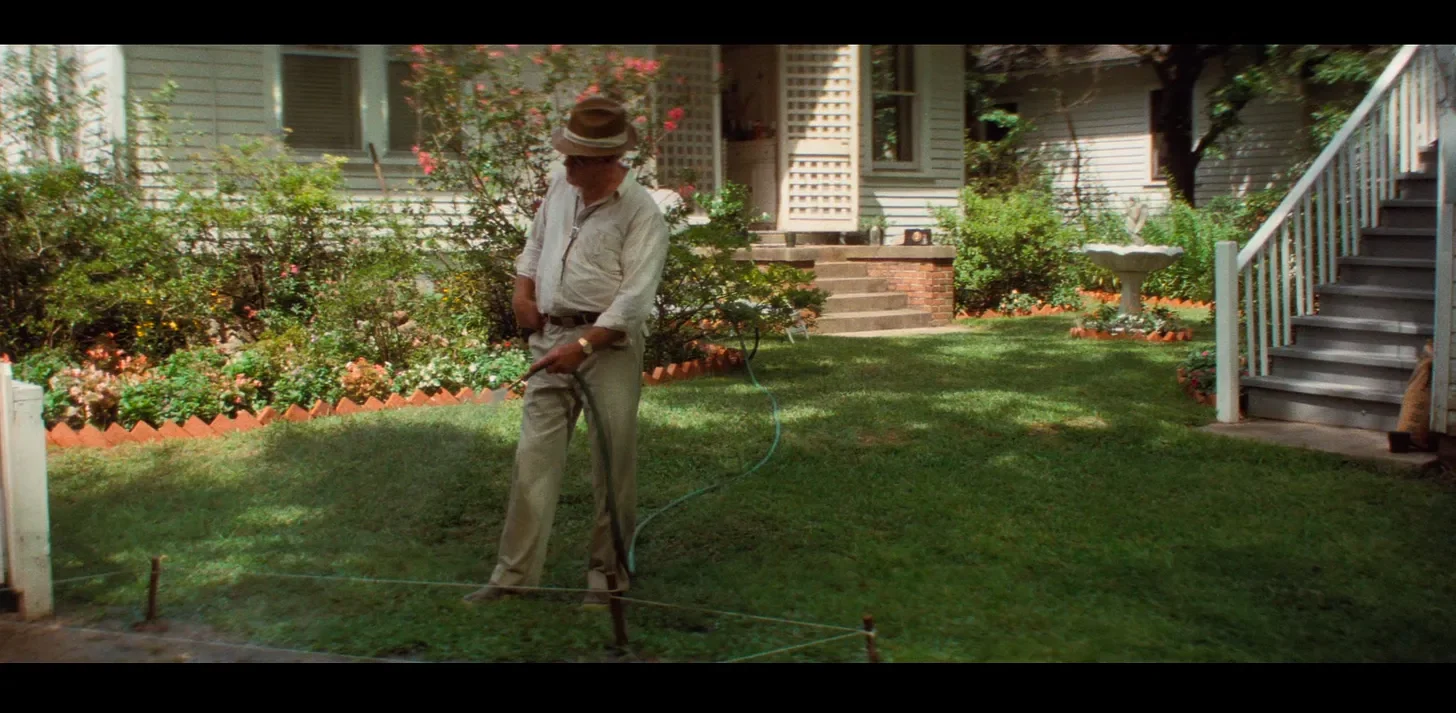
The film’s opening scene - bright colours and chromatic aberration, a sort of smearing, can be seen in the corners
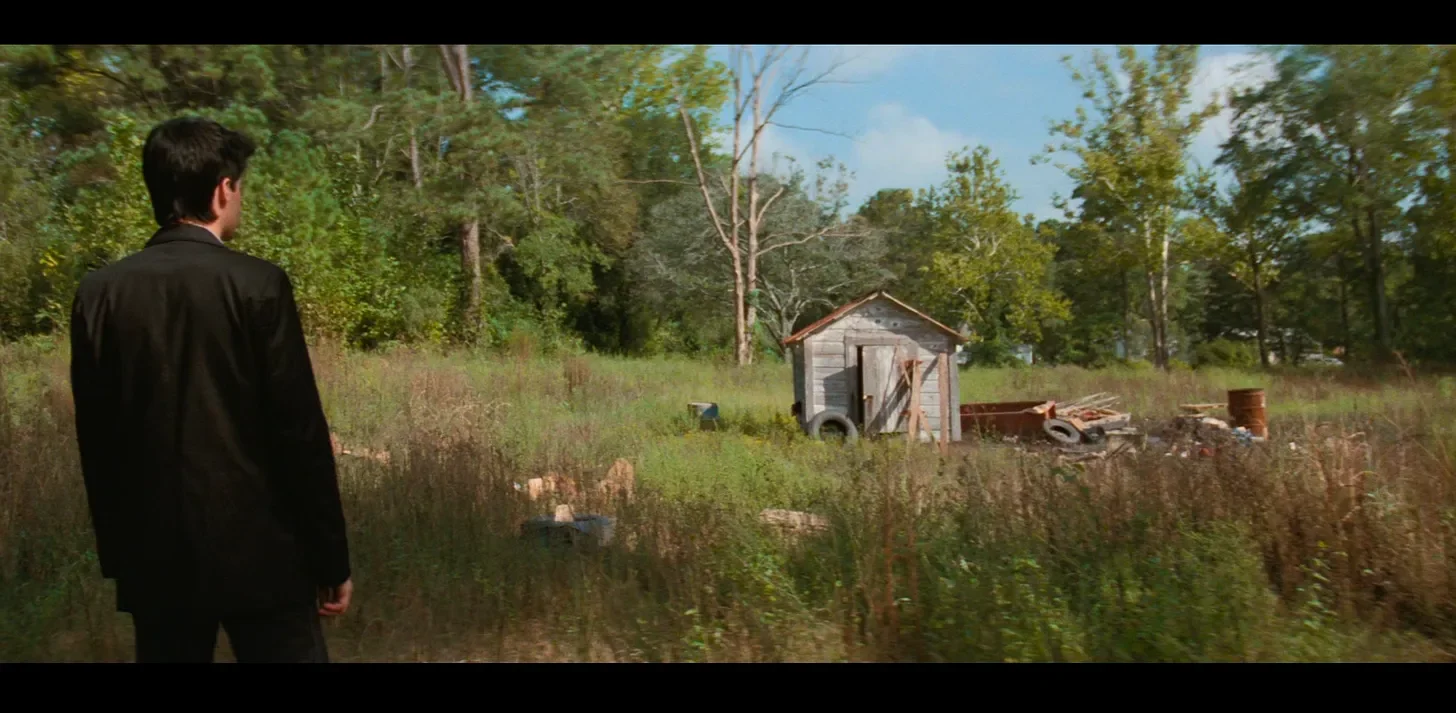
MacLachlan’s Jeffrey in a following scene from the beginning - The film retains its visual dreamlike aura until the ear, the inciting incident that crushes the status quo
The film opens with bright, Technicolor grading. The camera is wide-eyed, almost to a fault, with chromatic aberration sneaking into the edges of the frame. Sandy(!) might as well attend Grease’s Rydell High School. The girls wear poodle skirts and Jeffrey pulls out front in his cherry red Oldsmobile, all intentionally reminiscent of the remembered 50s glory and Americana Grease evokes. The film degrades, gets physically murkier, and later characters emerge briefly from darkness as thick as treacle. This is a world that exists in both unreal brightness and colour as well as browns, dark blues, and inky blacks, neither half coming together and reconciling the impossibility of their coexistence.
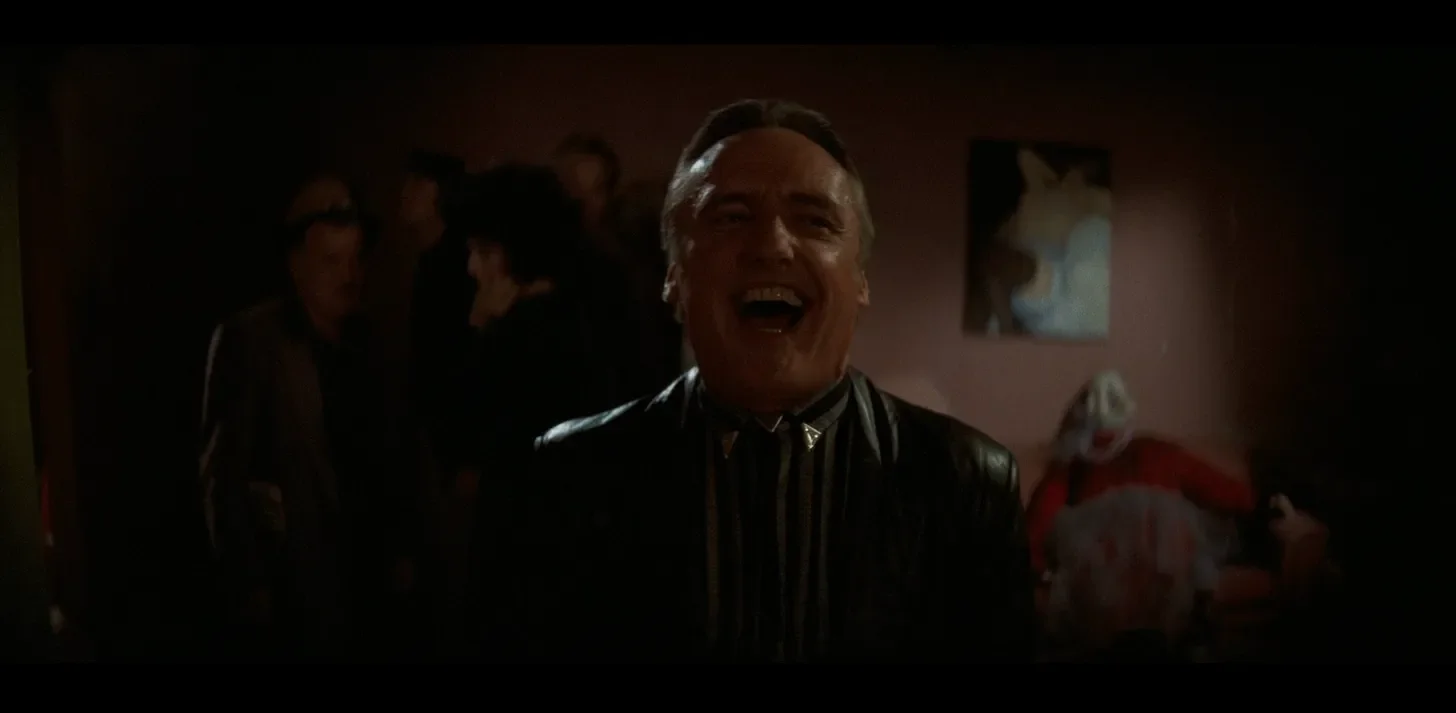
Hopper’s Frank Booth, a villain who comes from the darkness very literally here.
Lynch is an artist who wants to interrogate dualities and the incongruity these halves display. In Blue Velvet, this is seen most plainly in how red and blue are often shown in pairs. This ranges from the simple, a police car’s white and blue paint job accented by red lights or the fireman’s blue uniform contrasting the red of the engine on which he rides, but there are more obviously symbolic implementations. When Dorothy performs Blue Velvet in the club she’s lit by a blue spotlight, contrasting her bold red lip and the red curtains behind her on stage. The red here, and in most intentional uses of it in the film, represents a passion. Something romantic, in Dorothy’s alluring lips, destructive, in the fire that flashes across the screen during a fit of sexually charged angst, or a mixture of the two. I’d compare it to blood and to life force itself, something unrestrained and primal. It is Dorothy cutting Jeffrey’s face that allows some red - his blood - to make its way to the surface and give way to their romantic encounter. It’s Frank’s application of red lipstick all over his face that demonstrates his haphazard use of sexual intimidation. Red’s opposite in this chromatic dyad, blue, is multifaceted to me. On initial viewing, I saw it as symbolic of ‘blue’ in the way it’s used in referencing blue comedy. It relies on breaking sexual taboos. Hopper’s Frank Booth is not interested in Dorothy or the background of striking red passion that surrounds her, merely the blue velvet of the song and the dress that disguises her naked form. The blue velvet drives him to this sexual violence and control over Dorothy and in brief moments of clarity he rubs a swatch of the blue velvet that makes up her dress and weeps openly, watching her perform the titular song. Later thought made me consider whether it was more in line with placidity, simply an oppositional force to red. Both work and the different interpretations are to me not competing at all, merely different lenses through which to enjoy the film and consider it deeply. No art is really meant to be ‘decoded,’ per se, to view art as a puzzle to be solved rather than as an experience is wrong in many ways. It prevents open thought and being transported, one cannot truly connect with a jigsaw puzzle.
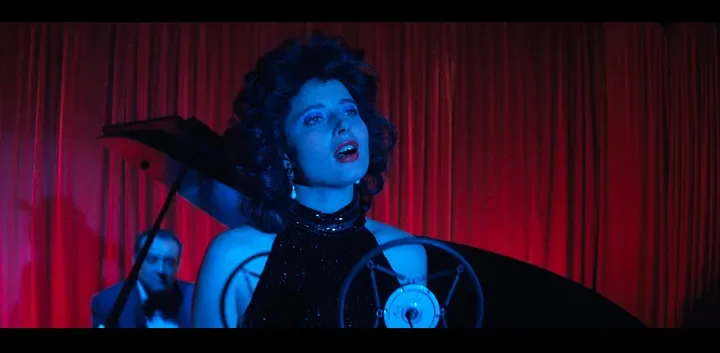
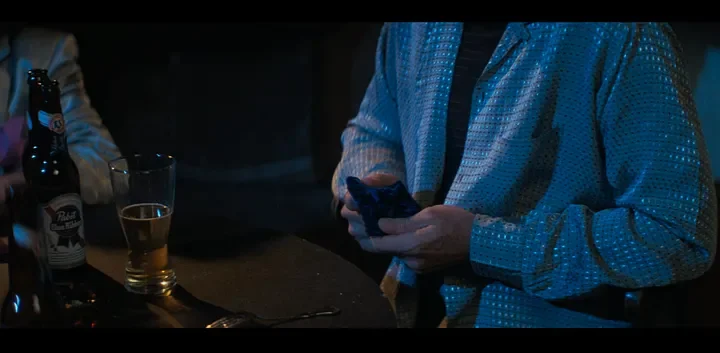
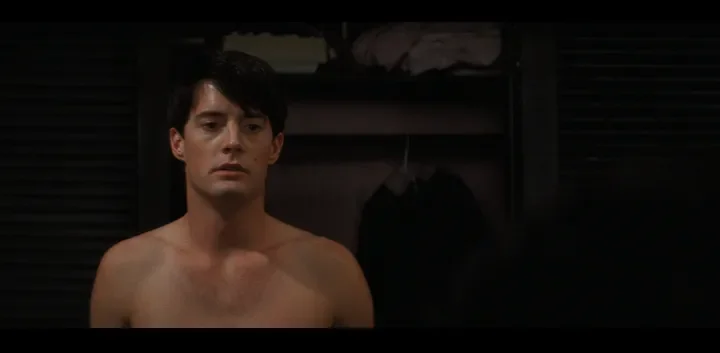
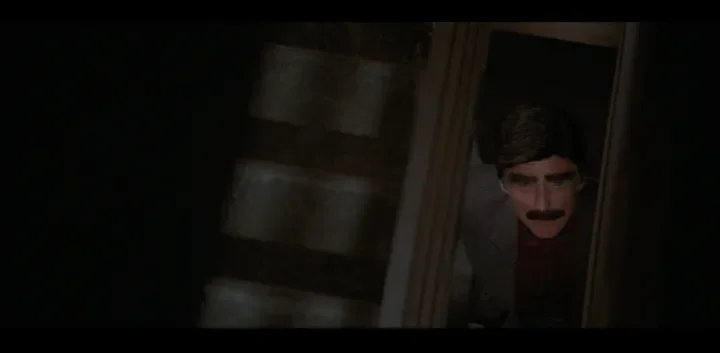
In order: Dorothy lit in blue against the red curtains, Booth rubbing his blue velvet swatch in tears, Jeffrey's spilled blood giving way to passion, Booth in his handsome man disguise (because it is funny and terrifying)
If I may be allowed to be extratextual in my analysis of Blue Velvet for a moment, utilising both Eraserhead and some light biographical information about the director, I do have one idea I think is worth sharing. For Jeffrey, red represents not only his pure romantic desires but also how his strong feelings regarding Dorothy could lead him to hit her, against his conscious wishes. As such you could read into red representing the Id and all the emotionality, positive and negative, that stems from it. Something to be engaged with but controlled as a just, moral character as Jeffrey strives to be. Ultimately the film is about love and the redemption it offers. Jeffrey’s confusing love for Dorothy–not a pure one necessarily–combined with his basic love for humanity is what drives him to endanger himself constantly in pursuit of the truth and eventually everyone’s salvation. It is the mutual and purer love he shares with Sandy that allows him the self-actualisation and power in the film’s conclusion that he lacks in a mirrored scene in the film’s opening act. Eraserhead I see as being a deeply Freudian film, one that features a literal representation of the Id as a freakish humanoid who takes control in brief spurts. Sexuality is depicted as something animalistic and horrifying. Your conscious self takes a backseat while the id takes over. You can try to repress it, lock it away in a box, but it’ll come out in one way or another as in the wet dream sequence. Sperm are a parasite, the resulting baby is a manifestation of that animal feeling and the loss of control over the sexual. In the 9 years between Eraserhead and Blue Velvet Lynch has evolved his opinions and matured and this manifested in his works regardless of whether that’s intentional. He removes his lust, inherently immoral and disgusting, from nightmarish Philadelphia, and gives it redemption in the idyllic American heartland, the small town of Lumberton, North Carolina, with its picket fences.
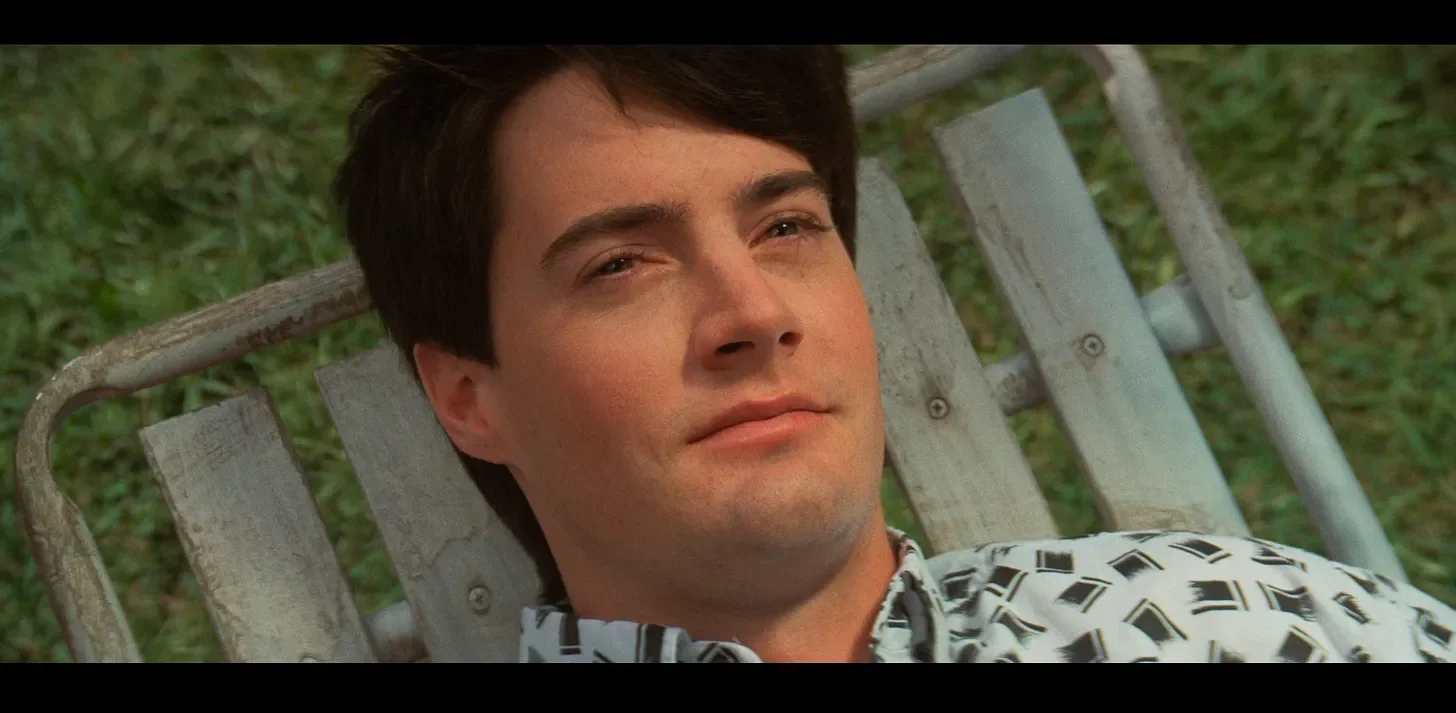
Jeffrey has returned to the colourful world of the opening - not naive this time but in an idyllic world that he has earned through strife, risk, and personal growth
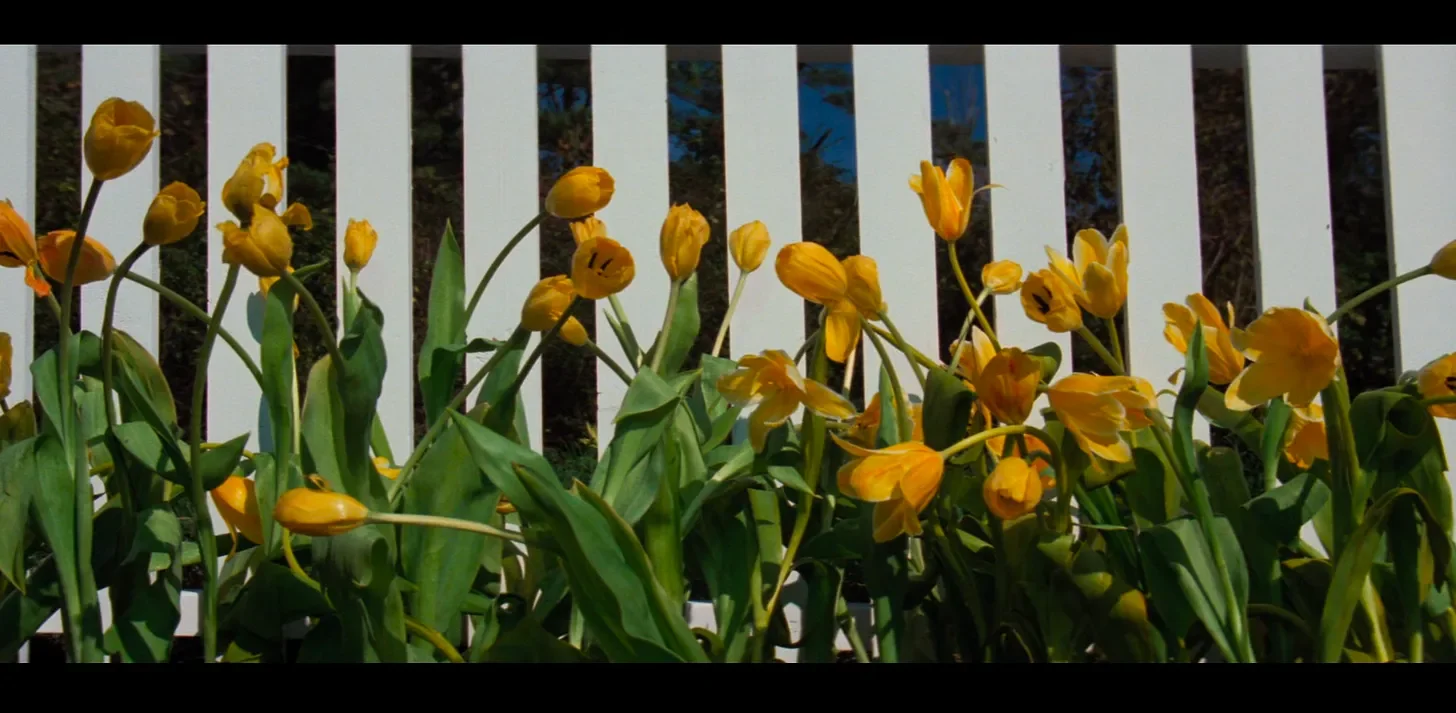
Notice: The shot of flowers at the film’s close that mirrors the one at the opening. The flowers have changed from the symbolism-laden red to a sunnier yellow.
Lynch has always been a proponent of love as a cure to humanity’s ills and to cruelty in general. Famously in Twin Peaks: The Return, he performs a soliloquy to the audience: in regards to other characters’ bigotry, the choice was to “fix their hearts or die.” I think this film offers a subtler genesis to that idea. One more hopeful and arguably naive, the writing of a man of 40 instead of 71. He says open yourself up to love and to humanity and the world can be healed of the infections lying below the surface, just within your ear. The bugs, the rapists, the police corruption, it can all be flushed away and the fable-like feeling from the opening - merely a facade then - can become realised.
-
Initially this piece was going to be a pure review, then an analysis, and it morphed finally into a type of pure appreciation piece for the artist and his film. I’ve omitted parts about the technical filmmaking because I think it no longer suits what I’ve ended up with, but I hope above all it inspires people to watch a little Lynch and not be put off by his films’ ‘weird’ public perception. They may be a little out of left field but let that be precisely the reason you watch instead of avoiding them. See how you respond to them after approaching them earnestly and with curiosity.
The Prince Charles cinema, where I saw Mulholland Drive and which recently put on a Lynch marathon in his memory is under threat of closure. There’s a petition to save it which I’ve linked here. Save it and then go to it, experience and enjoy some cinema in a special place.