
When, finally, a mystery came across my desk, I didn’t think it was a mystery at all. I had reached for a copy of Austen’s Pride and Prejudice. One of the Penguin Classics ones where they put a painting on the cover. And this one is gorgeous. A double portrait by Sir Thomas Lawrence called “Fullerton Sisters.” Two women sit together in matching white dresses, their posture informal and relaxed. If you, like me, try to find who the women in this painting are, you will face the same repeated sentiments I did: “little is known about the sitters [of the painting]” “identity unknown.” In the end I’d find out that the Fullerton sisters weren’t sisters, their surname wasn’t Fullerton (not quite), and it would take me far more hours of sorting through digitized microfiche, letters, and census data to figure out who they were than I originally thought.
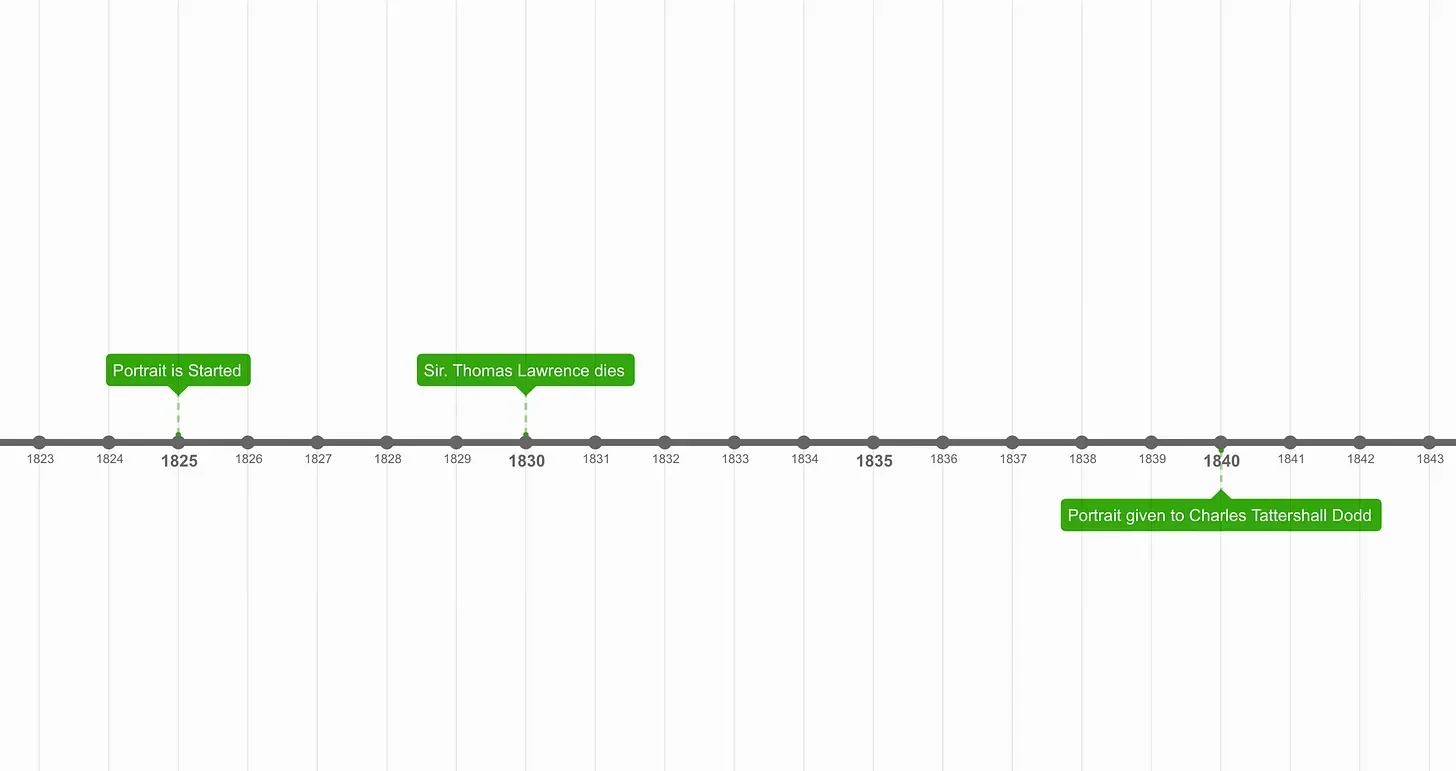
For the sake of easier understanding I’ll employ some visual techniques. Starting with a timeline. By reading the basic provenance notes from a Christie’s listing, we can add three points of interest: the painting was started in 1825, Sir Thomas Lawrence’s estate gave the unfinished portrait to the sitters/subjects after his death in 1830, and one of the women in the portrait gave it to an artist, Charles Tattershall Dodd, from Tunbridge Wells, sometime in the 1840s
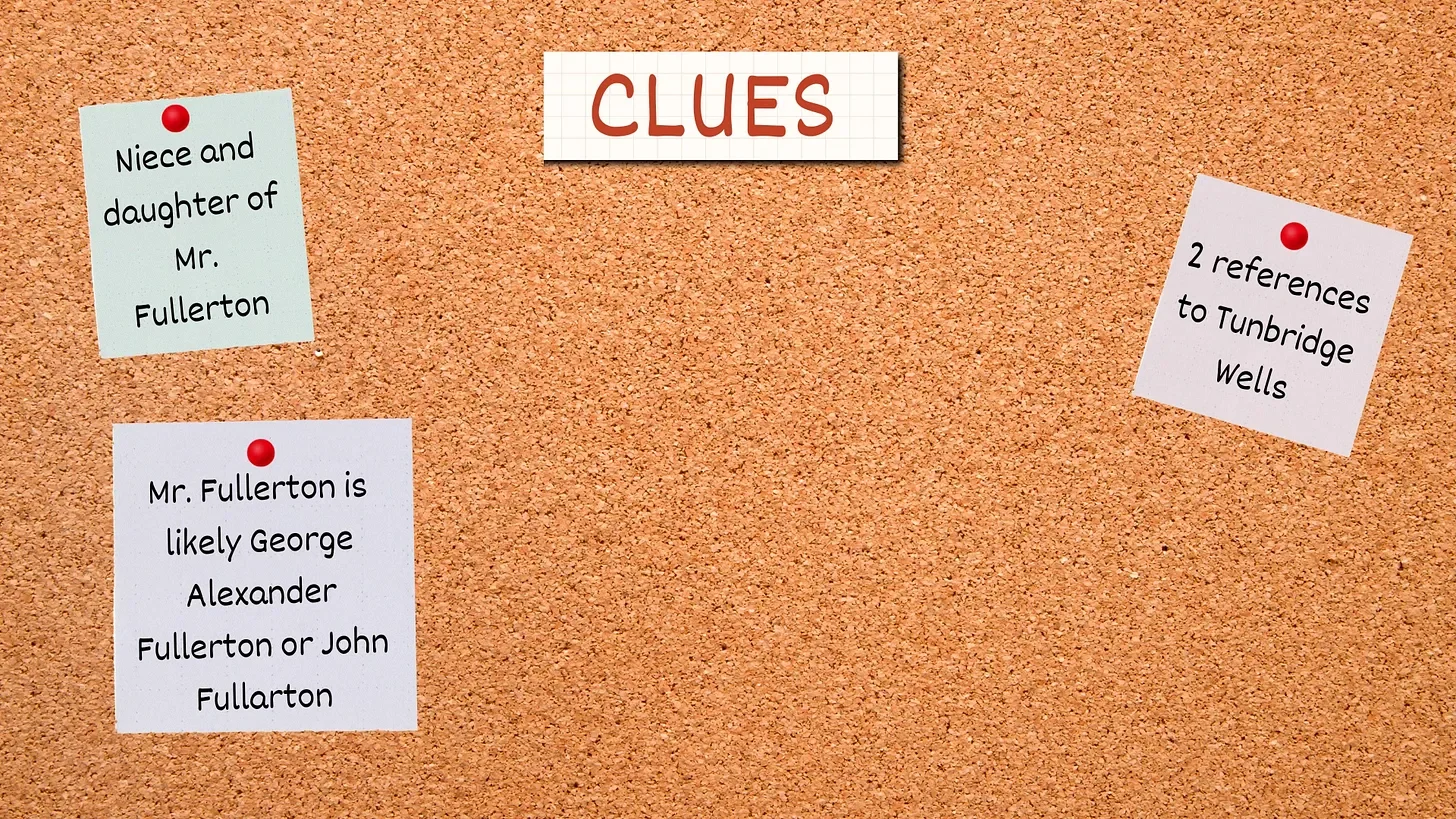
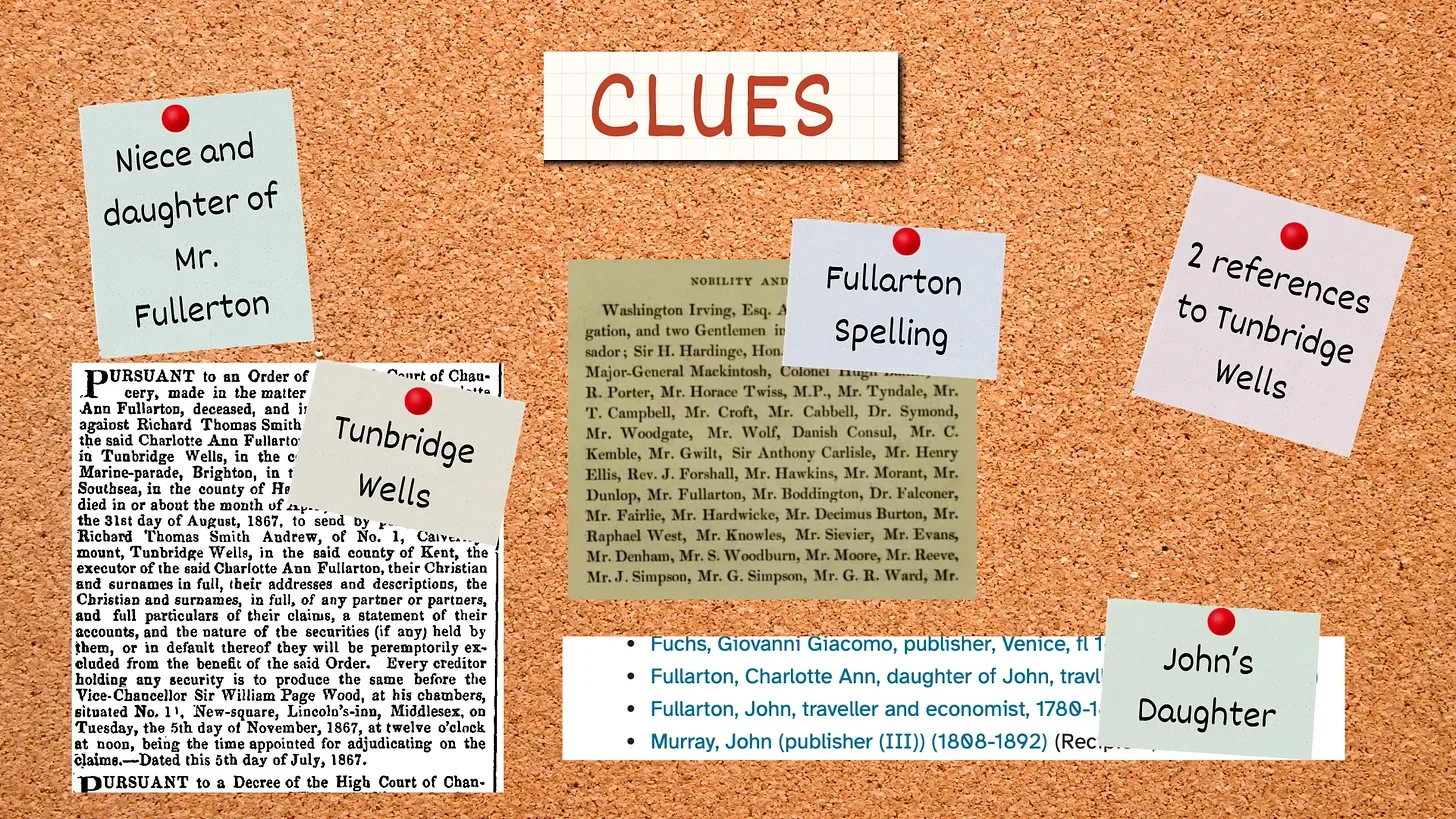
Like our favorite mystery protagonists, I’ll also be using this clue board so we can solve it together.

First, we have to think about the painting itself. Sir Thomas Lawrence, at the time president of the Royal Academy, was extremely well-paid. His portrait portfolio includes earls, lords, ladies, archdukes, the Pope, George III, and multiple portraits of George IV. And, for some reason, the “Fullerton Sisters.” I think it’s fair to make the leap that whoever commissioned this portrait was relatively wealthy. This isn’t the type of portrait you could commission if you weren’t.
When Sir Thomas Lawrence died, he left over 100 unfinished paintings in his studio. Many were completed by assistants and then shipped off to their intended owner, but “Fullerton Sisters” was left unfinished before being dispatched.
In charge of all this chaos was Archibald Keightley, a printer and solicitor who became the executor of Lawrence’s estate after his death. And, clue number one, he left behind a claim book where he documented the paintings and the transactions associated with them. There he wrote that the painting was of the niece and daughter of a Mr. Fullerton of Tunbridge Wells.
But, who is Mr. Fullerton? How was he so important that he was able to commission a regency-era portrait from one of the most in-demand artists of his time but I’ve never heard of him? And even with a quick Google search he doesn’t pop up. Or rather, many influential Mr. Fullertons pop up but none of them have any obvious connections to Tunbridge Wells, the place he was supposedly “of,” or to Sir Thomas Lawrence.

The Candidates
Let’s make some criteria for our search for the right Mr. Fullerton.
Age: to be a father of a presumably teen girl in 1825, Mr. Fullerton was likely born around 1780 (though we are keeping very wide margins on this one)
Location: if not the town of Tunbridge Wells, at least some connection to Kent (the county) more generally
Wealth: lots of it
I won’t bore you with the hours of sorting through the records of hundreds of men born around 1780 named Fullerton. Instead I’ll give you the final two I landed on.
George Alexander Fullerton (née Downing)
Sources: UCL Centre for the Study of Legacies of British Slavery, National Archive: Records of the Prerogative Court of Canterbury, National
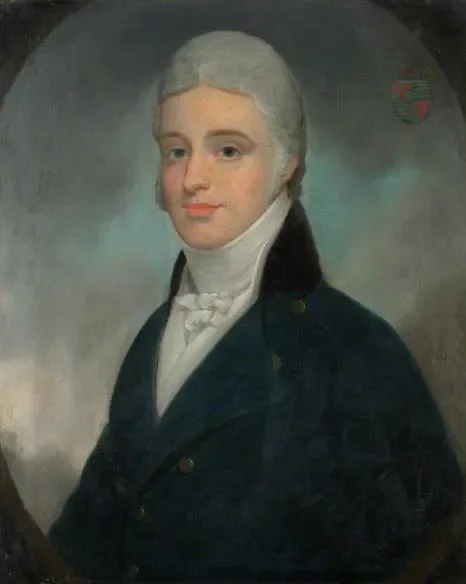
George Alexander Fullerton was born to Dawson Downing and Catherine Fullerton in 1775 in Ballintoy, Ireland. He later took his mother’s last name as a nod to his great uncle who he would be the primary benefactor of. His great uncle, Alexander Fullerton, owned 3 sugar plantations that he would pass on to George Alexander. He enslaved 413 people.
George Alexander Fullerton inherited his great uncle’s immense wealth including properties across England. He had a son, Alexander George, and a Daughter, Frances (b. 1814).
John Fullarton
Source: Dictionary of National Biography (1885)
John Fullarton, born in 1780 in Scotland, was a writer who originally made his fortune working as a surgeon for the East India Company, running a newspaper, and eventually getting into banking in Calcutta. There he met his wife (only referred to as Miss. Finney) in the early 19th century and moved back to England around 1823. During a trip to Egypt, his wife died in Memphis in 1837. Later he’d go on to become a mildly controversial writer on economics.
Analysis
There were a lot more men in the running previously. I cultivated a long list of potential candidates for Mr. Fullerton and culled it one by one. Some didn’t have daughters. Some were too old. Too young. Some simply didn’t have the resources required for the story to make sense.
George Alexander Fullerton looks pretty perfect for it. He’s wealthy. He is the right age range. He had properties in Kent which were close to Tunbridge Wells.
John Fullarton was included because I didn’t have any reason to axe him. Sure he’s wealthy, but his name isn’t spelled the same way as in the claim book from the beginning. His brief biography doesn’t tell us about any children, much less daughters and nieces. Or anything about the town of Tunbridge Wells.
But then it hit me. If George Alexander’s daughter was born in 1814, she’d be far too young to be in the portrait in 1825. So I was stuck with John Fullarton as the only one I wasn’t able to disqualify. But I didn’t have any positive evidence. He was just the guy who was left over. His ill-received economic writings ended up being the key.
Justifying John
There are a few issues with John as the Mr. Fullerton. The spelling of his last name is different from the Sir Thomas Lawrence’s executor’s claim book spelling of “Mr. Fullerton.” His biography is so sparse that if he did have children, it wasn’t obviously apparent. And, most damning, I had yet to find evidence to connect him to Tunbridge Wells (as mentioned in the claims book).
Let’s start with the first issue.
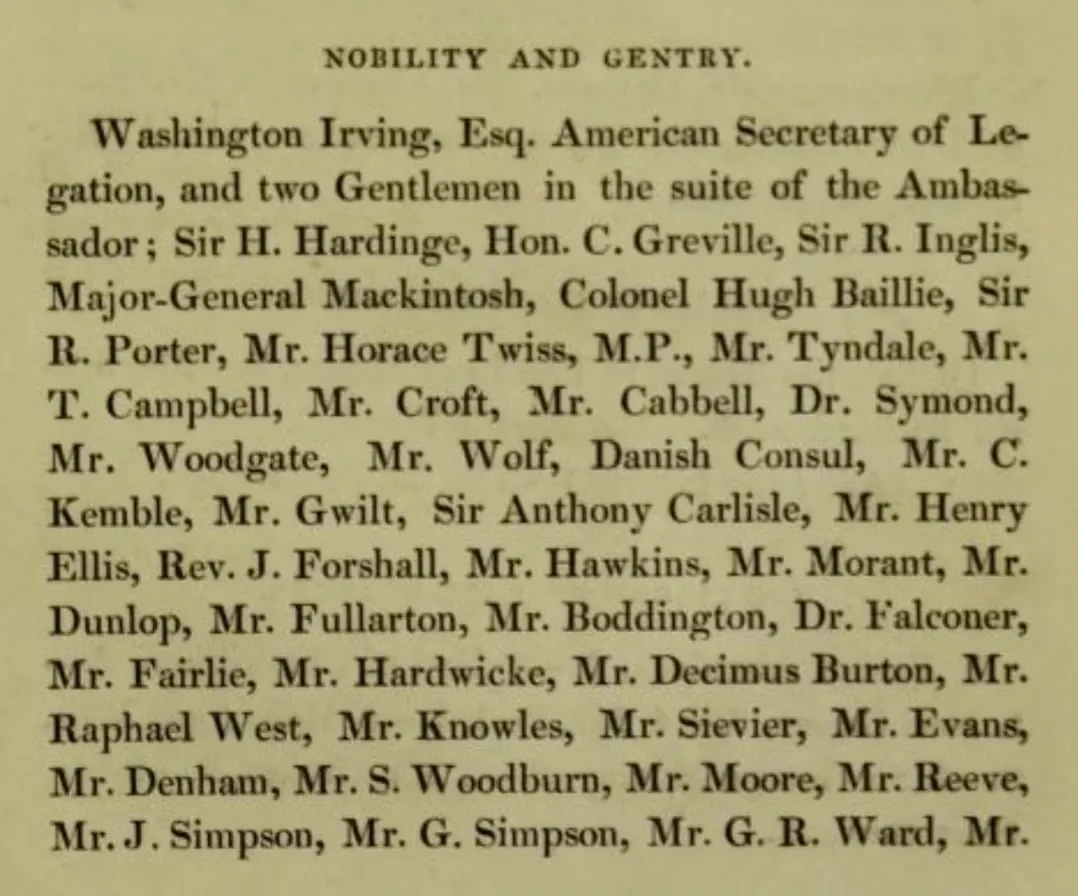
I went through several collections of correspondence, documents, and papers associated with Sir Thomas Lawrence that are held by the Victoria and Albert Museum, Cambridge University’s King’s College Archive Centre, and also documented in the book The life and Correspondence of Sir Thomas Lawrence by DE Williams. That last one brought me a list of guest-book-signers at Lawrence’s funeral. Under nobility and gentry is Mr. Fullarton. With an “a.”
The trickier second question: did he have a daughter?
I had no luck with birth and death data from local parishes. I read plenty of his writing and found no personal content. With nowhere else to go, I tracked down who his publisher would’ve been in the 1840s to see if there were any documents of his in the archive. There he was: J Murray.
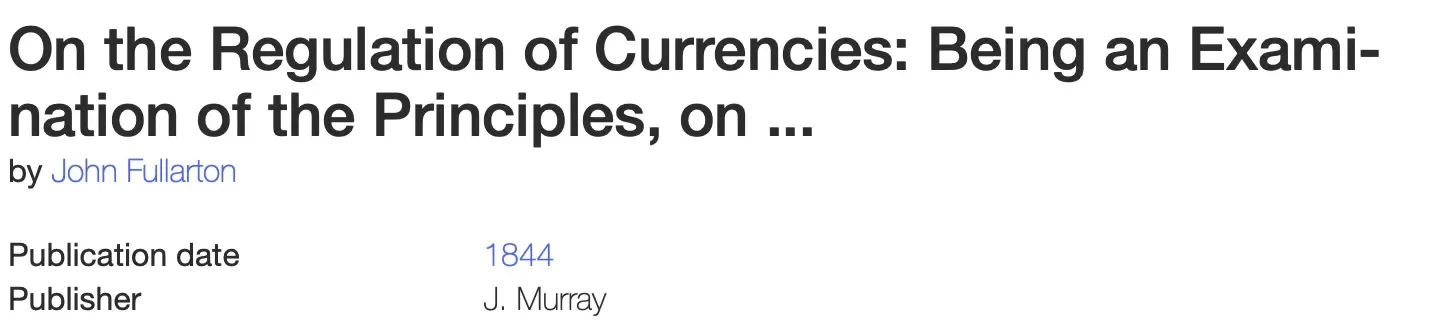
As luck would have it, a collection of J Murray’s letters exists on the National Library of Scotland’s archive catalogue. When I scrolled down through the archive list to find John’s name I found someone else’s too.
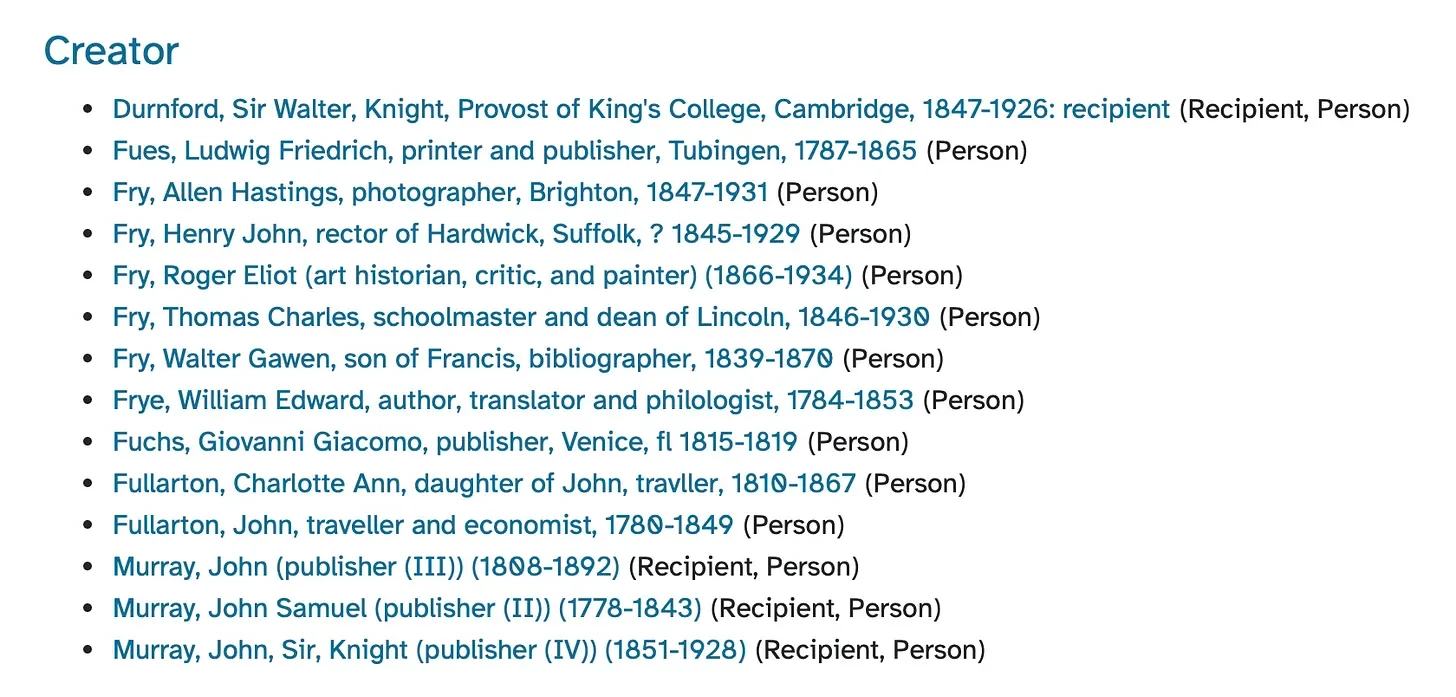
His daughter. Charlotte Ann.
Charlotte Ann was born in 1810, making her 15 years old at the time of the portrait. I went looking a little deeper for connections before I declared victory.
I found my proof in an 1867 edition of the London Gazette that followed Charlotte Ann’s death.
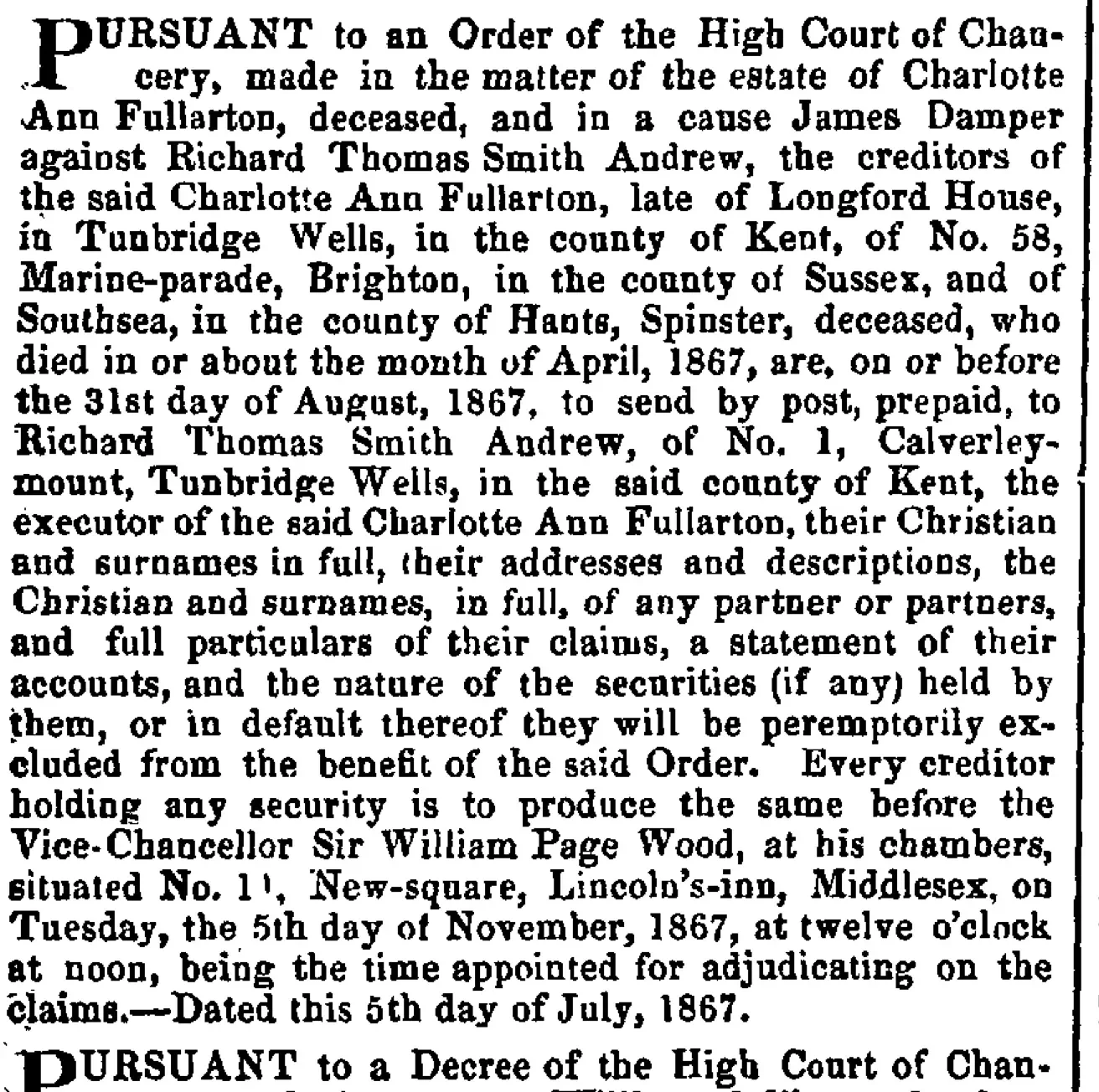
Here she is described as of Tunbridge Wells. To confirm this claim I searched for further documentation (thank you National Archives). There I found her more info about her will. She is of Tunbridge Wells. Her executor is too, implying her life was at least somewhat centered there.
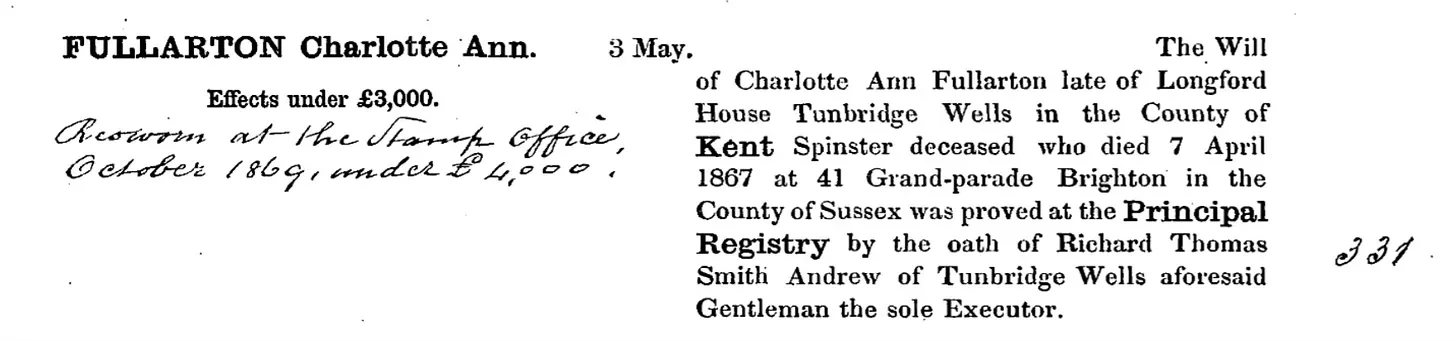
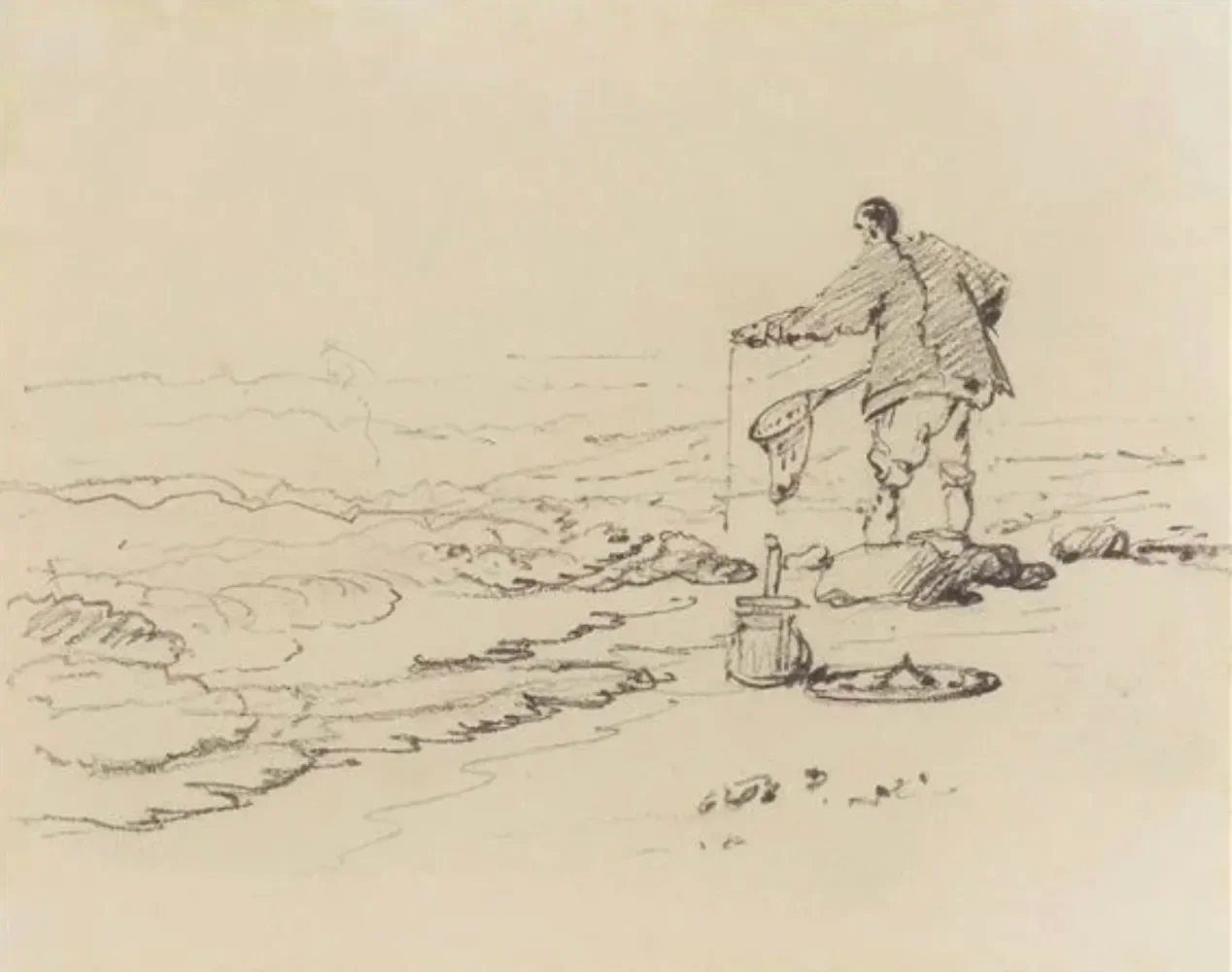
To flesh out her character more I looked for anything personal about Charlotte Ann I could find. She traveled and drew. I dug up some sketches she did on a trip to China with her parents.
On the back of this sketch is an inscription. Though blurry. I’ve transcribed it below.
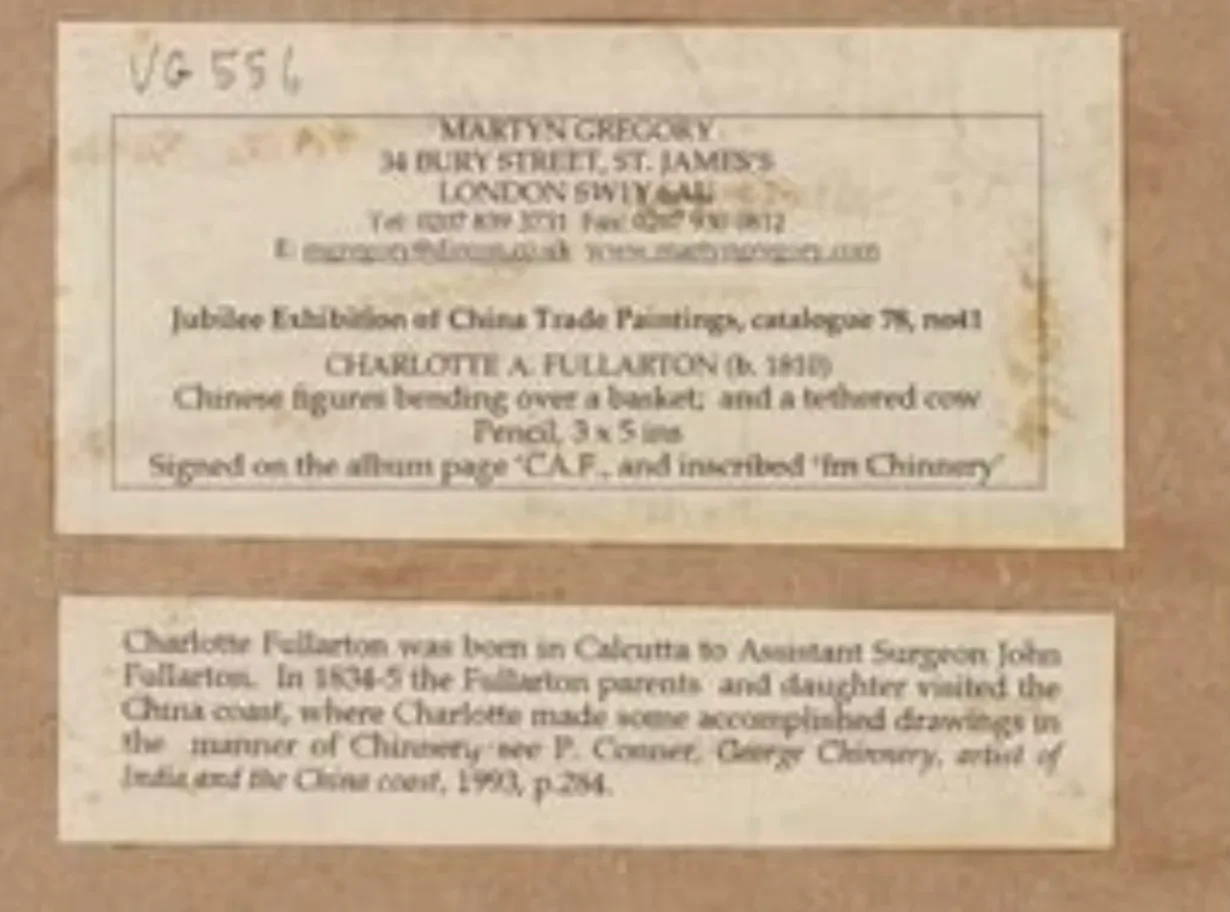
“Charlotte Fullarton was born in Calcutta to Assistant Surgeon John Fullarton. In [illegible] the Fullarton parents and daughter visited the China coast, where Charlotte made some accomplished drawings in the manner of [illegible].”
I didn’t find out who the other woman in the painting is. But, John Fullarton was an only child so Charlotte Ann’s cousin would be on the maternal side. Charlotte Ann’s mother’s maiden name is Finney. We lucked out with Charlotte Ann being unmarried. Her records were mostly together. They were easier to connect to her father. Her cousin might be harder to find because that’s potentially not the case. She could possibly not have even had the last name Finney in the first place if it was her mother related to Charlotte Ann’s mom. But, I think it’s a start.
I can’t be sure I’m right and this is a very condensed version of my research. I hope I’ve convinced you a little. Perhaps we can both enjoy the feeling of being one of only a few people who probably know who this painting is of. It’s enough for me to tentatively call it case closed on this 200-year-old mystery.